Triac Composites has published an update on two of its Vietnamese-built trimarans participating in the 2026 Atlantic Rally for Cruisers. At the tracking snapshot used by the manufacturer, recorded at midnight UTC on 28 November, the Rapido 40 Cruiser Illico held first place among the multihulls, while the Rapido 40 Racer Rapido occupied third. Their respective overall positions were fourth and sixth. The results are provisional, with approximately 1,500 nautical miles or more remaining for each yacht. The report is notable for owners considering fast offshore multihulls because the two boats share a design lineage but have been configured around different sailing priorities.
Two approaches to a common platform
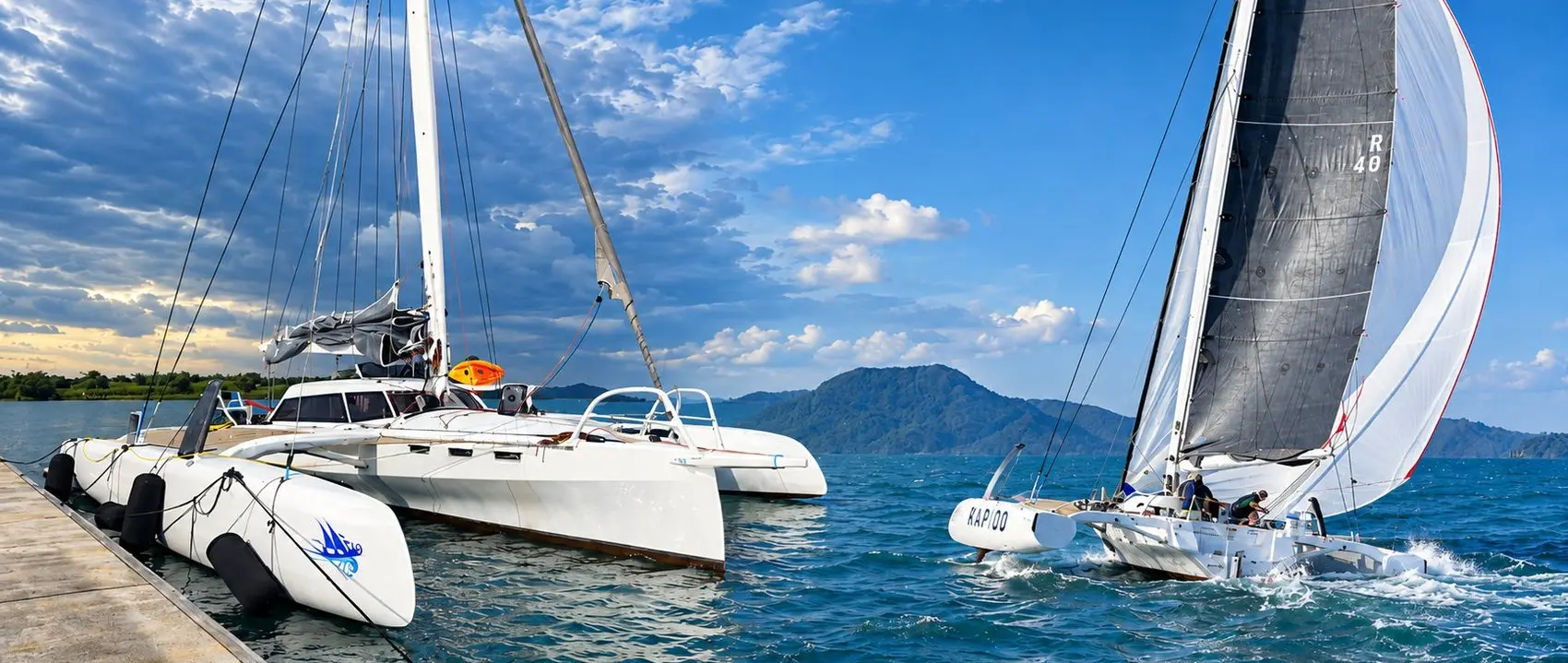
Both yachts were designed by Morrelli & Melvin and constructed by Triac Composites in Ho Chi Minh City. The Cruiser version is developed for offshore voyages that combine substantial sailing performance with accommodation suitable for living aboard. The Racer is a lighter derivative with a reduced coachroof and a simpler interior. These differences illustrate how a similar structural concept can support quite different programmes of use.
A buyer examining the two configurations should distinguish the common design principles from the specification of an individual boat. Weight distribution, accommodation, installed equipment and the actual inventory carried on a passage all have implications for a yacht's behaviour. The manufacturer has not published a controlled comparison of the boats under identical loading and conditions. Their progress in the rally provides an interesting real-world illustration, rather than an experiment from which the isolated effect of a single design change can be established.
The 28 November tracking snapshot
The builder's account attributes its fleet information to YB Tracking. Illico had covered 1,235 nautical miles and was reported to have 1,540 nautical miles remaining. Rapido had covered 1,215 nautical miles, with 1,595 remaining. The figures describe different boats operating across a moving fleet, rather than two objects travelling along a fixed line at constant speed.
In the twenty-four hours preceding the snapshot, the Cruiser had made good 186 nautical miles and the Racer 200. The manufacturer identifies the Racer's figure as the highest in the multihull division over that period. This is useful evidence of the ability of the racing configuration to advance substantially under the conditions encountered, but the difference cannot be attributed solely to its reduced interior weight. The actual route, wind, sail selection and condition of equipment may influence the reported distances.
The course to Saint Lucia
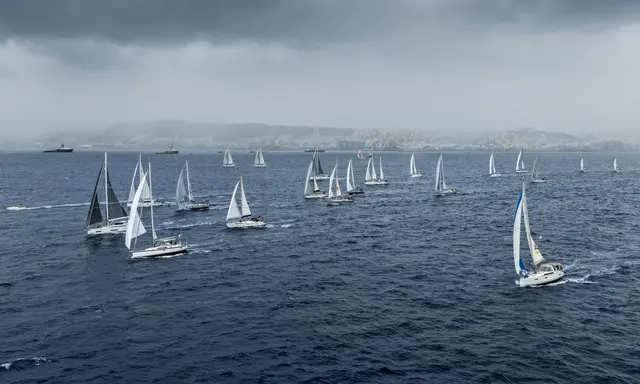
The ARC fleet departed Gran Canaria on 22 November, heading towards Saint Lucia on a passage commonly described as approximately 2,700 nautical miles. The distances involved explain why relatively small changes in daily progress can accumulate into substantial differences between boats. At the same time, an early position in the fleet is no assurance of the eventual finishing order.
Owners following the rally should consult the organiser's current fleet information if they wish to establish the positions of the yachts after the published snapshot. The present article records the particular report issued by Triac rather than presenting an independently updated race table. Both boats have already covered significant distances, but neither had finished the crossing at the point described by the manufacturer. Their future progress will depend on conditions and the operation of the vessels during the remainder of the voyage.
Rotating carbon masts and foil arrangements
Triac identifies rotating carbon-fibre masts without spreaders, asymmetric carbon C-shaped foils and rudders with T-shaped lifting surfaces as features shared by the two yachts. These components form part of a design intended to support performance while the three hulls are exposed to considerable dynamic loads. Their suitability depends on the engineering of the whole boat, rather than on the use of carbon fibre alone.
The description of the lifting appendages should not be confused with a claim that the vessels are designed to fly completely clear of the water under every sailing condition. Their actual contribution depends on geometry, speed, loading and operation. A buyer interested in this type of multihull should seek the designer's explanation of the operating characteristics and maintenance requirements. The ongoing Atlantic crossing demonstrates an application of the hardware but does not provide a complete record of the loads encountered.
The engineering of the crossbeams
A trimaran's crossbeams create a structural connection between the central hull and the floats. The manufacturer's article draws particular attention to the beam used on Rapido 40 Racer Hull 01. The beams are required to transmit loads arising from the interaction between the hulls and the sea, making their structural design a fundamental aspect of the vessel.
Manufacturing these structures requires more than reproducing an external shape. The internal reinforcement, orientation of the constituent materials and quality of the connections need to correspond with the designer's requirements. Inspection and documentation are particularly relevant when a yacht is being acquired second-hand or prepared for another demanding offshore programme. A history of successful sailing is useful context, but it does not replace the appropriate assessment of the yacht's present condition.
Composite manufacturing in Vietnam
Triac identifies several processes available at its manufacturing facility, including vacuum infusion, carbon prepreg processing, CNC machining and an autoclave measuring 8.5 metres in length. A seven-axis industrial robot operating along a 23-metre track is also described as part of its manufacturing capability. These facilities allow the company to address tooling and the construction of complex marine components within its own operation.
It would be incorrect to assume that every component on either Rapido 40 has been produced using every one of these processes. The appropriate manufacturing method depends on the component and the engineering specification. The significance of the factory's capabilities lies in the potential to coordinate the production of tooling, individual structures and the complete assembly of a vessel. The manufacturer presents the two trimarans as finished products whose progress can now be followed in a demanding operational environment.
The ocean-going certification
The manufacturer reports that both boats have CE Design Category A certification under the European recreational craft framework. This designation describes the design conditions applicable under that framework. It should not be interpreted as a guarantee that a boat can operate safely in all conditions or that the competence and decisions of its crew no longer matter.
The point is especially pertinent to the lighter racing version, whose reduced accommodation and different emphasis do not necessarily imply a restriction to short inshore races. Its reported certification provides useful context for the intended offshore operation. Owners should nevertheless examine the actual certification documentation, operating limitations and relevant equipment requirements for an individual yacht. A classification of design capability is not a replacement for a realistic assessment of the intended voyage.
Problems encountered at sea
The manufacturer also reports that both boats have faced sail-related difficulties during the crossing. Illico has lost the use of one asymmetric spinnaker and experienced damage to another, while Rapido encountered a problem with a spinnaker furling cable earlier in the passage. These incidents demonstrate why a fleet position must be understood in the context of the equipment actually available to a crew.
A fast offshore yacht needs to be capable of continuing its voyage when a particular sail or item of equipment cannot be used. Owners preparing a multihull for an ocean passage should develop their inventory and maintenance arrangements with appropriate professional advice. The relevant priorities include the condition and compatibility of the actual equipment and the ability of the crew to identify and respond to problems. The builder's account does not establish the detailed cause of each incident, and none should be inferred from the limited description.
Assessing performance and the cruising trade-off
The two Rapido 40 configurations demonstrate that a cruising boat and a race-oriented derivative can participate in the same offshore event. A lighter boat may offer different performance characteristics, while a fuller interior can serve requirements that are particularly important during extended ownership. The most suitable specification depends on the priorities of the individual owner and the intended pattern of use.
The reported provisional lead of Illico within the multihull division is particularly interesting in this context. It underlines that the distinction between a Cruiser and a Racer does not establish a fixed order in an actual ocean event. Preparation, conditions and crew decisions all matter. The published figures provide a useful reason to investigate the boats' individual histories and design choices, not a basis for an unconditional recommendation of one configuration over the other.
The remainder of the Atlantic crossing
The 28 November figures establish a noteworthy point in the progress of the two Vietnamese-built yachts. The official image supplied by Triac consists of earlier photographs of the boats, rather than live imagery from their present Atlantic positions. Its image of the Racer is attributed to the Royal Langkawi Yacht Club.
Luxury Yacht Guide has not independently surveyed the boats, measured their performance or obtained a newer live tracking snapshot. The reported positions and manufacturing details come from Triac's 29 November account, and the eventual results must be obtained from the rally organiser. The crossing remains a useful demonstration of two different configurations of a performance multihull participating in the same long-distance sailing programme.
Related Luxury Yacht Guide reporting
- ARC Fleet Sets Course for Saint Lucia as 700 Sailors Depart Gran Canaria
- CATANA Ocean Class Catamarans Place Sixth and Seventh Into Mindelo on ARC+ 2026
- Vaan R8 Gains Belvedere Terrace Option in 23.8m Electric Catamaran
- Volvo 70s and IMOCA 60 Set for RORC Atlantic Contest
Primary reporting and image credit
Primary source(s): https://www.triaccomposites.com/post/vietnam-composite-manufacturing-arc-2026. Triac Composites / Royal Langkawi Yacht Club (Racer image); official composite of file photographs of Illico and Rapido, not live Atlantic imagery. Image is used only for correctly attributed factual editorial coverage and never represented as open-licence stock photography. Original source image.