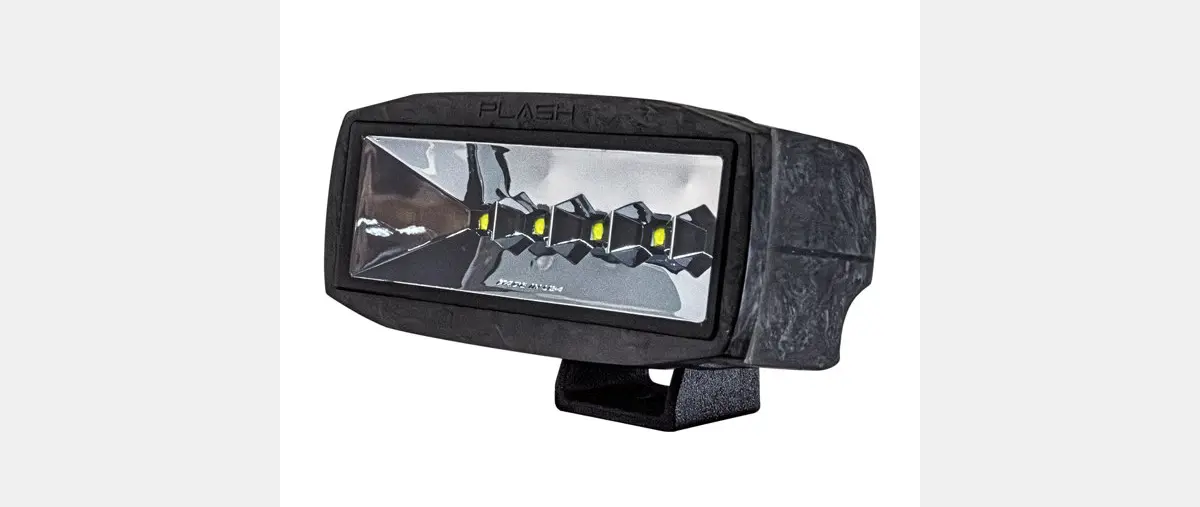
Different housing materials for exposed deck lighting
Plash Marine Lighting is extending its forged carbon-fibre LED lighting range with Altius CF-1 and Satius CF-2 spreaders and has shown an early version of the Tahoe 20-inch low-profile bar. The company detailed the products ahead of IBEX 2026 in Tampa. Two spreaders are already available; the Tahoe remains planned for January 2027 and its final performance specifications have not yet been published.
The development concerns lighting equipment fitted to hardtops, cabin sides and similar exposed areas. Owners of 12–23.99-metre yachts have to balance useful working light with deck appearance, corrosion resistance, electrical demand and avoiding excessive glare. Materials and mounting arrangements can be as relevant as lumen output.
Altius and Satius use contrasting mounting approaches
Altius CF-1 is designed to sit flush against its mounting surface, reducing the protrusion of a traditional housing. Satius CF-2 is surface-mounted and uses a separate carbon-fibre bracket. Both are described as using a forged-carbon housing with quoted thermal conductivity of 810 watts per metre-kelvin, intended to move heat away from their LED components.
Plash quotes output above 1,800 lumens, 12–24-volt DC compatibility and IP67 protection for both products. Satius also has reverse-polarity protection and a hydrophobic coating, according to the release. Those ratings inform equipment selection but do not establish that either fixture is safe for every immersion or deck-wash condition.
Why heat and salt water matter
LED performance and longevity are affected by the temperature around the diodes, while conventional metal housings can be exposed to corrosion in salt conditions. Plash positions its composite material as an alternative to coated aluminium and gives a target diode life exceeding 50,000 hours. That remains a manufacturer estimate, not an independently verified duration in all installations.
Choice of beam and mounting location also matters. A powerful white flood aimed across a cockpit may be useful for work but uncomfortable during an evening underway; red or blue settings serve different purposes and cannot replace compliant navigation lights. Installation should avoid interference with instruments or other vessels.
A low-profile project still to reach market
The planned Tahoe bar extends the same materials approach into a twenty-inch lighting strip for arches, hardtops and T-tops. Plash says final lumen, power and beam figures will be issued closer to launch. Owners should not specify it for an imminent refit on the assumption that a rendering establishes purchase availability or final dimensions.
For builders and refit managers, the key comparison is complete system suitability: illumination, heat, corrosion behaviour, mounting strength and service access. The IBEX launch introduces new choices and an upcoming product, with a competent marine-electrician-led installation still essential. Prospective installers should establish whether existing wiring and controls will accommodate the selected colour configuration. It is also sensible to consider how a failed fixture could be replaced without damaging the surrounding hardtop finish.