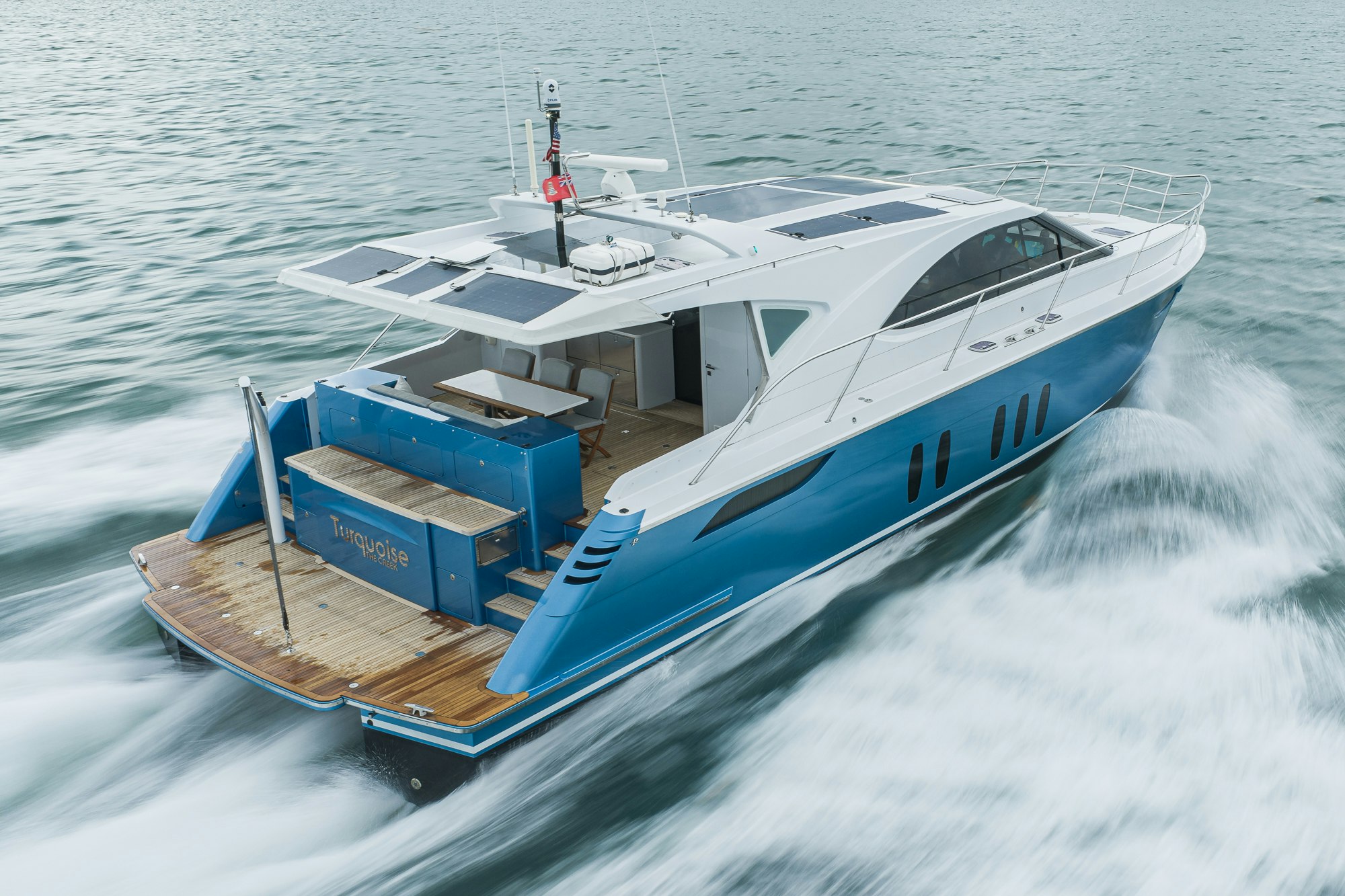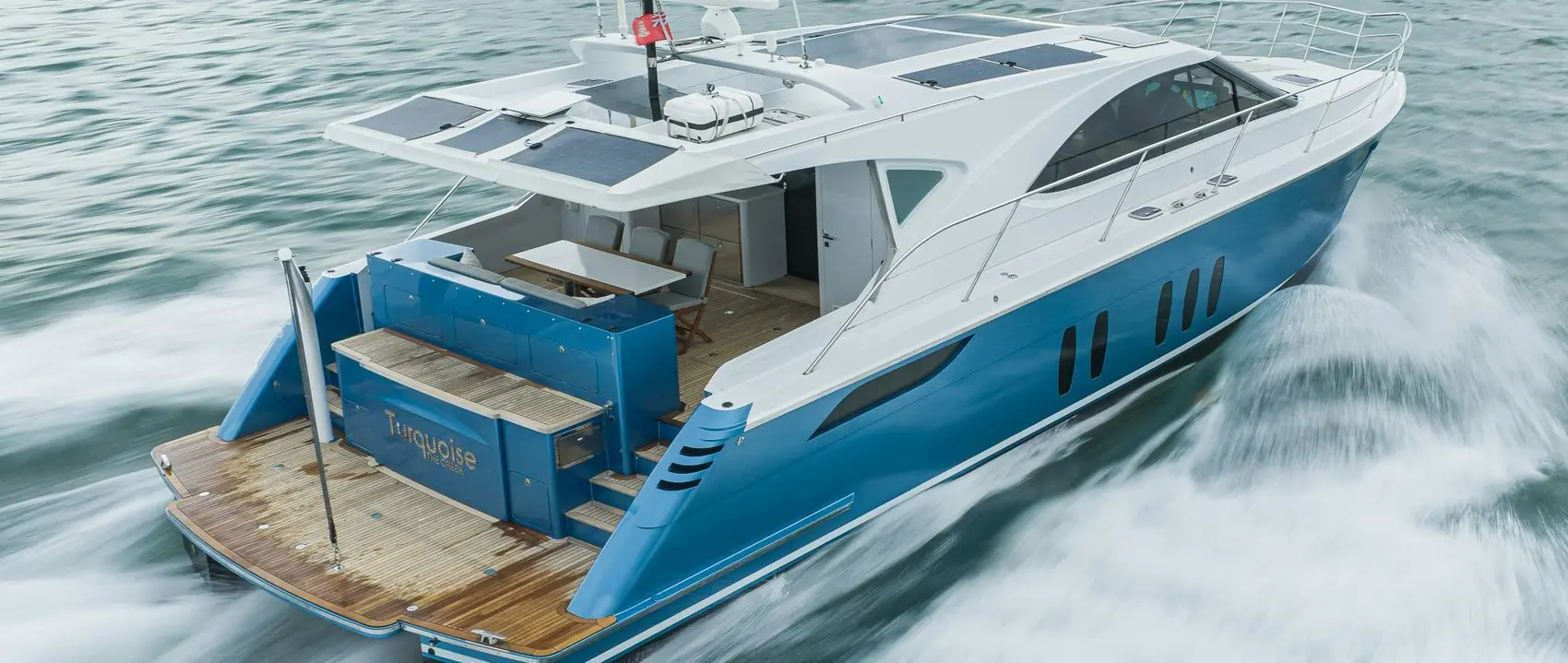
Northrop & Johnson announced the sale of TURQUOISE on 24 November 2026, bringing a new commercial development to the brokerage history of the 2017 Pachoud 60. The company identifies Sean Doyle as the representative of the seller and states that the motor catamaran was last offered at US$1.6 million. The consideration paid by the purchaser has not been disclosed in the announcement.
Luxury Yacht Guide previously reported the introduction of TURQUOISE to the sales market. The significant change in November is the broker's announcement of a completed sale, rather than another description of the yacht's availability. The vessel's dedicated listing continues to display asking-price information, but the newer, dated sale notice establishes the status reported here. A retained listing should not be mistaken for confirmation that a yacht remains available.
A distinct position within the motor yacht market
The Pachoud 60 is interesting because it approaches the approximately 18-metre motor yacht differently from a conventional monohull sports cruiser. Two relatively slender hulls support the broad main living platform, while the design incorporates a hydrodynamic foil intended to contribute to the boat's performance. The naval architecture is attributed to Roger Hill.
For owners considering this category of vessel, the distinction lies in the distribution of space and machinery as much as in the number of hulls. A catamaran's bridge-deck arrangement can provide considerable width at the principal accommodation level, while the spaces within the individual hulls serve a different purpose. The design therefore offers a combination of communal areas and separated sleeping accommodation that merits comparison with other yachts at a similar overall length.
The significance of the published performance
The broker reports a maximum speed of 40 knots. TURQUOISE has two MTU diesel engines, each rated at 1,250 horsepower, providing substantial installed power for a yacht in this size sector. The combination of that machinery, the hull configuration and the foil arrangement is central to understanding the design's performance-oriented character.
The quoted maximum should be understood as a vessel specification, rather than a measurement independently obtained for this sale report. A yacht's speed through the water is affected by displacement, machinery condition, sea state and the cleanliness of its underwater surfaces. A prospective purchaser of a comparable boat should investigate performance across its operating range. A single maximum-speed figure does not reveal how comfortably or economically a particular cruising speed can be maintained over an extended passage.
Why the foil is only one component of the design
A foil-assisted catamaran is not necessarily the same as a boat designed to lift its hulls completely clear of the water. In the case of TURQUOISE, the available brokerage material identifies the foil as a contributor to performance but does not establish a detailed independently measured lift curve. It would be inappropriate to infer the degree of hull unloading at a particular speed from the description alone.
The design should instead be evaluated as a complete hydrodynamic system. Hull geometry, the vessel's loading and the installation of underwater appendages can interact in ways that are important to ride quality and resistance. Buyers considering a similar configuration should seek relevant design and operating information, including the inspection and maintenance requirements of the foil. An appendage that contributes to performance may also create specific requirements when lifting, transporting or maintaining the boat ashore.
Composite construction and ownership considerations
The brokerage material describes an epoxy-composite hull and superstructure. This is a significant aspect of a motor yacht conceived around a balance of speed and usable accommodation. Composite construction can allow the structure to be designed around particular weight and stiffness objectives, but the resulting boat must still be assessed according to its actual construction and condition.
An independent survey of a used composite yacht should pay attention to structural load paths and areas around machinery, appendages and deck fittings. Any earlier repair work should be documented and evaluated by a suitably experienced specialist. The condition of a painted exterior surface cannot, on its own, establish the condition of the underlying laminate. The vessel's construction drawings and the history of repairs and maintenance are valuable evidence when a buyer is trying to understand its long-term service requirements.
Speed and passage-making are different considerations
The former sales specification includes a quoted range of 1,500 nautical miles at ten knots, supported by a fuel capacity of 9,000 litres. This is notable because it illustrates an operating mode quite different from the high-speed capability highlighted in the sale notice. A vessel able to travel quickly under suitable conditions may also be operated at a more moderate speed when the priorities are endurance and fuel management.
Published ranges are not safe passage-planning limits. Fuel reserves, weather, diversions and the availability of reliable consumption measurements need to be considered independently. Owners examining comparable power catamarans should ask whether consumption figures have been established at representative loading and sea conditions. They should also distinguish the theoretical capacity of installed tanks from the quantity that can reliably be used. These considerations matter particularly where an itinerary involves substantial distances between refuelling facilities.
The role of width in the accommodation plan
At approximately 6.3 metres across, TURQUOISE offers a comparatively broad platform for its main-deck living spaces. The broker describes a continuous arrangement linking the driving position, saloon and aft galley with the cockpit. Instead of locating the cooking area well away from guests, the configuration allows it to serve the interior and the outdoor social area.
A wide main deck is not simply a matter of creating room for more furniture. The ability to move through the boat, to access the helm and to prepare food while other people use the accommodation can make a considerable difference to daily life aboard. Buyers should assess the layout with their intended crew and guest numbers in mind. The relationship between the operating station and social spaces is especially important if the owner expects to handle the yacht personally.
Guest cabins divided between two hulls
The advertised accommodation comprises four cabins for eight guests, with a principal cabin forward and the remaining sleeping spaces distributed across the yacht's hulls. The distribution includes different bed arrangements and bathroom access. For a family or a group of friends, the resulting layout may offer a practical balance of communal space and privacy.
The advantage of this arrangement depends on the way in which the boat is used. A cabin situated within a hull has different spatial characteristics from a room constructed across the full beam of a monohull yacht. Buyers should inspect access, headroom, storage and ventilation rather than infer the quality of accommodation from the number of cabins. Sound from propulsion equipment and technical systems is another consideration that may not be apparent when visiting the vessel in a marina with its engines stopped.
Tender handling and access to the water
The yacht's former inventory includes a hydraulic bathing platform, tender storage and a smaller craft that can be carried aboard. This aspect of the design is relevant to an owner who wants to use anchorages rather than depend exclusively on marina berths. A tender can provide access to shore and opportunities for shorter excursions independently of the main vessel.
The ability to carry and handle a tender should be considered alongside the boat's load limits and the design of its lifting equipment. A practical assessment includes access to the water, the space available to those handling the smaller boat and the condition of the associated machinery. The appropriate operating procedures should come from the vessel's documentation and competent instruction. Even a comparatively spacious yacht can present constraints when several people and heavy equipment are being moved around the stern.
What the announcement does and does not establish
The sale notice reports that the vessel changed hands and records its last advertised asking price. It does not establish whether the transaction closed at that price. It also does not identify the purchaser's plans or provide an independently confirmed valuation of the vessel.
This distinction is important for anyone following brokerage activity. A closing announcement can establish that a particular yacht found a buyer without supplying sufficient information to calculate its realised market value. It is one useful piece of evidence within a broader picture that may include asking-price histories, time on the market and the condition of comparable boats. The last advertised figure should therefore remain clearly identified as such.
Implications for prospective power-catamaran owners
TURQUOISE provides an example of a relatively specialised motor yacht entering and subsequently leaving the public brokerage market. Its combination of a broad living platform, high installed power and a design directed towards both performance and passage-making differentiates it from more conventional sports yachts. The November sale announcement supplies a new commercial milestone for that particular vessel.
Readers comparing similar yachts should examine the extent to which the design matches their own priorities. The attractions of a large saloon and separated cabin arrangement must be weighed alongside berth availability, maintenance requirements and the implications of the propulsion package. Northrop & Johnson's announcement confirms the sale of TURQUOISE, while the detailed former brokerage specification provides useful historical context. Neither establishes a general price benchmark for all foil-assisted power catamarans.
Related Luxury Yacht Guide reporting
- Pachoud 60 TURQUOISE Joins Market at $1.6m
- GranOcean W-66 Brings Charter-Led Planning to the 20m Power Catamaran Market
- Leopard 53 Powercat in Best Big Boats Award Final
- Riviera 735 SUV Expands Australian Luxury Cruising Range With New Flagship
Primary reporting and image credit
Primary broker announcement(s): https://www.northropandjohnson.com/news/brokerage-new-build/turquoise-pachoud-60-yacht-sold. © Respective photographer / Northrop & Johnson. Subject-specific first-party brokerage photograph; photographer not individually identified. Image is used only for correctly attributed factual editorial coverage and never represented as open-licence stock photography. Original broker image.