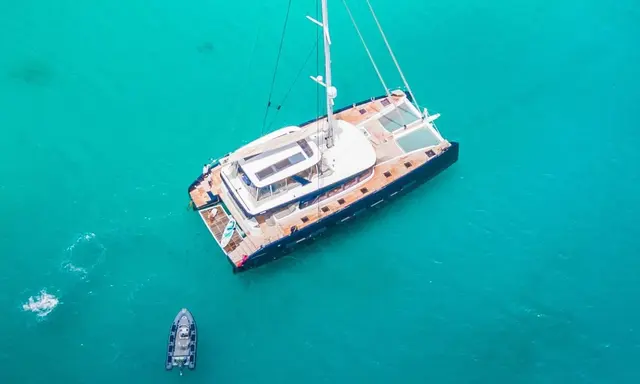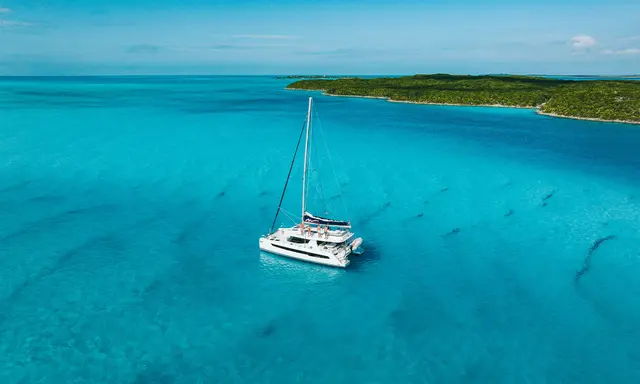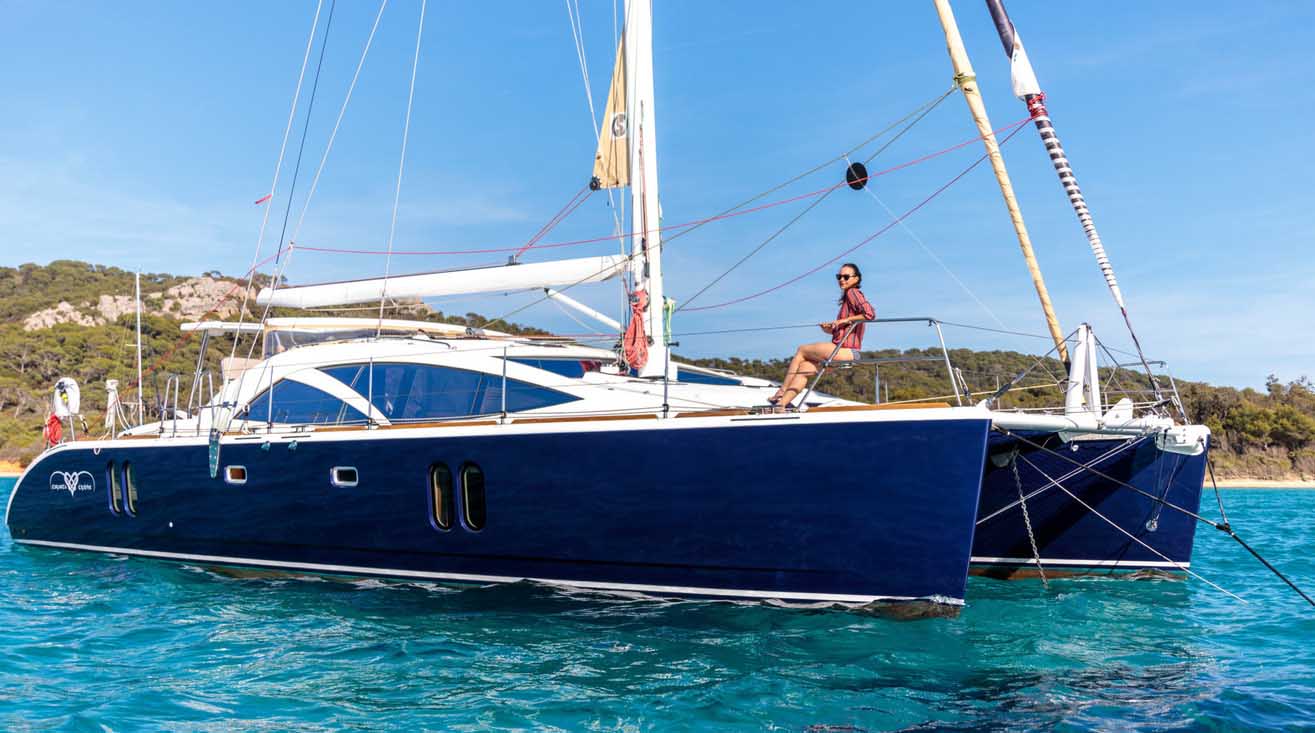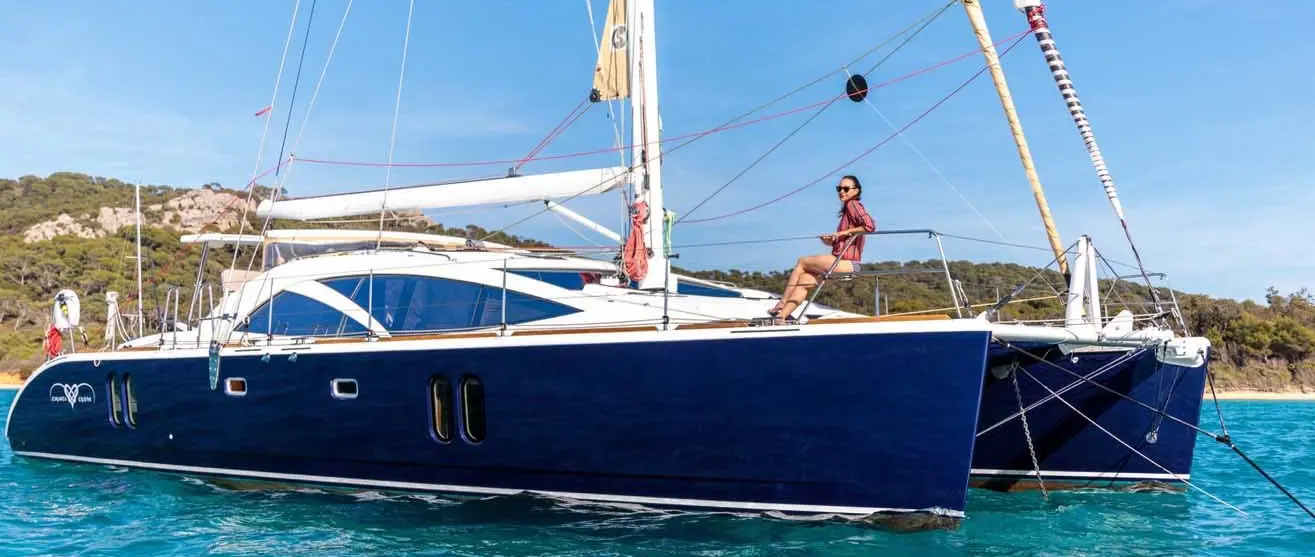
Bernard Gallay Yacht Brokerage has announced an early booking offer for CURANTA CRIDHE, a 15.35-metre sailing catamaran operated with a professional crew of two. The announcement, issued on 9 November 2026, offers a ten per cent discount on charter contracts signed before May 2027. Importantly, the date applies to the signing of the agreement, not necessarily to the period of the cruise. A booking completed within the advertised window may therefore be relevant to guests considering the following summer season.
The yacht was built by Discovery Yachts in 2011 to a Dixon Yacht Design project and has received several rounds of work, most recently in 2025. The current charter specification, checked on 28 November, quotes weekly starting rates of €21,000 in the low season and €23,000 in the high season. Specific availability, the application of the discount and all additional charges remain subject to confirmation through the charter agreement.
The distinction between a booking deadline and a travel deadline
The offer is particularly relevant to guests who already have a broad idea of where they wish to cruise but have not yet chosen a yacht. Unlike a promotion that applies exclusively to a specified week of travel, the published terms relate to the date on which the charter contract is signed. This potentially allows a guest to secure the advertised terms while planning a voyage in a later period.
It does not follow that every summer week is still available. Nor does the wording establish that the reduction is applicable to all expenses associated with the charter. Prospective guests should ask for a written quotation for their particular dates and itinerary, including a clear explanation of the fee to which the reduction applies. The actual deadline date, deposit requirements and cancellation terms should be established before making a financial commitment. Early planning can be beneficial when several members of a party must coordinate their holidays, but a promotional deadline should not replace proper consideration of the contractual conditions.
An alternative to a larger crewed yacht
At just over 15 metres, CURANTA CRIDHE occupies a different position from the large sailing catamarans increasingly offered with extensive guest amenities and multiple professional crew members. The boat offers three cabins for six guests rather than a larger accommodation inventory. Its size and layout may appeal to guests who prefer a relatively intimate charter and who wish to spend much of the day close to the surrounding coastline.
A smaller crewed catamaran may offer a very different experience from a yacht with several service departments. The two-person crew needs to organise navigation, vessel operations and guest services within the practical constraints of the boat. Before booking, guests should discuss how the daily programme and meal arrangements work. The most appropriate vessel is one whose accommodation and service model matches the expectations of the group rather than one selected solely on the basis of the advertised weekly fee.
The distribution of space across two hulls
The published beam of 7.86 metres is significant in understanding the yacht's accommodation. The two hulls provide sleeping spaces, while the central structure creates a wider area for the principal communal functions than would normally be available on a monohull of similar length. The outdoor deck areas add further opportunities for guests to spend time together or pursue different activities.
The dimensions should nevertheless be considered in relation to the actual layout. Width alone does not establish the size of every individual cabin or the degree of privacy it offers. Movement between the main deck and accommodation, ventilation and the placement of technical equipment can affect the experience of living aboard. Prospective charterers who have previously travelled on a much larger yacht should examine the cabin arrangements and the available storage rather than assume that a catamaran will reproduce every aspect of the larger vessel's accommodation.
Flexible sleeping arrangements for a group of six
The yacht's advertised accommodation includes a principal cabin with a queen-size berth and two further cabins whose sleeping arrangements may be configured as a king-size bed or separate twin beds. Each cabin has its own bathroom. This is a practical distinction for a relatively small charter vessel because it allows several different kinds of group to consider the same boat.
Three couples may value the double-bed arrangement, whereas a family or group of friends may need separate sleeping places. The charter team should confirm the configuration before arrival so that the arrangements are appropriate to the actual occupants. Guests with specific mobility requirements should also discuss the means of accessing the cabins and bathrooms. The fact that a particular number of people can be accommodated does not establish that the yacht will meet every individual's needs. Matching the cabin layout to the party is particularly useful when the voyage will involve a full week or longer aboard.
What the 2025 work adds to the charter offering
BGYB identifies improvements to the galley, replacement mattresses, changes to propulsion equipment and updates to the electrical installation among the work completed by 2025. The significance of those changes extends beyond a refreshed interior appearance. A galley is an important working space on a charter yacht, especially when the crew is responsible for preparing meals while also managing the practical requirements of a voyage.
The operator's description should be understood as a report of the specified work rather than proof that every system aboard is new. Guests can ask for current photographs and confirmation of the amenities relevant to their particular requirements. A vessel that has undergone several successive programmes of work may retain much of its established design while incorporating newer equipment in selected areas. The actual quality of the charter experience will depend on the condition and operation of those systems as well as the arrangements made by the crew.
Energy storage and quieter periods at anchor
The advertised upgrades include lithium battery banks and updated solar equipment. On a sailing catamaran, the broad deck and superstructure can create opportunities for installing photovoltaic equipment. The practical value of the installation depends on the amount of electricity the boat consumes, the available charging sources and the actual output during the charter.
An owner or technical manager may be interested in the detailed energy balance, but charter guests are more likely to notice the way the boat operates during periods at anchor. For example, the extent to which electrical loads can be supported without running a generator continuously will depend on the capacity of the storage system and the equipment being used. The broker has not supplied sufficient measurements to establish a particular period of silent operation. Guests should therefore avoid assuming that air conditioning or other substantial loads can always be maintained from batteries alone.
The relationship between draft and the itinerary
A stated draft of 1.30 metres may provide more options for a crew planning a coastal sailing itinerary than would be available on some deeper-draft yachts. In the Western Mediterranean, the ability to consider a variety of suitable anchorages can contribute to the experience of travelling aboard a catamaran. Guests may be able to enjoy the landscape from the yacht rather than depend on a marina for every overnight stop.
A shallow draft is not an assurance of safe access to every cove or beach. Actual conditions, local environmental restrictions, protected habitats and the captain's assessment will determine which locations are appropriate. The presence of two tenders may facilitate access to shore in suitable conditions, but operations are subject to the crew's safety procedures. Guests should discuss the relative importance of swimming, shore visits and sailing before a proposed itinerary is finalised.
Choosing among Western Mediterranean cruising regions
The broker's published charter destinations include the French Mediterranean coast, Corsica, Sardinia and several parts of Italy. These possibilities should be viewed as potential cruising areas rather than a guarantee that every destination can be included during the same week. Distances, weather and the location of embarkation and disembarkation are important in shaping an achievable itinerary.
A group seeking a relaxed holiday may prefer to concentrate on one island or a relatively compact stretch of coastline instead of attempting to cover several regions. Those particularly interested in sailing may prefer an itinerary that allocates more time to passages. The choice should be informed by the captain's advice and the actual availability of the vessel at the desired embarkation port. Costs associated with repositioning, where applicable, should also be clarified before a contract is signed.
The water-sports and outdoor programme
The published equipment inventory includes paddleboards, a kayak, snorkelling equipment and other recreational items. Combined with the exterior lounging areas, these facilities may be particularly appealing to families or groups who wish to spend considerable time on and around the water. A week aboard a sailing catamaran can provide opportunities to alternate active periods with quieter days without requiring substantial changes to the itinerary.
The use of water-sports equipment is subject to conditions, local rules and the abilities of the guests. Those interested in particular activities should discuss them with the charter team in advance, including whether any equipment is available only with instruction or supervision. A two-person crew may need to manage several competing demands during the day. Clear communication about the group's expectations will help establish how the available activities can be organised appropriately.
Evaluating the advertised rates
The current charter specification gives starting weekly rates of €21,000 and €23,000 for the respective low and high seasons. If the advertised ten per cent offer applies to those base fees, the corresponding illustrative figures would be €18,900 and €20,700. These are calculations based on the published numbers, not broker-confirmed quotations or total holiday costs.
The contract should identify any additional expenses, taxes, provisioning arrangements and services that are not included in the charter fee. Guests should also confirm whether the promotional terms apply to their actual dates and whether there are any minimum durations or other restrictions. CURANTA CRIDHE's November announcement is an opportunity to plan a 2027 voyage on a relatively intimate crewed sailing yacht with a documented programme of updates. The value of the offer will depend on the complete agreed terms, the suitability of the yacht for the party and the cruising programme that can actually be arranged.
Related Luxury Yacht Guide reporting
- Refitted Lagoon 77 MANE ET NOCTE Offers Post-New Year BVI Charter
- GranOcean W-66 Brings Charter-Led Planning to the 20m Power Catamaran Market
- Leopard Details Sail-Area Gains Across Its 43, 46 and 52 Catamarans
- Lagoon Invites Buyers Aboard the 43 at Paris Nautic Show
Primary reporting and image credit
Primary broker announcement(s): https://www.bernard-gallay.com/news-50ft-catamaran-curanta-cridhe-10-off-charter-contracts-signed-before-may-2027. © Respective photographer / Bernard Gallay Yacht Brokerage. Subject-specific first-party brokerage photograph; photographer not individually identified. Image is used only for correctly attributed factual editorial coverage and never represented as open-licence stock photography. Original broker image.