Leopard Catamarans has published new builder-led explanations of how hull geometry, rig proportions and helm placement influence the sailing performance of its modern cruising range. In its 20 November 2026 technical feature, the company compares the Leopard 43, 46 and 52 with their predecessors and identifies larger sail plans as a deliberate way to help owners keep sailing in lighter conditions rather than reach for the engines. Leopard reports a 12 per cent increase in upwind sail area for the 43 compared with the 42, a 12 per cent increase in standard sail area for the 46 compared with the 45, and a 17 per cent increase in upwind area for the 52 compared with the 50 under equivalent sail assumptions. The figures are manufacturer comparisons, not independent guarantees of passage speed or fuel economy. For owners weighing a catamaran in the luxury cruising class, the announcement offers insight into design decisions usually hidden behind a cabin layout and a brochure photograph.
A design explanation rather than another model launch
The new feature is not a report that the Leopard 43, 46 or 52 has launched on 20 November. It is a first-party design analysis that the builder has made public, describing what its naval architects and engineers prioritise when developing a sailing catamaran. That distinction matters because the word performance can be used loosely in advertisements. Leopard's discussion identifies specific technical choices: stepped hull sides, narrow waterline sections, sail area, mast and boom proportions, control placement and analysis of hull resistance. The source supplies a useful framework for informed questions, but it does not provide a complete independent polar diagram for each model or a controlled comparison under all conditions. A serious buyer should take the published figures as the beginning of technical evaluation.
Why light-air performance matters to cruising owners
Many sailing catamarans spend substantial time in moderate or declining wind rather than consistently ideal sailing conditions. If a boat cannot move comfortably at the speeds its owner expects in lighter air, the temptation to start the engines increases. That affects noise, fuel consumption, maintenance and the satisfaction of travelling under sail. Leopard says the new-generation rigs were designed to provide useful power when the breeze softens, without converting a family cruiser into a specialised racing yacht. This goal is credible in principle, but the actual outcome depends on wind strength, sail trim, sea state, displacement and the skill of the crew. A performance comparison should therefore involve real passages or representative trials, including a description of the sails fitted and the weight of the yacht during testing.
The Leopard 43's revised hull and rig
The builder attributes several changes to the Leopard 43 compared with the earlier 42. Its mast is described as three feet taller and the upwind sail area as 12 per cent greater. The design also uses wave-piercing hull geometry and reverse bows, paired with the stepped hull approach that creates accommodation volume higher above the waterline. The interest here is in the balance of priorities. A narrow waterline can reduce certain resistance penalties while the broader upper portions of the hull accommodate the spaces buyers expect. Yet a hull's efficiency cannot be understood from one dimension alone. The bow shape, bridge-deck height, loading, wetted surface and rig forces all have to work together. An owner considering the 43 should ask for the intended sailing displacement and performance data for the actual cabin configuration.
The Leopard 46 introduces a different set of choices
For the Leopard 46, the builder reports a taller mast and 12 per cent more sail area with standard sails than the previous 45, or a 15 per cent increase when its performance package is specified. The optional package is associated with radial-cut aramid sails, a significant detail because sail cloth, cut and construction influence both performance and maintenance. A buyer should establish which sails were used in the builder's comparison, what the cost and service life might be, and whether the equipment suits a crew that often sails with only two people. A more powerful sail plan can be rewarding but may place greater emphasis on dependable winches, reefing systems and deck hardware. The attraction lies not in a single percentage but in a complete rig and handling arrangement that matches the owner's experience.
The Leopard 52 is the naval-architecture case study
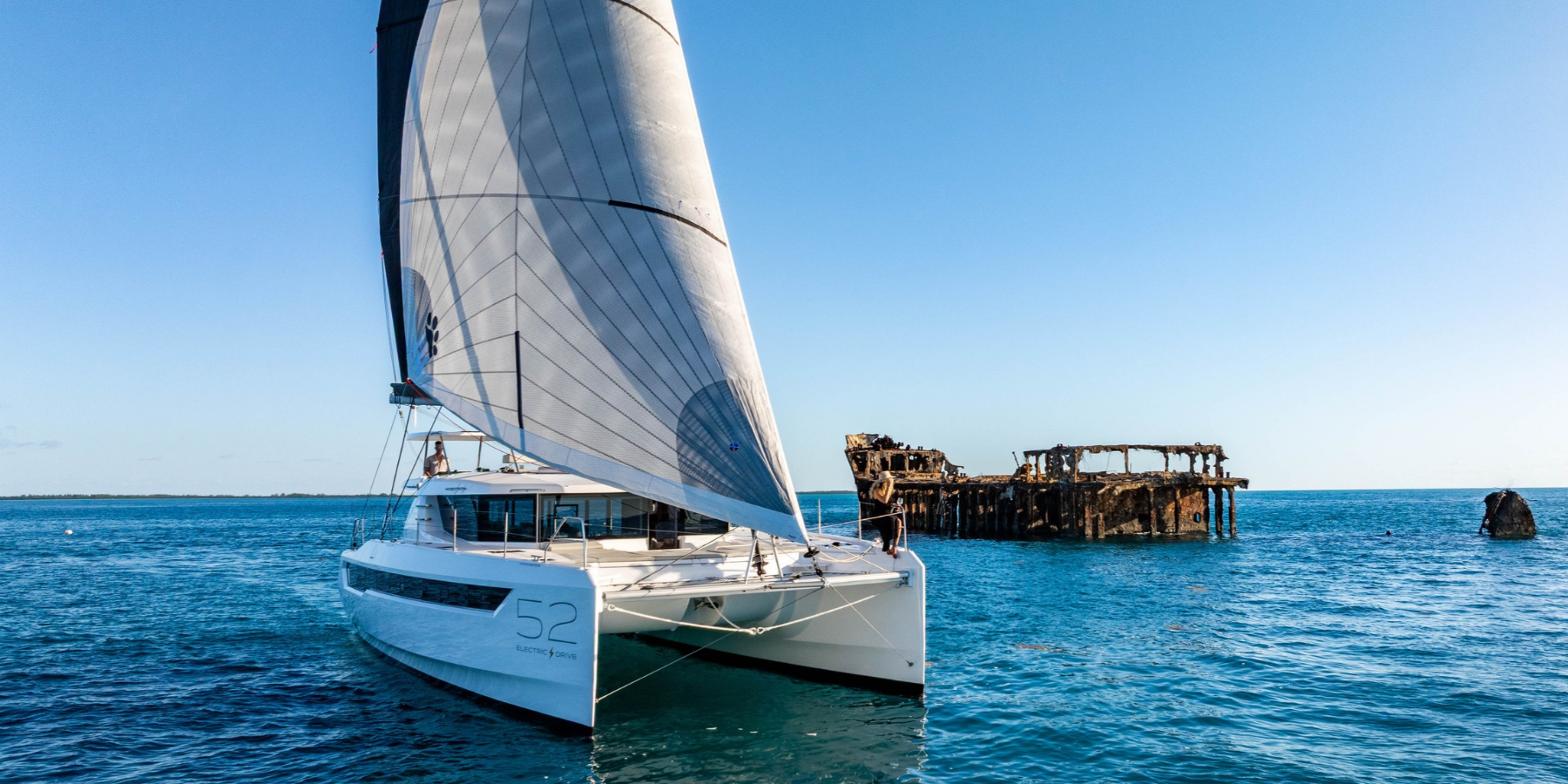
Leopard's new feature devotes particular attention to the 52 and the work of naval architecture firm Simonis Voogd Design. The company describes using computational fluid dynamics to refine the hull and review pitching, resistance, bridge-deck height, centre of gravity and weight distribution. It also reports 17 per cent more upwind sail area compared with the 50 under equivalent sail assumptions. That combination shows why sail area is never an isolated specification. A larger rig can produce more force, but the boat must be able to carry it efficiently and comfortably. Hull form and displacement determine how much of that force becomes useful speed rather than additional drag or motion. For a yacht in the 15-to-16-metre segment, the implications extend to comfort on long passages, rig service and the amount of equipment carried aboard.
Stepped hulls and accommodation volume
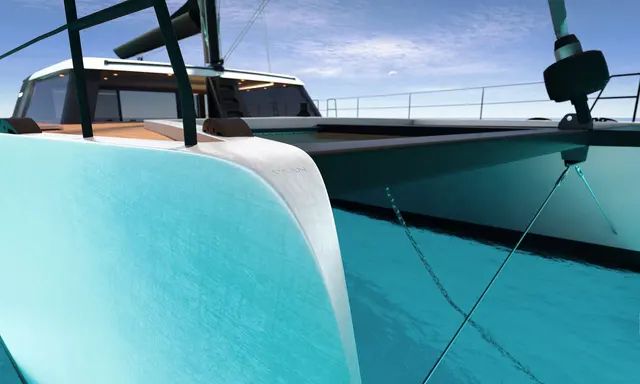
One of the most interesting claims in Leopard's design explanation concerns the way its stepped hulls retain a narrower waterline while adding volume higher up. This is a response to the commercial reality of cruising catamarans: owners demand usable cabins, storage and privacy, while designers seek to limit underwater resistance. It is a sensible problem to address, but the published description does not establish a universal efficiency advantage over every competing design. Buyers should examine hull drafts, keel configurations, payload capacity and actual weight distribution. A catamaran that leaves the yard light may perform differently after the owner adds cruising equipment, extra batteries, tools and supplies. That makes payload and loading documentation especially important when making comparisons.
Single-handed sailing needs a safety discussion
Leopard says the helms of all three sailing models are arranged so the boat can be managed by one sailor, with instruments, lines and winches located close to the steering position. Protected helms and proximity to the social areas are intended to make the experience more comfortable. That does not mean a single person can safely undertake any passage without support, regardless of conditions. Owners should consider whether sail changes, reefing, anchoring and line handling can be managed under pressure, not simply in fair weather. Equipment failure can create situations that demand help from another competent person. A useful sea trial would include reefing, tacking and sail retrieval with the crew size the owner expects to have aboard. Clear visibility and secure footing are as important as the location of the controls.
Sailing and living spaces must work together
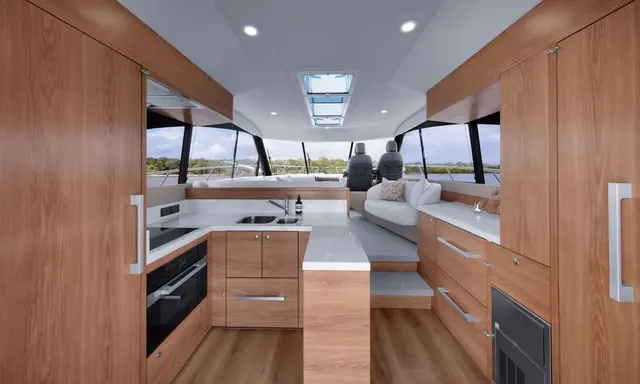
A cruising catamaran is often both a vessel underway and a home at anchor. Leopard's article points out that its boats connect the saloon and aft cockpit while placing the helm close enough for the person steering to remain engaged with the group. The 43 can devote the starboard hull to an owner's stateroom, the 46 can provide a utility space for laundry or work, and the 52 offers several cabin configurations extending to six cabins. Those choices change the balance between accommodation and equipment storage. The buyer who works from the yacht may value a dedicated office more than an extra berth; a family on holiday may prioritise privacy, refrigeration and space for activities. The design should accommodate those needs without overloading the boat or making essential maintenance difficult.
What the manufacturer percentages do and do not establish
A 12 or 17 per cent increase in sail area is a verifiable design comparison only when the underlying sail definitions and model configurations are made clear. It does not translate automatically into the same percentage increase in boat speed, reduction in engine hours or savings in fuel. Sail power, resistance and stability interact nonlinearly. Performance can also vary between standard sails and optional high-performance sails or between a light boat and a fully provisioned cruiser. Buyers should request polar performance information or measured trial reports where available and ask how they were obtained. They should compare boats with consistent loads, sail types and weather conditions. A manufacturer technical feature helps explain the design rationale, while independent evaluation tests how the theory performs in the owner's actual use case.
Service implications of more ambitious rigs
Larger sail plans introduce practical maintenance questions. Owners should investigate standing and running rigging loads, inspection intervals, sailcloth choices, winch service, hardware warranties and the ease of obtaining replacement parts abroad. A crew planning a long offshore programme needs confidence that the reefing system can operate predictably and be repaired without a factory visit. The difference between standard and optional performance sails may affect the long-term replacement budget significantly. It is also useful to discuss how rig tuning changes with different payloads or sailing programmes. A builder can design a sophisticated sail plan, but the owner's enjoyment depends on maintaining it properly. Simple, well-documented operations often matter more to a family cruiser than the theoretical maximum speed under ideal conditions.
Evaluating a Leopard against other catamarans
The best comparison begins with a written cruising brief: destinations, usual crew number, typical passage length, home marina, expected days at anchor and the amount of equipment carried. Then compare beam, displacement, sail area, mast height, bridge-deck clearance and accommodation against the same operating assumptions. A sea trial is valuable, particularly in conditions that include light winds and short waves. Examine the ease of reefing, the working positions at the helm and access to deck hardware. Owners should also obtain actual annual costs for berthing, insurance, rigging service, sails and machinery. The Leopard feature provides a clear set of topics to discuss, but it is not a substitute for independent technical and financial advice before committing to a particular yacht.
Why this technical release matters now
The significance of the 20 November explanation lies in the builder offering specific design changes rather than simply asserting that its new boats sail better. It shows how the Leopard 43, 46 and 52 have been developed with attention to rig power, hull resistance and the convenience of handling a large cruising catamaran with a small crew. Those aims are relevant to a rapidly evolving market in which owners want more interior comfort without losing the pleasure of travelling under sail. The claims remain manufacturer-provided and should be tested against real operating data. Nevertheless, the discussion makes it easier for a prospective buyer to ask informed questions about weight, sail area, steering ergonomics and service. That is the value of a substantial technical release in a market often dominated by visual presentation.
Sources and image credits
Reporting based on Original manufacturer's official event or dated technical announcement.
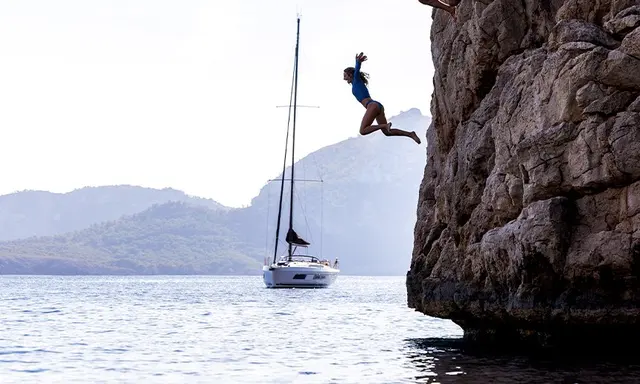
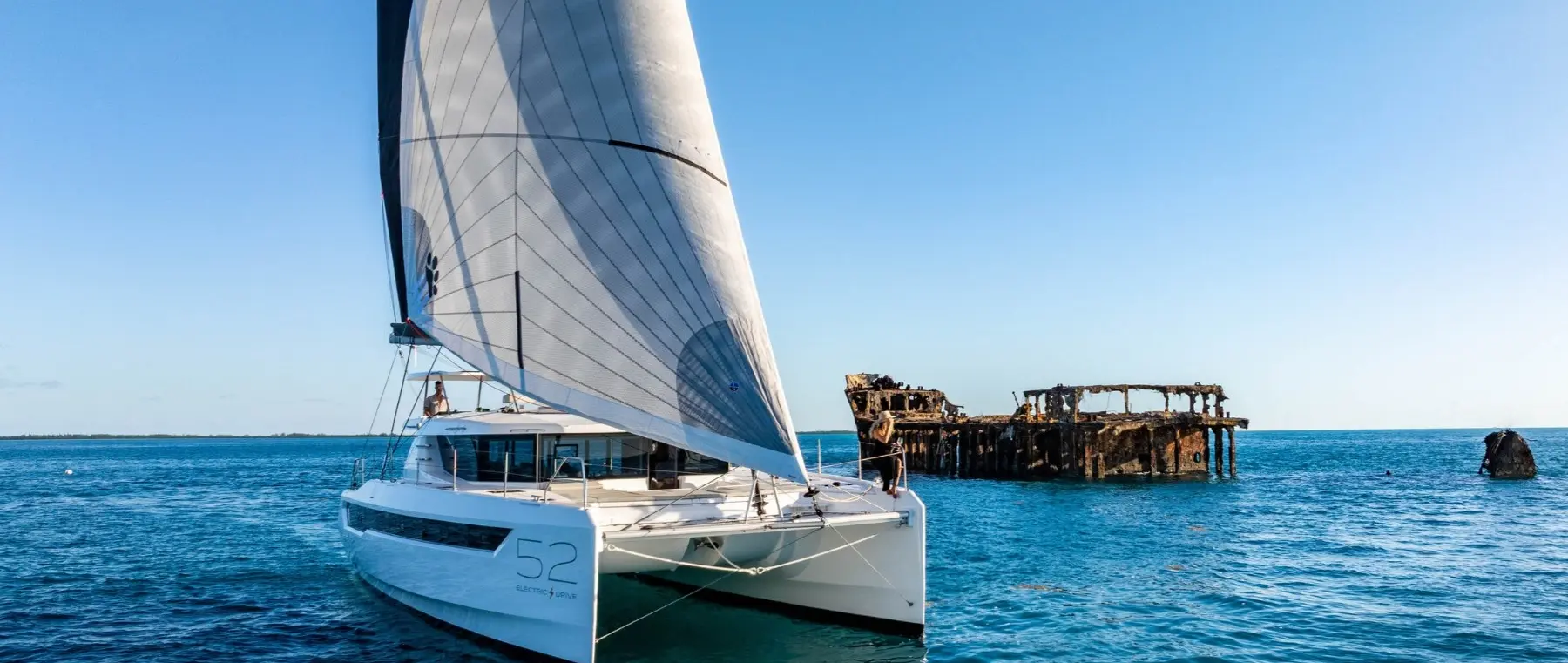
Lead photograph: Original image of a Leopard 52 from the maker's 20 November 2026 sailing design feature.. © Original manufacturer and photographer or creator. Rights remain with their holders. Original official image source.