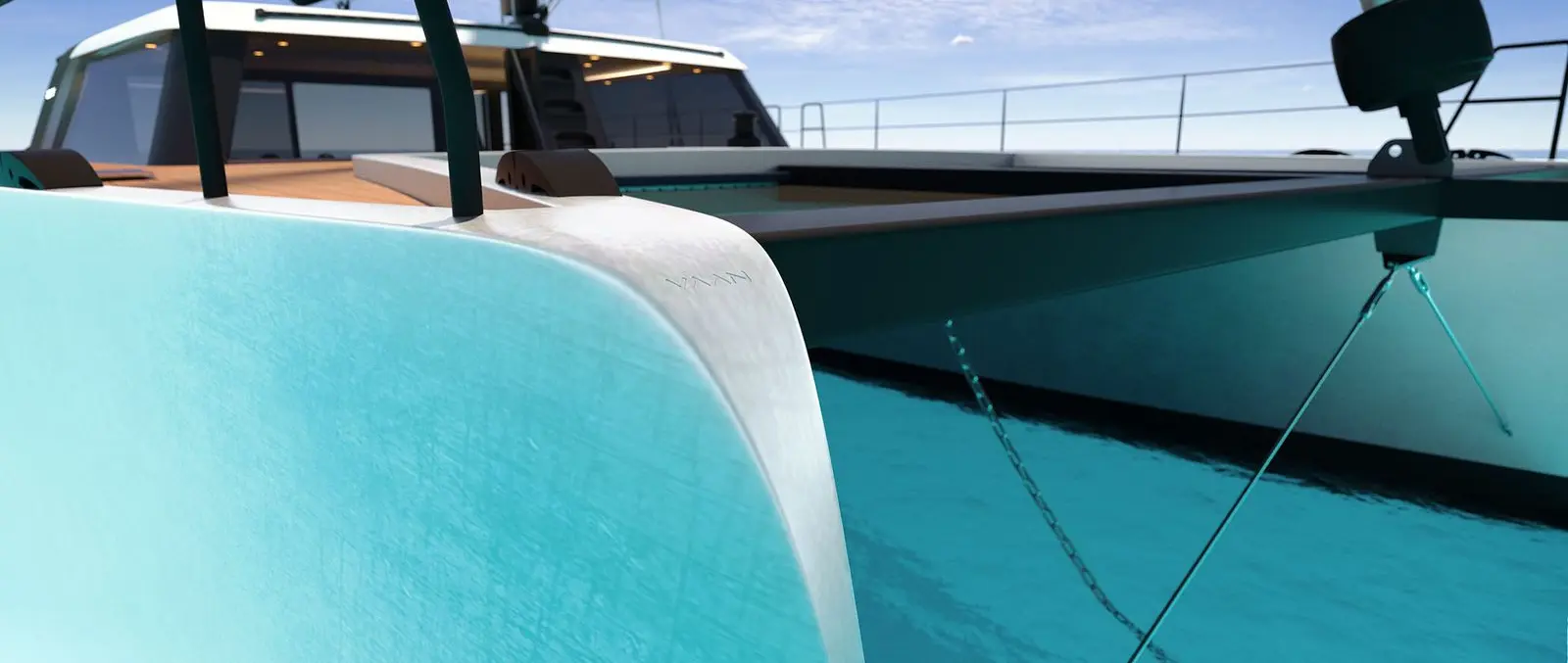
Dutch aluminium catamaran builder Vaan Yachts has opened its 2027 design update programme with a change to the bows of its sailing yachts. Announced on 18 November, the revision will extend across the R4, R5, R6 and R8. Instead of introducing an entirely new model, the yard is evolving the shape of its existing range, beginning with the forward extremities of the two hulls.
The new profile incorporates a subtle inversion and a more pointed entry, with the upper surfaces brought together in a sculpted transition. The builder has also chosen to engrave its identifying mark into the aluminium itself. Images published with the announcement illustrate the intended visual character of the revised hulls. Further changes for the 2027 model year are due to be announced before the end of December; the current announcement should therefore be understood as the first instalment of a wider programme, not a complete specification for next year's yachts.
Four models within the luxury sailing market
Vaan's range extends from the 12.80-metre R4 through the 14.95-metre R5 and 17.68-metre R6 to the 23.80-metre R8. These are the lengths currently displayed by the manufacturer. Each falls within Luxury Yacht Guide's coverage of yachts between 12 and 23.99 metres, although the larger models will have very different berth, crew and ownership requirements from the R4.
The manufacturer's current model information identifies a three-cabin arrangement for the R4, a choice of three or four cabins for the R5, four or five for the R6 and five, six or seven for the R8. These existing arrangements establish the context for the announcement. Vaan has not stated that the November bow revision changes any of those accommodation choices. Buyers discussing a new yacht should therefore distinguish the newly announced exterior geometry from the configuration of the existing model range.
A common styling feature across these four models is significant because it allows the builder to express the same architectural language at several different scales. A line that works on a relatively small sailing catamaran cannot necessarily be carried over to a much larger vessel by simple enlargement. Each hull must accommodate its own internal structure, displacement and sail-plan requirements. The new design is best assessed in the context of the individual model.
A change to the line of the bow
The slightly inverted profile gives the stem a more forward-leaning appearance when viewed from the side. Viewed from ahead, the revised aluminium surfaces converge into a pronounced V, according to Vaan's description. The transition from the upper part of the bow towards its leading edge is intended to combine a clearer visual expression with a finer entry into the water.
The company says the sharper shape is intended to move more cleanly through the water. It has not published comparative resistance curves, trials results or a quantified improvement in speed or fuel consumption with the design announcement. The expected characteristics should be treated as a design objective rather than measured performance. Hydrodynamic performance depends on the underwater form of the complete hull as well as visible changes above the waterline.
For a sailing catamaran, the form of the forward sections has implications for the distribution of buoyancy when operating in waves. Changes to the stem and nearby surfaces can also alter how the boat looks in relation to its deck and forward cabin areas. The public material does not establish whether the design alters displacement, reserve buoyancy or other engineering parameters on any particular model. Those are appropriate subjects for discussion with the builder if they are important to a prospective owner's cruising programme.
Why the construction method matters
Vaan attributes its ability to undertake annual revisions partly to its aluminium construction method. Unlike a moulded composite yacht built around fixed production tooling, a fabricated aluminium structure can offer a different route to introducing changes between successive builds. The builder emphasises that its production approach allows designs to be adjusted without having to manufacture a new hull mould for each modification.
That is not to say that changes are free of engineering or production consequences. Revised plates, structural details and assembly sequences may need to be considered individually. A controlled design change requires drawings, material specifications and quality checks, whichever construction method is chosen.
For the customer, the more useful distinction is between a design revision that is applicable to a model ordered in the future and a particular design configuration already under construction. A yard may not be able to introduce every announced change into every hull at the same stage of production. Owners should establish the applicable build specification and drawing revision before relying on the photographs or descriptions of an updated range.
This approach can also affect the way a series of yachts evolves over its working life. A model designation may remain the same while its standard equipment, interior details or exterior geometry changes. Brokers and surveyors need to establish the actual specification of an individual vessel rather than assume that all yachts carrying the same model name are identical.
A sculpted surface becomes part of the identity
The engraved aluminium logo is a small but telling detail in Vaan's announcement. Instead of treating the branding as a separate decorative panel, the yard is incorporating it into the curved section of the revised bow. The visible material and the geometry of the hull are therefore part of the brand's visual identity.
That distinction is particularly apparent on yachts whose designers make use of an exposed metallic appearance rather than disguising the underlying construction. Different finishes can emphasise or soften the visual effects of the shape. The announcement illustrates how the curve of the bow and the placement of branding can work together, although it does not set out the finish options for each 2027 model.
An owner's specification may involve considerations about maintenance, the preferred appearance over time and the treatment of surfaces exposed to the marine environment. Those decisions should be made using the yard's actual finish and maintenance information. The new styling alone does not establish that the requirements are different from those of the existing designs.
Assessing the change in a sailing programme
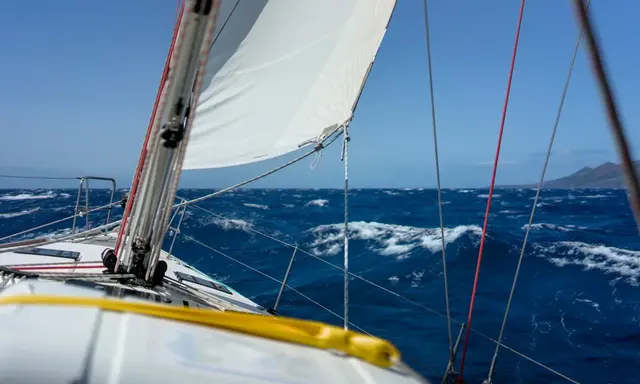
A luxury sailing catamaran may spend substantial periods at anchor, in harbour or sailing between islands. Prospective owners often assess a design from photographs taken in calm water or computer-generated imagery. Those images can provide an understanding of exterior arrangements but not the full behaviour of a yacht under sailing conditions.
The revised bow is one feature of a broader vessel specification that includes rig geometry, sail controls, steering, weight distribution and bridge-deck clearance. For someone considering long-distance cruising, the relationship between these elements is more important than the appearance of an isolated hull section.
The current release does not give new polar diagrams or trials data for the revised models. The prudent comparison is therefore between the manufacturer's documented existing specification and the exact 2027 specification supplied for an order, followed by whatever demonstrations or trials the builder can arrange.
The announced shape is especially interesting as an example of continuous evolution rather than an attempt to completely replace a successful product family. New designs can attract attention through large changes to their layouts or accommodation. A series that is incrementally revised presents a different proposition: individual improvements can be introduced while retaining the general identity of the boat.
What to establish before ordering
Owners considering one of the four Vaan models should ask which planned 2027 revisions are included in the hull they are discussing. This is particularly important because the company is publishing the design updates progressively. The announced bow change does not necessarily represent the final list of alterations for next year.
Berth dimensions and transport requirements should be based on the actual overall measurements of the proposed yacht. The manufacturer currently displays the four model lengths, but has not announced a revised dimensional table alongside the November news. Prospective owners should also request the relevant sail plan, equipment schedule, accommodation arrangement and any updated performance information.
Vaan's latest announcement is a specific indication of how its aluminium sailing yachts will develop for 2027. It provides a first look at a new bow form while leaving other planned revisions to later announcements. For the luxury sailing market, the story is not merely a styling change. It illustrates how a builder using fabricated construction can revisit individual design elements across a complete range while maintaining an identifiable family of yachts.
Sources
Official announcement and manufacturer information.
Photograph: Official original, specific 2027 bow close-up from the VAAN Yachts manufacturer announcement. Credited to VAAN Yachts for reporting on that product/design announcement; permission for other reuse not claimed. Source: https://www.vaan.yachts/wp-content/uploads/2026/11/Vaan-New-Bow-Front-Close.jpg.