An award for a yacht designed to cover distance
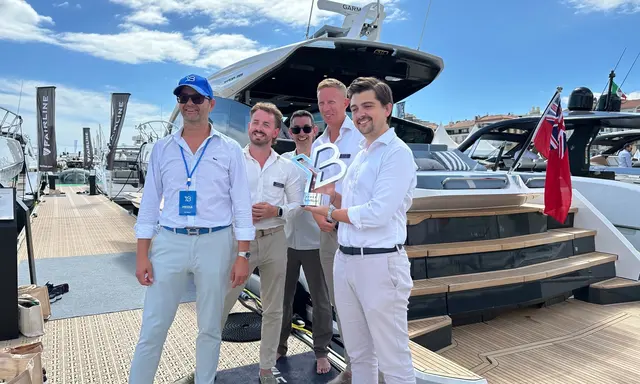
The Grand Soleil 60 has won the sailing-yacht-over-14-metres category at the 2026 Genoa Design Innovation Awards. The award was presented during the Genoa International Boat Show programme in early October, and the result is confirmed by the event’s organiser, Confindustria Nautica. Its independent jury singled out the design of the cockpit and deck together with the space and finishes below. For Cantiere del Pardo, the recognition falls on a yacht intended to combine offshore sailing with the comfort expected of a private luxury cruiser.
The 19.68-metre model sits firmly inside Luxury Yacht Guide’s 12–23.99-metre coverage. This matters because the design choices under discussion are not confined to much larger crewed superyachts: they concern the everyday compromises that owners of substantial but manageable private sailing yachts must make between security under way, handling efficiency and a welcoming life on board.
What the jury actually recognised
Confindustria Nautica’s 3 October announcement identifies the winner as the Grand Soleil 60 from Cantiere del Pardo, with Nauta Design credited for design and Matteo Polli for naval architecture. The stated reason centres on deck engineering, cockpit ingenuity, interior space and finish quality. These are jury findings, not the result of a published comparative sea trial or an independently audited performance ranking.
The award programme evaluates projects across categories, bringing together specialists from design, marine engineering, media and related disciplines. It recognises particular qualities within the competition’s framework. A win does not mean that the model is demonstrably the fastest sailing yacht in its class or the right choice for every owner. It is nevertheless useful evidence that the relationship between technical layout and onboard experience attracted serious professional attention.
The yacht’s principal dimensions
Cantiere del Pardo’s current specifications describe an overall length of 19.68 metres, a hull length of 18.30 metres and a beam of approximately 5.80 metres. The listed draught is 2.80 metres and displacement is around 27 tonnes. Those figures immediately place the yacht in an interesting ownership position: large enough for private spaces and useful stores, but with draught and handling characteristics that require considered berth selection, passage planning and crew experience.
Owners should work from the most recent builder specification for a particular hull because equipment and configuration can vary. Published dimensions are a guide to a model, not proof of the exact clearance required by a marina. In particular, berth length, fairway width, available depth, approach conditions and draft allowance should be confirmed individually before a booking.
Deck movement without unnecessary obstacles
The yard describes a stepless deck concept intended to make movement from the cockpit towards the foredeck more natural. A yacht of almost twenty metres creates long routes between sail-handling positions, seating areas and the companionway. Eliminating changes in level where feasible is an ergonomic benefit, particularly when people move around under way. It does not eliminate the need for handholds, appropriate footwear, safety lines or careful movement in difficult conditions.
The layout combines a broad cockpit with controls kept within reach of the helm, reflecting an interest in sailing with a relatively small crew. That does not make the yacht a boat for an untrained skipper. It means the designer has tried to keep important operating tasks within a manageable working area, an approach that can reduce unnecessary movement when manoeuvring or trimming in changing wind.
A cockpit made for sailing and staying
The cockpit is both a working space and a social room. Grand Soleil’s product description highlights cushions that extend towards the coachroof and cockpit tables that lower to form larger sunbathing surfaces. This ability to change the furniture arrangement lets the same deck support watches under sail, meals in harbour and time at anchor. The independent award jury’s attention to the cockpit is consistent with the model’s stated emphasis on multiple uses.
Practical ownership questions sit behind the promotional description. Guests need clear pathways when sails are being adjusted, and crew need access to lines and controls without crossing a dining arrangement. In harbour, the cockpit becomes a natural gathering point, but furniture, covers and cushions must also be stored or secured before departure. The quality of the transition between these uses is what buyers should test on board.
Rig handling and the smaller crew
Grand Soleil describes a full-batten furling mainsail and hydraulic assistance for the backstay and vang. These features are relevant because the forces involved in handling a yacht of this size are substantial. Properly chosen assistance can make sail controls more accessible, but each powered or hydraulic system adds components that need inspection and maintenance. Owners should understand the manual or emergency procedures before a long passage.
The specification also highlights a fold-down aft bathing platform that creates an additional place to relax at anchor. Such a platform changes the way guests reach the sea and the tender, especially in calm water. It is not a device to leave deployed indiscriminately in rough conditions. Loading limits, protection from propellers and movement in a swell should be checked with the yard’s instructions.
Interior arrangements designed around real cruising
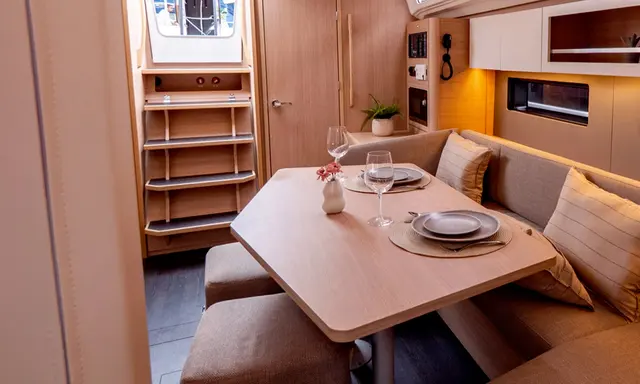
The yard offers a standard three-cabin arrangement, with an option for a fourth cabin created in place of part of the galley. The main saloon is described as bright and open, helped by a semi-raised arrangement and large hull windows. The master cabin has a French-style bed and private head, with two aft guest cabins also provided with bathrooms. A forward crew cabin for two appears in both of the layouts described by the yard.
The choice between galley space and another cabin is a revealing one. A family making extended passages may value food storage and preparation space differently from owners who frequently entertain larger groups near shore. Neither configuration is automatically better. Prospective buyers should walk through the full daily routine of cooking, storing provisions, taking night watches and accessing cabins before choosing the plan that looks most attractive in a brochure.
The importance of storage and tankage
Grand Soleil positions the 60 as a long-cruise yacht and points to generous tankage and storage for time away from port. Its current website lists 1,000 litres of fresh water and 1,140 litres of fuel, although buyers should confirm exact hull and option specifications with the shipyard. The relevant calculation for a passage is not simply how large the tanks are; it is the consumption expected from crew habits, generators, engines, watermakers and domestic equipment.
An owner planning to spend several weeks in remote anchorages will also think about rubbish storage, spare parts, refrigeration, laundry and the ease of reaching service points. Space that looks generous in a showroom can feel different when loaded with provisions and safety equipment. The central promise of a bluewater layout becomes credible through the mundane details that make long periods on board manageable.
Why 19.68 metres is an interesting part of the market
A yacht just under twenty metres can deliver a distinctly private luxury experience without assuming the permanent crew, shore infrastructure or budget of a much larger vessel. Still, it remains a serious technical asset. Owners need to consider berth fees, maintenance, insurance, sail inventory and operational support. A design award cannot answer those ownership questions, but the jury’s emphasis on sensible space planning is relevant to people balancing enjoyable living with manageable operation.
The Grand Soleil 60 will also interest charter-oriented operators and experienced sailing families for different reasons. Guests may be drawn to the living areas, while operators will consider durable finishes, service access and how the arrangement works during successive trips. If a yacht is to be used commercially, certification and local charter rules need to be evaluated separately.
Distinguishing an award from a performance test
The Design Innovation Award is a recognition of design qualities, not a laboratory claim about fuel use, passage speed, stability or safety certification. Nothing in the organiser’s announcement establishes a numerical advantage over another sailing yacht. The builder’s published figures, likewise, describe a model rather than sea-trial results from a specific owner’s configuration.
For the informed buyer, that distinction is useful. The award suggests which parts of the boat deserve close inspection: cockpit transformation, deck movement and the connection between social and functional spaces. A proper buying process would add a sailing trial, technical survey, independent advice and verification of documentation, as appropriate to the transaction.
A broader signal from the Genoa awards
The same organiser’s awards recognised a range of boating projects, including the Pardo GT65 in a motor-yacht category and the Lagoon 47 among multihulls. The Grand Soleil 60’s place among those winners suggests that adaptability and the relationship between living spaces and operation remain prominent design themes. That is an interpretation of the jury’s recorded motivations, not a claim that every winning yacht shares one engineering solution.
For Cantiere del Pardo, recognition of its 60-foot long-cruise project adds a new line to an established sailing heritage. For Luxury Yacht Guide’s readers, it provides a reason to examine the boat’s real-world arrangements and ask how faithfully its design supports the sailing they intend to undertake.
Original sources and image note
Primary sources: Confindustria Nautica’s official 3 October 2026 Design Innovation Awards results and Cantiere del Pardo’s current Grand Soleil 60 model page. Details such as the award category, credited designers and published principal dimensions come from those records. Ownership implications and suitability questions are editorial analysis.
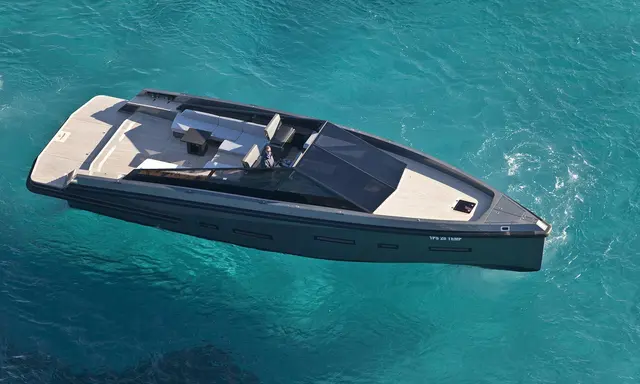
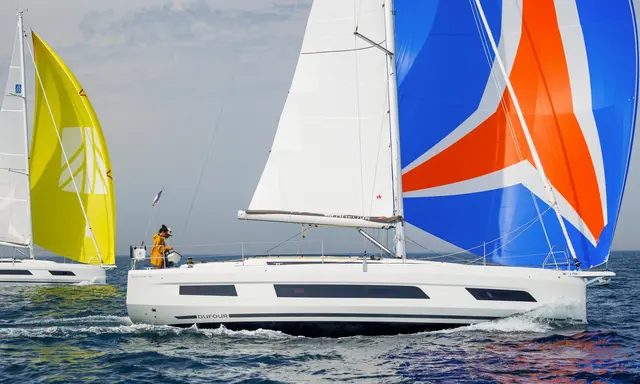
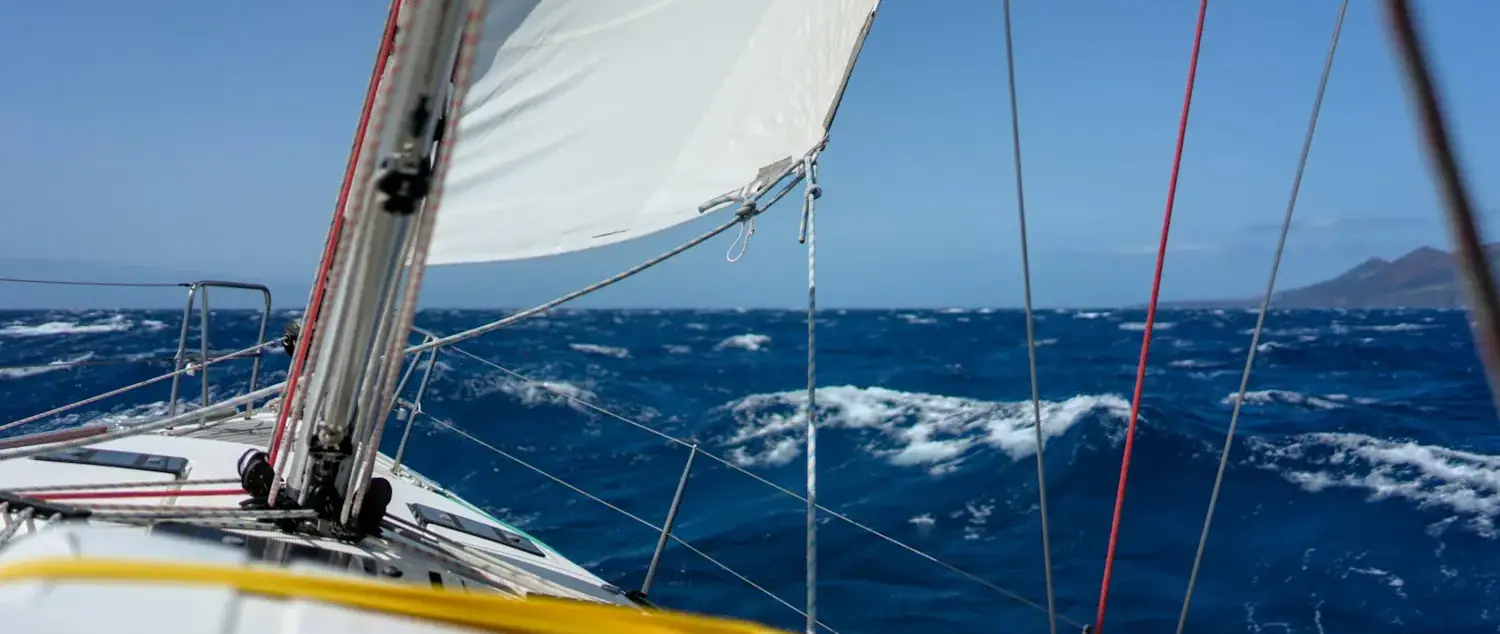
The photograph is a freely licensed contextual image of a sailing yacht at sea. It is not represented as a photograph of the Grand Soleil 60 or the Genoa award ceremony. Readers seeking imagery of the winning model should consult the manufacturer’s official gallery.