Three standards retained across a UK marina network
MDL Marinas has retained certification to three international management-system standards covering quality, environmental responsibility and occupational health and safety. In two statements issued on 21 and 27 October 2026, the British marina operator says the accreditations are ISO 9001, ISO 14001 and ISO 45001. It says it first held all three together in 2022 and has now maintained them following the relevant assessment processes.
For owners using a 12–24-metre luxury yacht, this is a business-operating story with practical consequences. A marina is not simply a length of pontoon. It is a service provider dealing with electrical supplies, boats moving in confined waters, contractors, visitor information, maintenance infrastructure, waste, staff training and the everyday quality of facilities ashore. Management controls are relevant to each of those activities.
What the certifications cover
ISO 9001 concerns a quality-management system: how an organisation defines its processes, monitors performance, responds to customer requirements and pursues improvement. ISO 14001 covers an environmental-management system, which includes identifying operational impacts, setting controls and checking progress. ISO 45001 concerns occupational health and safety, including the management of risks to staff and people affected by work activities.
These distinctions matter. A marina holding all three certificates has demonstrated that assessed management arrangements meet requirements within the certificate scope. It has not received a guarantee that every berth is always safe, that no environmental incident can occur or that every visitor will be satisfied. Specific facilities, equipment and services must still be judged on their actual merits. Certification provides a framework for accountability rather than immunity from error.
A continuing assessment, not a new marina opening
MDL says it was the first UK marina operator to secure the three certifications together in 2022 and describes the current result as a retention. This is therefore not the launch of a new marina, nor evidence that the certification body has just introduced new standards. The news is that the organisation has maintained the independently assessed systems as its network evolves.
The distinction is important in a sector in which the public can easily confuse recognitions, awards and direct facilities ratings. The ISO system looks at how processes are managed; it does not provide a universal ranking of luxury marinas. An owner choosing between two berths may reasonably treat credible certification as one positive signal, while still comparing location, draft, security, pricing, travel access and staff experience.
Facilities investment at three named sites
The operator links its management approach to recent improvements at individual marinas. Its published examples include work on customer facilities at Penton Hook, office and roadway improvements at Hamble Point, and a new 35-tonne boat hoist at Northney. These are tangible projects that can be assessed separately from the certificates, and they offer a clearer picture of how site management translates into day-to-day experience.
A 35-tonne hoist is especially relevant to boat owners seeking maintenance or seasonal lifting, but its nameplate capacity is not the only criterion for deciding whether a specific yacht can be lifted. Length, beam, displacement, sling geometry, access conditions and the boatyard’s operating limits all matter. Owners should not infer compatibility with a particular 20-metre yacht from tonnage alone. A marina must confirm the lift plan.
Water safety and cold-water preparedness
MDL says its teams have completed tailored training developed with Vitae Vi, focusing on water safety and cold-water immersion. Such preparation has obvious relevance at marinas where a slip, fall or unexpected entry into the water can become dangerous quickly. The subject is different from an offshore rescue operation: marina staff need practical responses suited to pontoons, ladders, shore equipment and the constraints of a busy waterfront.
Training programmes are only one part of prevention. Operators also have to keep access routes clear, check rescue equipment, manage contractors and respond to changes in weather and light. For visitors, a good briefing on local hazards and emergency contacts can be as valuable as a polished reception area. The ISO announcement provides useful context, but owners should still look for visible procedures and attentive staff when arriving.
The environmental figure and its scope
MDL reports that it reduced operational carbon emissions by 54 per cent between 2022 and 2025. This is a company-reported performance figure in the official statements. It is not described as a reduction in all emissions generated by visiting yachts or in every indirect activity associated with its business. That difference should be preserved when comparing environmental claims across marina operators.
Marinas can influence their own energy use, waste-handling practices and infrastructure, but they do not control every guest’s engine, travel choice or onboard energy system. Nor does an emissions reduction by itself prove that local water quality has improved. A responsible reading of the number is that the operator reports progress within its operational footprint, while the wider environmental effects of its network require separate evidence.
How a yacht owner should use this information
Owners often weigh a marina’s position on a cruising route against more detailed operational questions: whether shore power is suitable, whether a fuel berth is available, what visitor arrangements apply and how easily a crew can reach reliable maintenance. A certification can give reassurance that the operator has documented processes, but it cannot answer vessel-specific questions. The harbour office remains the authoritative source for actual berth availability, dimensions and local access restrictions.
For extended winter berthing, maintenance access and responsiveness to faults become particularly important. It is worth asking how incidents are logged, how contractors enter the site and whether staff can explain the process for reporting a damaged pontoon fitting or faulty shore-power outlet. A mature management system ought to support clear answers, but the owner should judge the service experienced rather than relying on certificates alone.
Why third-party assessment can matter commercially
The commercial value of independent assessment lies in the discipline it imposes on repeated operations. Marina networks contain sites with different equipment and local conditions, yet the organisation needs broadly consistent ways to handle risks, complaints and monitoring. An external certification process creates formal checkpoints and requires documented evidence. It can also help customers distinguish between a company’s stated aspirations and arrangements subject to outside review.
However, auditors assess against a defined scope and sampling method. They do not inspect each yacht every day or guarantee every staff decision. If owners want to know whether a particular location is covered by a certificate, they should request the current certificate and scope details. That is especially sensible when comparing a national operator’s commitments with the facilities of one specific branch.
An increasingly sophisticated marina business
The modern marina industry is changing alongside the boats it hosts. Owners now expect reliable communications, good shore facilities, energy management, berth information and access to trained assistance. A yacht of eighteen metres may carry sophisticated electrical systems while still relying on basic marina infrastructure for connection, safe manoeuvring and winter support. A small operational failure ashore can disrupt a significant voyage.
MDL’s announcement illustrates one response: placing quality, environmental controls and workplace safety within a common management structure. Whether this approach is better than another operator’s is not something the certificates alone establish. It does, though, indicate a decision to maintain a formal organisational standard across multiple locations, and the company has identified concrete recent investments to accompany that approach.
What has and has not changed for visitors
MDL has confirmed the retention of its three certifications and listed selected operational improvements. It has not announced that marina prices, berth terms or visitor policies have changed as a consequence. Owners should not expect an automatic new entitlement, a guaranteed berth or altered access rules merely because the certifications have been renewed. Published harbour information and individual booking agreements remain the points of reference.
The development will be most useful as one factor in evaluating marina management, particularly for owners planning longer stays. Buyers and captains should combine it with site visits, confirmation of technical capability and checks on insurance, lifting arrangements and available services. Quality management is most persuasive when procedures can be seen working in the real world.
Source and image note
Primary source: MDL Marinas’ official statements of 21 and 27 October 2026, describing the three retained ISO accreditations, selected infrastructure projects and the company-reported emissions figure. This report distinguishes those confirmed claims from editorial discussion of their significance for 12–24-metre yacht owners.
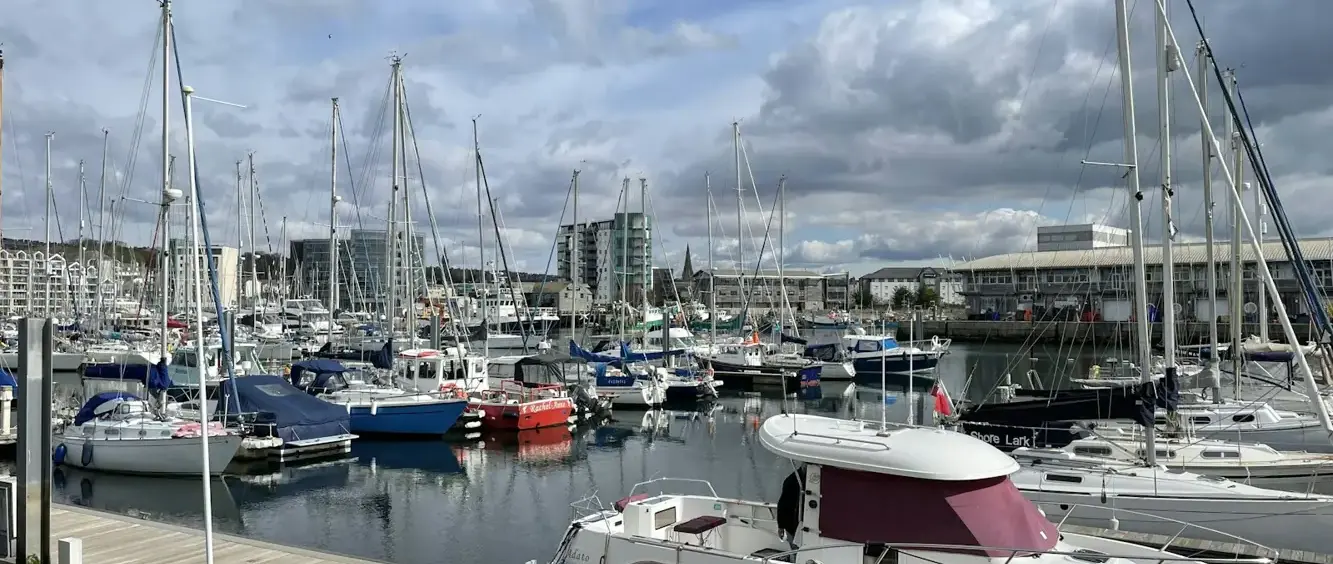
The accompanying photo shows a marina in Plymouth, England, photographed by Karen Cann and shared under the Unsplash License. It is a contextual British marina photograph, not an MDL site or an image of the certification ceremony. No claim about a specific MDL marina is made from the image.