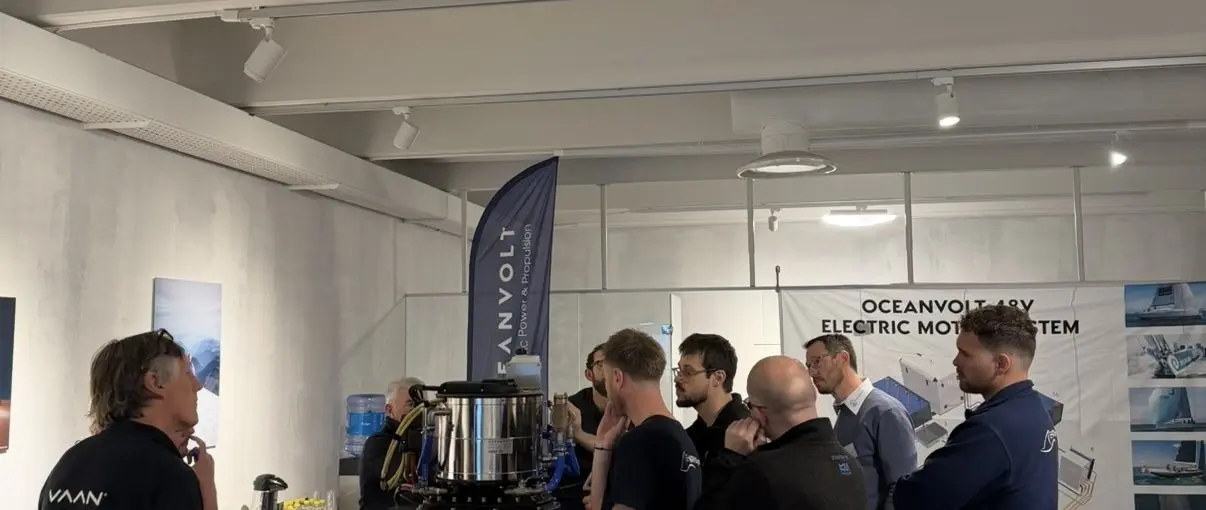
Finnish marine propulsion manufacturer Oceanvolt has reported the completion of a three-day technical and commercial training programme for its installation and boatbuilding partners. The company published its account on 18 November, following the event held from 27 to 29 October. Participants came from eleven countries, according to the manufacturer, reflecting the international distribution of its electric and hybrid marine propulsion business.
The training covered the process of specifying a propulsion system, installing the hardware, integrating power management and supporting the equipment after delivery. For the owners of luxury sailing yachts, those subjects are closely connected. The usefulness of an electric propulsion system depends not only on the equipment selected but also on the quality of the engineering work carried out around it.
Oceanvolt's latest announcement is therefore relevant to the development of services supporting electric sailing rather than a new product launch. The company has not announced a new motor, a new battery chemistry or a measured increase in sailing range as part of the programme.
Connecting the sales process to vessel engineering
The first day of the event focused on the commercial stage of specifying an installation. Oceanvolt describes introducing its partners to the tools and procedures it uses to design solutions for individual customers, as well as the product range itself.
A marine propulsion enquiry begins with a particular vessel and its proposed use. The operating requirements of a yacht used mainly for short harbour manoeuvres may be different from those of a cruising yacht expected to travel under power for extended periods. A solution suitable for one boat cannot be assumed to be suitable for another of the same length.
The technical proposal should establish the anticipated propulsion loads, the energy required during representative passages and the availability of charging. It should also consider the yacht's other electrical consumers. For a sailing yacht, the interaction between electrical propulsion and the sail-powered operating profile can be an important part of the design.
The commercial training is significant because the customer's earliest discussions may influence machinery selection and the design of the supporting systems. An unrealistic expectation of range or a misunderstanding about charging arrangements can be difficult to correct later in a project. A well-defined specification gives the owner and the installer a common basis for discussing what a system is intended to achieve.
The installation component
During the second day, participants received practical introductions to the company's hardware. Oceanvolt identifies its 6 and 15-kilowatt SailDrive systems, 10 and 15-kilowatt ServoProp systems, the ServoProp 25 and modular shaft-drive solutions in its AXC family. These figures describe published product designations and power options, not recommendations for particular vessel sizes.
The saildrive and shaft-drive approaches have different implications for yacht construction. A saildrive installation relates closely to the location of the propulsion unit and its interface with the hull. A shaft installation also requires consideration of the shaft line, supporting hardware and the positioning of the machinery.
An installer needs to assess the relevant arrangements for the actual boat before proposing a system. The requirements of a catamaran with independent propulsion in both hulls can be different from those of a monohull with a single auxiliary engine. A refit in which the existing machinery is removed also presents different constraints from a new build that has been designed around an electric system.
Practical familiarity with the manufacturer's equipment can help a yard identify questions at an earlier point in a project. It does not remove the need for qualified engineering, installation documentation or commissioning on the individual vessel.
The importance of the supporting electrical architecture
The third day of training covered power management, service, support and troubleshooting. This part of the programme addresses one of the principal differences between replacing an individual item of yacht equipment and installing a complete propulsion system.
Electric propulsion connects the motor to an energy store through power electronics and associated protective and control equipment. Charging sources, monitoring systems and the provision of energy to other electrical loads need to be considered together. In a hybrid arrangement, a generating source may also be incorporated into the system.
The components selected must operate within their documented limits and communicate appropriately. The yacht's design must also accommodate the weight and location of the equipment, the necessary service access and the relevant protective arrangements.
Owners should not interpret the availability of a particular motor as establishing the appropriate battery configuration or electrical installation. Those details must be specified by the responsible system designers and installers. Oceanvolt's announcement indicates that partners received an introduction to the suppliers and support processes associated with the company's solutions, but it does not publish a complete training syllabus or a record of individual qualifications.
This distinction is important when choosing a yard for a project. Attendance at a partner event is not in itself a certification of every subsequent installation. Owners should establish the experience of the proposed technical team, its responsibilities during commissioning and the arrangements for ongoing support.
What service provision means to a cruising owner
A sailor purchasing an electrically propelled yacht may initially concentrate on the expected experience under way: reduced machinery noise, the convenience of electrical controls and the way the propulsion arrangement complements sailing. These can be attractive aspects of an appropriately designed installation. Over the life of the yacht, however, practical support becomes equally significant.
A yacht undertaking a longer voyage may operate far from the yard that originally installed its equipment. Owners need to know which parts of the system can be supported by local service providers, what information is required to investigate faults and how manufacturer assistance can be obtained.
Good documentation is important in these circumstances. A record of the installed components, wiring arrangements, software versions and commissioning information can help an engineer understand the installation before undertaking work. The owner's documentation should also identify the operating and maintenance instructions that apply to the particular equipment.
Training a network of installation partners can contribute to that service structure, although the Oceanvolt release does not identify every participant or the geographic coverage available to every customer. The eleven-country figure establishes the international character of the event rather than a guarantee of service availability in eleven specified destinations.
New builds and the refit market
For a new-build sailing yacht, propulsion selection can influence decisions made while the boat's internal arrangements are still being developed. The energy-storage and machinery locations, access for installation and the space needed for supporting electrical equipment can be considered alongside the hull and accommodation design.
A refit is often more constrained. The owner may have existing structural arrangements, limited machinery access and a yacht designed around the weight and dimensions of a different propulsion system. The suitability of conversion depends on an engineering assessment of those circumstances.
Oceanvolt's training addressed both boatbuilding and installation partners, making the programme relevant to these different types of project. The company also provides technical resources through its website, including an overview of its propulsion solutions and a download centre for manuals and drawings. These resources can help an owner understand the range of information that a proposal should contain.
The proper comparison of different systems requires more than a quoted motor rating. Owners should consider the overall installation cost, anticipated operation, maintenance arrangements, energy-source requirements and the suitability of the chosen equipment for their vessel.
Developing an international support capability
The company's report presents the October event as an opportunity for its partners to exchange experience as well as receive instruction from its own staff. It also describes the continuing development of its commercial and technical network as interest in electric and hybrid marine propulsion grows.
For the 12-to-23.99-metre luxury sailing segment, the availability of appropriate engineering and maintenance services is a substantial part of the decision to adopt a new system. An owner may have confidence in a motor manufacturer while still needing to establish who will design, install and support the complete propulsion arrangement.
The programme reported this week addresses that relationship between manufacturer and local specialist. Its immediate significance is the development of the people and processes needed to deliver the technology, rather than a new hardware specification. Oceanvolt's November report offers a useful reminder that the progress of electric sailing depends on the capabilities of the service sector as much as it does on innovation in the equipment itself.
Sources
Official announcement and manufacturer information.
Photograph: Official original Oceanvolt company-training photograph published as the lead image with the manufacturer's 18 November editorial report. Credit retained for subject-specific news reporting; no general third-party licence claimed. Source: https://oceanvolt.com/wp-content/uploads/2026/11/IMG_5304.jpg.