A new milestone for French harbour operations
Aqua superPower and Lamanage Huchet Desmars, known as Groupe LHD, have announced what they describe as France's first fully electric mooring boat officially registered with the country's maritime authority. The partners set out the development in a release dated 16 November 2026 from Nantes. It concerns a commercial harbour-service craft, not a private luxury yacht, and should be understood in that context. Its relevance to yacht owners comes from what the project reveals about the changing infrastructure and support services used in increasingly electrified ports.
Mooring launches perform work that is often invisible to visiting owners: transferring crews, handling lines and assisting larger vessels during arrivals and departures. These are demanding services with short response windows and sometimes difficult weather. Electrification therefore creates a different challenge from replacing a recreational runabout used only for occasional outings. A harbour operator must be confident that energy storage, turnaround time and shoreside power availability match the duty cycle. The French project combines all three elements rather than presenting a battery-powered hull in isolation.
Who is involved and why those roles matter
Groupe LHD is the operator connected to the mooring vessel, while Aqua superPower is responsible for providing and managing high-power marine charging equipment. The announcement also identifies regional partners VEBRAT, OCEA and 3MO in the Pays de la Loire region. OCEA built the prototype vessel for LHD, and VEBRAT is associated with its energy-storage and propulsion work. The partners describe a coordinated regional project backed by European development funding and a separate financial contribution from the CMA-CGM C Fund.
That division of responsibilities is central to the project's commercial significance. A shipyard supplies the craft, specialists develop its propulsion and battery architecture, the harbour operator defines the working requirement, and a charging provider undertakes the infrastructure obligation. If any one element is missing, an electric fleet can become difficult to operate. Owners watching the wider port industry should pay attention to these integrated arrangements, because reliable infrastructure services generally depend on shared standards, long-term service agreements and practical engineering ownership rather than marketing claims alone.
Battery capacity and the meaning of the technical figures
The companies describe an energy-storage system of more than 300 kilowatt-hours, developed by VEBRAT and certified by Bureau Veritas. They identify a reported top speed of 12 knots and the ability to reach worksites more than 30 miles away, even where operating conditions are demanding. These are statements in the company release. They do not provide a full public sea-trial curve or demonstrate the same endurance for every combination of load, weather, current and speed. The distinction matters when comparing the design with conventional diesel harbour craft.
A battery's energy rating is not the same as usable endurance. Actual service time also depends on propulsion efficiency, hotel loads, operating reserve, temperature and battery management strategy. Long-distance transit at high speed creates different consumption from slow mooring assistance near the quay. The published figures are best treated as indicators of the system's intended operating envelope, with detailed route and duty-cycle analysis required before another port adopts a similar design. Owners evaluating electric support craft should ask for mission-specific data rather than extrapolate from headline battery capacity.
Charging is part of the vessel's design
Aqua superPower is supplying a marine fast-charging system rated at 400 kilowatts, according to the release. The Port of Nantes Saint-Nazaire has supported the initiative through electricity-grid work, including a transformer intended to power the charger. Those details are not incidental. High-power charging requires a suitable electrical connection, an appropriate marine installation, protection against the waterfront environment and an operating plan that allows a craft to recharge between tasks. Without sufficient grid capacity, even a well-designed electric boat can become operationally constrained.
The rating also should not be mistaken for a guarantee that the battery will accept 400 kilowatts continuously or that a complete charge can be achieved by dividing capacity by charger output. Charging rates can vary with state of charge, battery temperature, operating limits and shore infrastructure. A working port may also need redundancy and backup procedures if a charger is out of service. The broader lesson is the importance of designing the shore installation alongside the craft rather than treating the charging point as an accessory selected after delivery.
Where the initial operational work will take place
The project is linked to the Nantes Saint-Nazaire port system in western France. Aqua superPower's release refers to initial demonstrations at the upstream barge in Donges, followed by deployment in Nantes and potential expansion towards Montoir-de-Bretagne. Those sites represent industrial-port operations rather than an announcement of new charging berths for private yachts. The companies describe a longer-term ambition to extend such electric workboat arrangements into other French and European ports, but the release does not disclose binding orders or schedules for each future location.
Port geography strongly influences electric operating requirements. Distance between work areas, tidal conditions, availability of suitable quays and the timing of vessel arrivals all matter. A deployment that works well on one estuary may need different power, charging and logistics arrangements on another coast. Even for marinas catering to smaller yachts, the same principle applies. Shore infrastructure is most effective when planners understand how vessels actually move, where they wait and what uninterrupted service the harbour needs to maintain.
A prototype with an operating-test history
The partners say a six-month operational trial began in spring 2026. They describe the programme as an opportunity to validate performance, refine operating practices and demonstrate the practical capability of electric port services. Their November statement says OCEA is completing minor final modifications following the trials. That timeline is important: the announcement is not a claim that a completely untested prototype has suddenly entered service, nor does it by itself establish a full commercially scaled fleet operating across France.
Trials can reveal limitations that are difficult to see during design, including how equipment behaves when repeatedly exposed to salt, vibration, load changes and frequent short voyages. Crew training and fault reporting are equally significant. A sensible evaluation looks at vessel availability, charging reliability, maintenance effort, battery management and operational reserve over time. The release contains positive project findings, but independent long-term operating costs and comparable diesel-versus-electric performance data have not been provided. Those questions remain relevant to anyone considering replication.
Why small yacht harbours should still pay attention
A commercial mooring launch is not directly equivalent to a 16-metre cruising yacht, yet the transition is part of a wider harbour-service picture. Luxury yacht owners depend on waterfront infrastructure, from line handling and pilotage in larger ports to safety launches, water taxis and service craft around marinas. Reducing exhaust emissions and local noise from frequently operating support boats may improve conditions for waterfront businesses and residents. The degree of benefit depends on how much diesel operation is displaced and how electricity is produced.
There can also be indirect value for operators of premium yachts. An established marine charging network can encourage specialists, yards and port authorities to build competence in high-power electrical installations and maintenance. However, a 400-kilowatt industrial workboat charger is not automatically open for visitor-yacht charging. Access standards, connectors, billing arrangements, safety procedures and operator permissions must be confirmed separately. Owners should not interpret the French release as an offer of new shore-power services at particular marinas without checking that those services have actually been commissioned.
Regional industrial and financial context
The announcement identifies European support through ERDF REACT-EU and related programmes, alongside support from the CMA-CGM C Fund administered by Bpifrance. It states that European regional funding covered more than half of the research-and-development cost of the prototype's electric propulsion and associated energy management arrangements. These public and institutional contributions help explain why a technically ambitious harbour workboat could proceed through a prototype stage. They do not establish that private operators elsewhere will receive comparable funding or realise identical financial returns.
The economics of electrification involve the vessel, energy storage, charger, grid connection, maintenance contracts and the operating opportunity cost of charging downtime. Energy prices are only one part of that calculation. Capital expenditure can be front-loaded, while potential savings from reduced fuel use or maintenance must be demonstrated against the real operating pattern. Ports considering comparable projects should work from service data and transparent assumptions. Headline support funding should not be presented as a stand-in for a commercial business case in another location.
Operational safety and crew training
Electric propulsion changes the hazards that crew and service technicians must manage. High-voltage circuits, energy isolation, firefighting arrangements, marine ingress protection and emergency recovery procedures need dedicated consideration. The presence of a certified battery system is relevant, but certification of one component is not the same as certification of every vessel installation or an assurance of risk-free operation. The release says Bureau Veritas certified the energy-storage package; other approvals should be confirmed from the project partners where operational or procurement decisions depend on them.
Crews should understand charging procedures, emergency stop facilities, unexpected power loss and any limits on rescue operations. Waterfront personnel also need access arrangements that keep untrained people away from active high-power connections. These are general marine engineering priorities, not allegations of deficiencies in this project. The point is that the success of an electrified harbour fleet relies as much on repeatable safe operating procedures as it does on motor and battery specifications. A reliable workflow has to be suitable for duty at inconvenient hours and in difficult conditions.
Environmental claims require an appropriate boundary
The partners describe the boat as a step towards zero-emission port services. In operational terms, fully electric propulsion can avoid combustion exhaust at the vessel during use. That is distinct from saying the complete lifecycle is carbon-free. Electricity generation, battery production, replacement cycles and disposal arrangements all contribute to a wider environmental assessment. The benefit of lower local noise and direct exhaust can nevertheless matter to people working and living close to frequently used harbour facilities.
Comparisons with conventional craft should use a representative mission, not an idealised short run. The amount of energy required per hour of mooring work, the impact of waiting at berth and the requirement to maintain standby capability will affect the result. Diesel craft and electric craft may have different energy and maintenance profiles. Investors and port customers should look for published measured operating data as services mature. A credible environmental transition is best supported by transparent accounting and repeatable evidence, rather than sweeping claims based only on the powertrain.
What happens beyond the initial port project
Aqua superPower and Groupe LHD have expressed interest in scaling the approach to other French and European ports. Future expansion would likely depend on operational results, access to suitable quay space, charging investment and the needs of the local operator. It would be premature to state that a nationwide system is in place or that new private-yacht facilities have opened as a consequence of this project. At present, the confirmed news is the registered French electric mooring craft, its stated technical arrangement and the charging partnership announced in November.
For yacht owners and marina operators, the more useful long-term indicator will be whether port-service electrification becomes normal infrastructure rather than a demonstration. Reliability, quiet operation, predictable costs, rescue arrangements and charging availability will determine acceptance. The French project supplies a concrete example of an integrated vessel-and-port system for a demanding commercial task. Its potential influence on 12–23.99-metre yacht operations will be indirect, but significant if the technologies and support networks become more widely available.
Sources, scope and photography
The core facts in this report come from Aqua superPower's first-party press release dated 16 November 2026, which identifies the industrial partners, technical claims, regional funding and initial deployment plans. It is a company announcement, not a separately audited trial report. In particular, the stated battery capacity, worksite range, charging rating and planned expansion are attributed to the partners and should be verified again for any purchasing, infrastructure or operational decision.
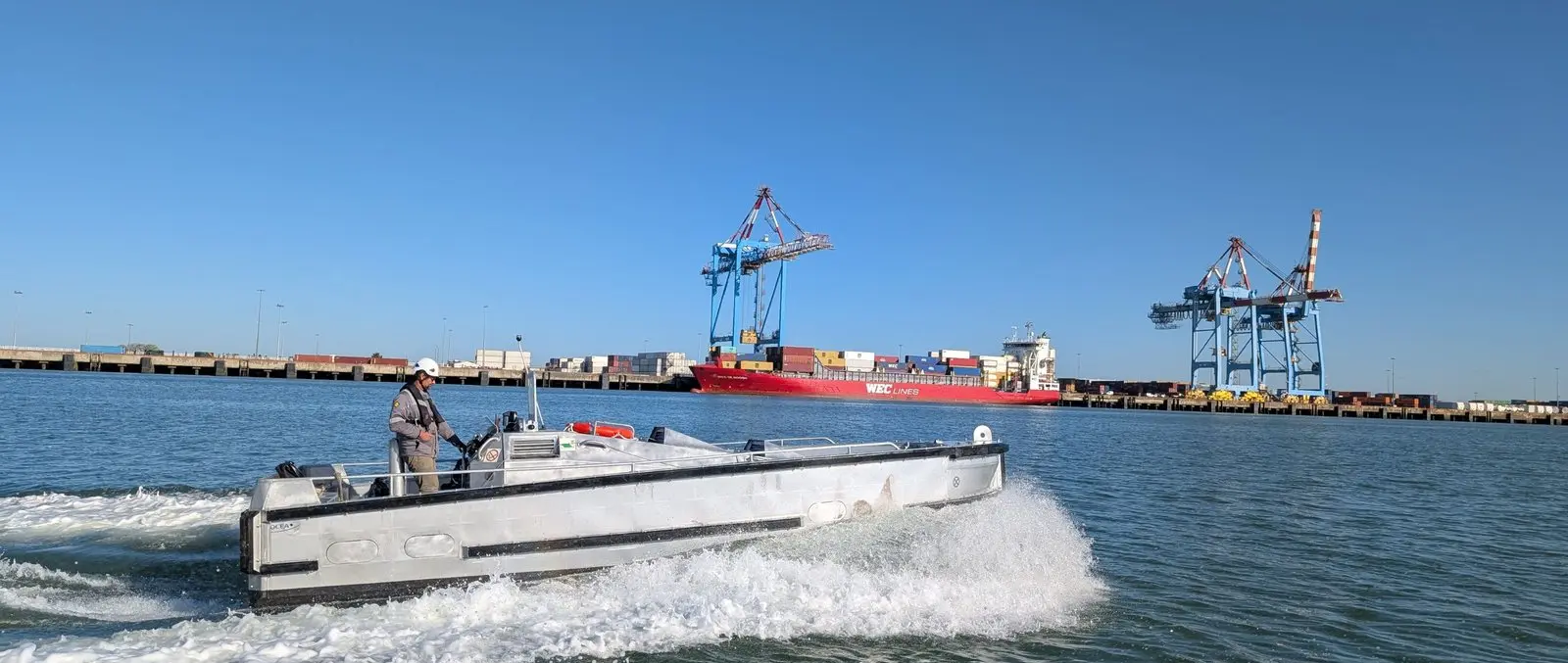
The photograph accompanying this report is supplied by Aqua superPower on the same official announcement page. It shows the subject of the project rather than unrelated waterfront stock. Editorial analysis of charging economics, environmental boundaries, crew procedures and potential implications for luxury-yacht berthing is distinct from the company's reported claims. No new visitor-yacht charging entitlement or private marina opening is asserted on the basis of this announcement.
Image credit: Aqua superPower first-party press photograph accompanying its announcement dated 16 November 2026. Official image source: https://cdn.prod.website-files.com/6666b34ff872e2e1c56b9dcf/6afac7a71a50bfc23d940d6d_PXL_20260922_083205327.MP.jpg