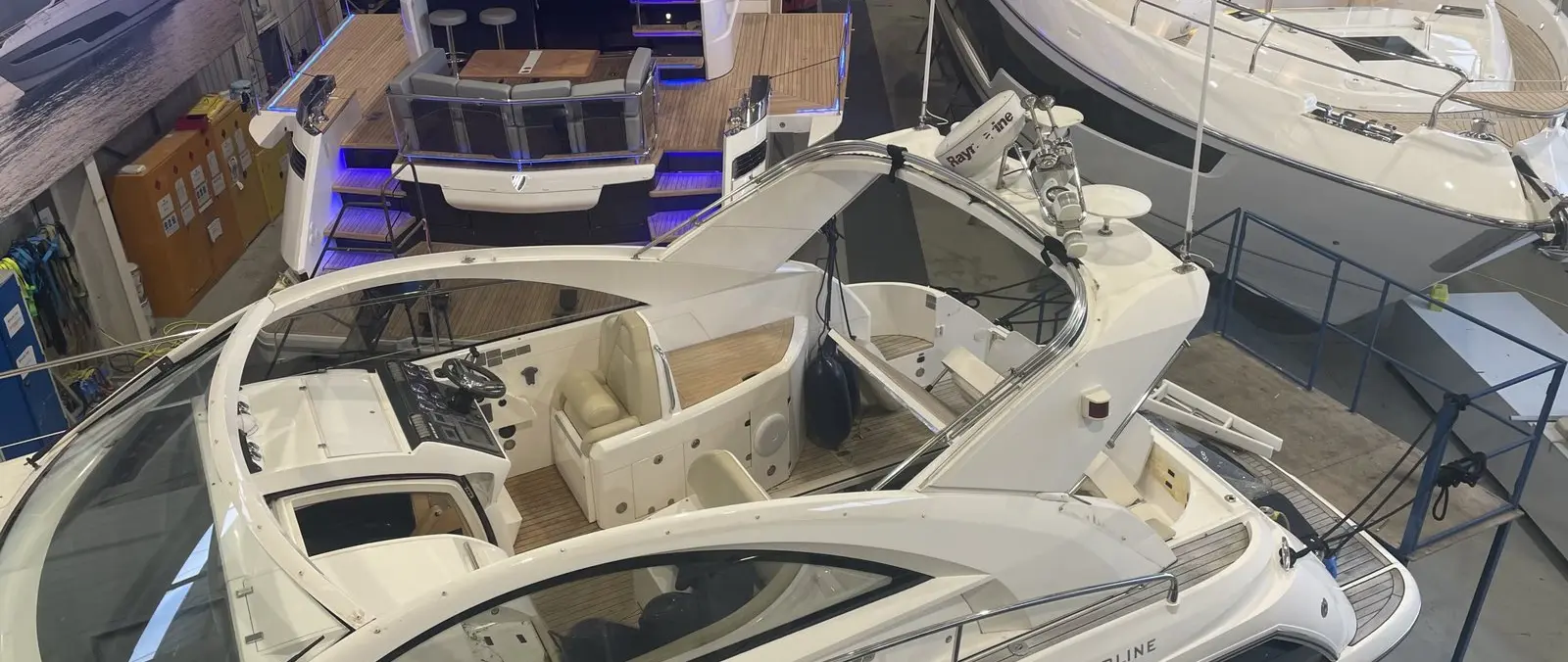
A manufacturer takes a broader role in the refit market
Fairline's Signature Refit service gives the British motor yacht builder a more formal role in work that owners commonly commission from independent yards. The manufacturer describes a managed programme extending from interior refreshes and mechanical upgrades to major restorations. The notable commercial detail is that the service is not restricted to yachts carrying the Fairline name. Owners of other premium motor yachts are invited to discuss projects with the same specialist team. That opens a potentially different route for buyers who want a centrally managed refurbishment rather than separate arrangements with several contractors.
The announcement matters in the 12–23.99-metre segment because these yachts can remain in private ownership for many years while their interiors, navigation systems and machinery requirements change substantially. A carefully scoped refit can sometimes be more suitable than replacing a well-known boat. But no project should be assumed straightforward simply because it falls within a familiar model range. Hull construction, access, existing electrical systems, structural condition and documentary history all influence what is feasible and what the final cost will be.
What the Signature Refit programme actually covers
Fairline identifies bespoke upholstery, joinery, finishing and interior adjustments among the principal areas of work. It also lists engineering and mechanical modernisation, navigation and entertainment systems, external restoration, and more comprehensive refurbishment. That breadth could allow a single project to address several owner complaints at once: tired finishes, inadequate electrical capacity, obsolete electronics or an uncomfortable motion profile. A manufacturer-led scheme does not mean each requested modification is automatically compatible. The yard must assess the individual vessel and determine which work should be approved or redesigned.
For owners, the practical benefit of the service model is not a promise of a particular outcome; it is the possibility of having one responsible project manager coordinate technical survey, design choices, procurement, installation, inspection and handover. On a midsize motor yacht, apparently independent changes often interact. A new generator can alter ventilation and electrical distribution, interior joinery can affect access to tanks, and a stabilisation retrofit may require structural and control-system work. Keeping these dependencies visible before dismantling starts is a central part of effective refit management.
A refit service that welcomes other yacht brands
The decision to offer the programme to owners outside the Fairline fleet is particularly interesting. A builder naturally holds the best factory information for its own designs, but its engineering and joinery capabilities may also be relevant to vessels from other yards. Fairline explicitly presents cross-brand eligibility as part of Signature Refit. This widens the group of potential clients, although the exact access and feasibility will depend on the construction and technical documentation of each boat. Factory-level competence is useful, but it is not a substitute for obtaining the other builder's drawings when needed.
Owners considering that route should ask which responsibilities the refit provider will accept for a yacht of another make. For example, who signs off proposed structural penetrations, checks electrical load calculations, approves replacement glazing or verifies new equipment clearances? There may also be warranty and insurance questions involving the original builder. A clear statement of accountability will be more valuable than a general promise of craftsmanship. The formal service announcement is a starting point for evaluating a contractor, not proof of suitability for every brand or model.
Where the work may be carried out
Fairline says work is normally undertaken at a dedicated facility on the Suffolk coast near the company's commissioning centre. Its published service outline also describes the possibility of work at an owner's berth or marina, including locations in the United Kingdom, mainland Europe and further abroad when appropriate. Those options could make a material difference to an owner who spends the summer in the Mediterranean or keeps a yacht away from its home market. However, location decisions are necessarily project-specific and cannot be inferred from a broad service-area statement.
Transporting a yacht to a dedicated yard can provide better access to lifting gear, controlled workshop conditions and a coordinated supply chain. A home-berth intervention can reduce relocation demands for smaller jobs but may face port restrictions, weather delays, utility limitations and security or insurance conditions. Heavy machinery work, painting and major structural changes generally require more detailed site planning. The sensible sequence is to establish what work is needed first and only then decide where it can be undertaken safely, economically and to the required standard.
Interior renewal without losing a yacht's character
A well-executed interior refit aims to improve how spaces are used without fighting the underlying architecture of the boat. Fairline mentions upholstery, custom joinery and new finishing materials as available services. In the 12–23.99-metre bracket, the most effective changes often concern practical details: comfortable seating dimensions, resilient materials, better cabin lighting, storage accessibility and the ergonomics of the galley and helm. Such improvements should be planned around actual ventilation, maintenance and weight limits, rather than merely copying a contemporary showroom appearance.
Materials should be selected for marine use and reviewed for fire characteristics, cleaning requirements and durability. Owners may want a more modern palette, but a refit is also a chance to improve access to pumps, wiring and isolation valves behind the furnishings. Any addition of large stone surfaces, extensive glazing or heavy custom cabinetry deserves a weight and balance review. A yacht's original handling characteristics matter. Fairline's stated approach of retaining a vessel's original design character while introducing updated finishes points towards a measured rather than indiscriminate transformation.
Stabilisation options deserve individual engineering
Signature Refit specifically mentions gyroscopic stabilisers, underway ride-control systems and combinations of the two as possible comfort upgrades. Those systems operate in different ways and can impose different structural, electrical and cooling demands. A gyroscope is not a generic accessory that can be placed wherever a locker happens to be empty. The builder or specialist needs to consider mounting foundations, service access, emergency procedures and the effect of added mass. Underway control systems must also be matched to the vessel's hull, speed profile and existing automation.
The owner's cruising pattern should shape the specification. A yacht spending many nights at anchor may have different priorities from one making long high-speed coastal passages. Even a technically compatible system requires realistic expectations about sea state and motion reduction. Fairline's promotional material identifies solutions that may be available through its service; it does not establish a guaranteed percentage improvement aboard any particular vessel. Independent sea-trial assessment and a clear commissioning acceptance test are sensible parts of an agreement where stabilisation is a major reason for the refit.
Machinery, navigation and electrical upgrades
Mechanical refurbishment and technology integration are among the manufacturer's advertised areas of expertise. These are often the investments that most materially change long-term dependability, even when they are less visible than a new interior. A renewal programme might involve cooling systems, machinery controls, battery architecture, navigation displays, communications or entertainment equipment. Every proposal should distinguish a replacement made because the existing equipment is failing from an optional convenience upgrade. Combining the two can save access costs, but only if the overall engineering plan remains coherent.
Electrical capacity is a common constraint. Additional appliances, larger displays, stabilisers and hotel loads may exceed the original design assumptions. A yard needs to account for alternator and shore-power limits, battery charging, cable protection, circuit separation and available installation volume. Owners should ask how old wiring and third-party systems will be documented after the work. The most expensive future failures can arise from poorly recorded modifications. A properly updated schematic and component schedule are as important to subsequent technicians as the visible result at handover.
How projects are scoped and quoted
Fairline sets out a staged process beginning with an owner consultation, followed by a defined scope, specification and budget. Its published terms say that, once scope and budget are agreed, a 50 percent deposit starts detailed planning and procurement of specialist components. Owners should treat this as the manufacturer's stated general process, not as a universal payment schedule for every individual contract. The actual agreement should specify milestones, deliverables, variation procedures and what happens if unforeseen defects are found once equipment and lining materials have been removed.
Before signing, a useful survey should identify the yacht's present condition, critical access routes, machinery history and any applicable class or flag obligations. The owner and contractor can then classify each requested job as essential, desirable or optional. It is helpful to separate fixed-price elements from work that remains subject to opening-up inspections. A contingency is usually prudent, particularly on older hulls. This planning may feel less glamorous than selecting new materials, yet it often determines whether the final refit experience is predictable or contentious.
Insurance repairs form another part of the offer
The manufacturer also advertises specialist support for accidental-damage insurance repairs. Its outline includes an on-site assessment, detailed repair specifications, cost estimates and cooperation with surveyors, underwriters, insurers and loss adjusters. This could interest owners facing repairs that require original-quality finishing or structural knowledge. There is a clear distinction, however, between a yard offering repair services and an insurer agreeing to pay a particular claim. Coverage, excesses, exclusions and the approval process remain governed by the policy and the relevant claims assessment.
When damage occurs, photographs, survey observations and a precise chronology should be preserved before work changes the evidence. Temporary measures may be needed to protect the yacht, but the scope of permanent repair should be agreed with the appropriate parties. Owners should request records of materials and methods, final inspection findings and warranty provisions. In more complex cases, an independent surveyor may provide helpful oversight even when a respected manufacturer performs the repairs. Good documentation also matters if the yacht is later offered for sale.
Handover, warranty and ongoing accountability
Fairline says it provides final checks and, where appropriate, a familiarisation sea trial before completing the handover. The company also describes a one-year warranty on refurbishments and upgrades, subject to applicable manufacturer terms. That qualification should be read carefully: individual third-party equipment can carry different conditions, and coverage depends on what was actually contracted. Owners need to know which components are covered, the route for reporting a defect and who can provide support when the yacht is cruising outside the United Kingdom.
A proper handover should go beyond presenting an immaculate finished saloon. It should include revised wiring and plumbing diagrams, equipment manuals, commissioning results, maintenance instructions, spare-parts information and an explanation of any changes to operating procedures. Crew or regular skippers should be familiarised with the updated systems. If new electronic controls or power-management functions have been installed, the operator needs to understand both the normal workflow and the fallback procedure. The strongest outcome is a yacht that remains easy to operate and maintain years after its cosmetic improvements have been admired.
Resale, survey and asset value considerations
An extensive refit is sometimes justified partly by the owner's hope of improving resale appeal. Updated finishes, dependable machinery and documented upgrades can make a vessel more attractive, but it would be misleading to promise that refurbishment expenditure is recovered in the sale price. Buyers evaluate age, brand, hull condition, engine hours, maintenance history, equipment specification and market supply. A bespoke interior chosen to one owner's taste may be less compelling to another buyer than a well-maintained, relatively neutral layout.
Before commissioning expensive discretionary work, an owner can ask an experienced broker and independent surveyor which deficiencies matter most to prospective purchasers of the yacht's type. There may be a strong case for correcting technical faults and preserving factory documentation before selecting premium decoration. A complete refit history should record changes with photographs, invoices, certificates and as-built drawings. Such evidence gives the next owner confidence and reduces the need to investigate undocumented work. It does not remove the need for a fresh independent survey when ownership changes.
What the November 2026 report establishes
Contemporary marine-sector reporting in November describes the rollout of Fairline Signature Refit, while the builder's own service webpage supplies the primary details of its scope, facilities, owner process and warranty outline. The material does not provide a published price list, universal delivery schedule or proof that every proposed system can be fitted to every yacht. Those omissions matter: a service announcement should not be turned into an unsupported promise about cost, performance or turnaround.
For owners of premium 12–23.99-metre motor yachts, this is nonetheless a meaningful development in aftersales options. It puts manufacturer-led project management, refurbishment, upgrades and insurance work under a recognisable programme, and expressly invites clients from other brands. Its value will be measured in the quality of technical scoping, the standard of engineering, the clarity of the contract and the way support is delivered after handover. Source: Fairline Yachts official Signature Refit service description; contemporaneous 17 November 2026 industry coverage. Photograph: official Fairline Yachts Signature Refit media.
Image credit: Official Fairline Yachts manufacturer image on its Signature Refit service page; first-party editorial product/service publicity. Official image source: https://media.fairline.com/2026/11/11090734/IMG_0985-scaled.avif