Why a spare part is not simply a catalogue number
Jeanneau has published new guidance for owners seeking replacement equipment for its sailing and motor yachts, explaining why identifying the exact hull is often more important than knowing a model name and year. The French builder's 17 November 2026 article describes a dealer-only reference system called Sp@rep@rts, which uses factory technical records, exploded diagrams and a yacht's Hull Identification Number to find the correct component. This is a practical subject for anyone maintaining a 12-to-23.99-metre yacht: a steering fitting, interior panel or piece of deck hardware may appear identical across several vessels but differ according to construction date, factory options or market specification. The announcement is not a new spare-parts product launch. It is a detailed explanation of a support process that already exists, and of the care owners should take before ordering components that affect safety, fit and long-term reliability. Jeanneau's description also demonstrates why manufacturer knowledge remains valuable well beyond the day a boat is delivered.
The hull identification number starts the search
The builder advises owners to have the Hull Identification Number, or HIN, ready before contacting a dealer. Jeanneau explains that this identifier normally appears on the hull near the starboard side of the aft transom and allows the dealer to trace the exact vessel to the relevant technical record. A year of construction is useful background but may not capture changes introduced partway through a production run. Two yachts leaving the same yard in the same year may have different arrangements because equipment was revised, an optional system was specified or an installation changed for a particular market. The owner should photograph the number clearly and check any ambiguous characters rather than risk a parts search based on incorrect information. In a survey, purchase file or maintenance register, preserving this identifier alongside model and engine details makes later requests easier. It is a small administrative discipline with practical engineering consequences.
A replacement can look right and still be wrong
Jeanneau warns that a new reference may be compatible with an original part, technically equivalent or suitable only after an adaptation has been made. This is an important distinction. Marine fittings are often designed to fit precisely into an existing arrangement of mountings, wiring, hoses, clearances and structural supports. A component with the correct shape may still differ in its materials, operating limits or electrical connection. Even a decorative fitting can create problems if its finish, fixing pattern or thickness differs from the original. The yard's technical data is therefore the reference point, not a photograph from an unrelated online catalogue. For safety-related systems such as steering, gas supply or propulsion auxiliaries, the consequences of an inappropriate substitution can be far greater than a cosmetic mismatch. Owners should ask the dealer and installer to explain any proposed alternative and the evidence supporting its compatibility before approving a repair.
More than 80,000 parts across over 280 models
The maker says Sp@rep@rts contains more than 80,000 spare-parts references covering over 280 Jeanneau models. Dealers can consult function-specific catalogues and exploded views, with subjects that include steering, running rigging, plumbing and ballast-related equipment. This scale reflects the breadth of equipment fitted to yachts over many years. It also illustrates why a generic internet search is an unreliable substitute for a structured technical record. The existence of many references is not itself a promise that every historic component remains in stock. A record may help identify what was originally installed and whether a modern replacement is available; availability and delivery are separate enquiries. The dealer is expected to interpret the manufacturer's technical information and communicate the price and anticipated lead time. Owners benefit by treating part identification, sourcing and installation as three connected but distinct steps.
Options make two apparently similar boats different
A model may have been offered with different winches, furling arrangements, engines, electronics, interior layouts and other factory options. Jeanneau says its reference system can take those choices into account, including details associated with different markets. An example given by the builder is gas-system equipment supplied for boats sold in the United States. Owners buying a second-hand yacht should not assume the specification matches another example featured in a broker's advertisement or a model brochure. The practical service record should identify the equipment actually installed, whether original or modified later. A surveyor inspecting an older boat may need to trace both its factory configuration and subsequent refit changes. Sp@rep@rts provides a strong starting point through construction records, but it cannot alone prove that a previous owner has not altered an assembly. Physical inspection still matters whenever the yacht's history is uncertain.
Exploded drawings explain more than a product photograph
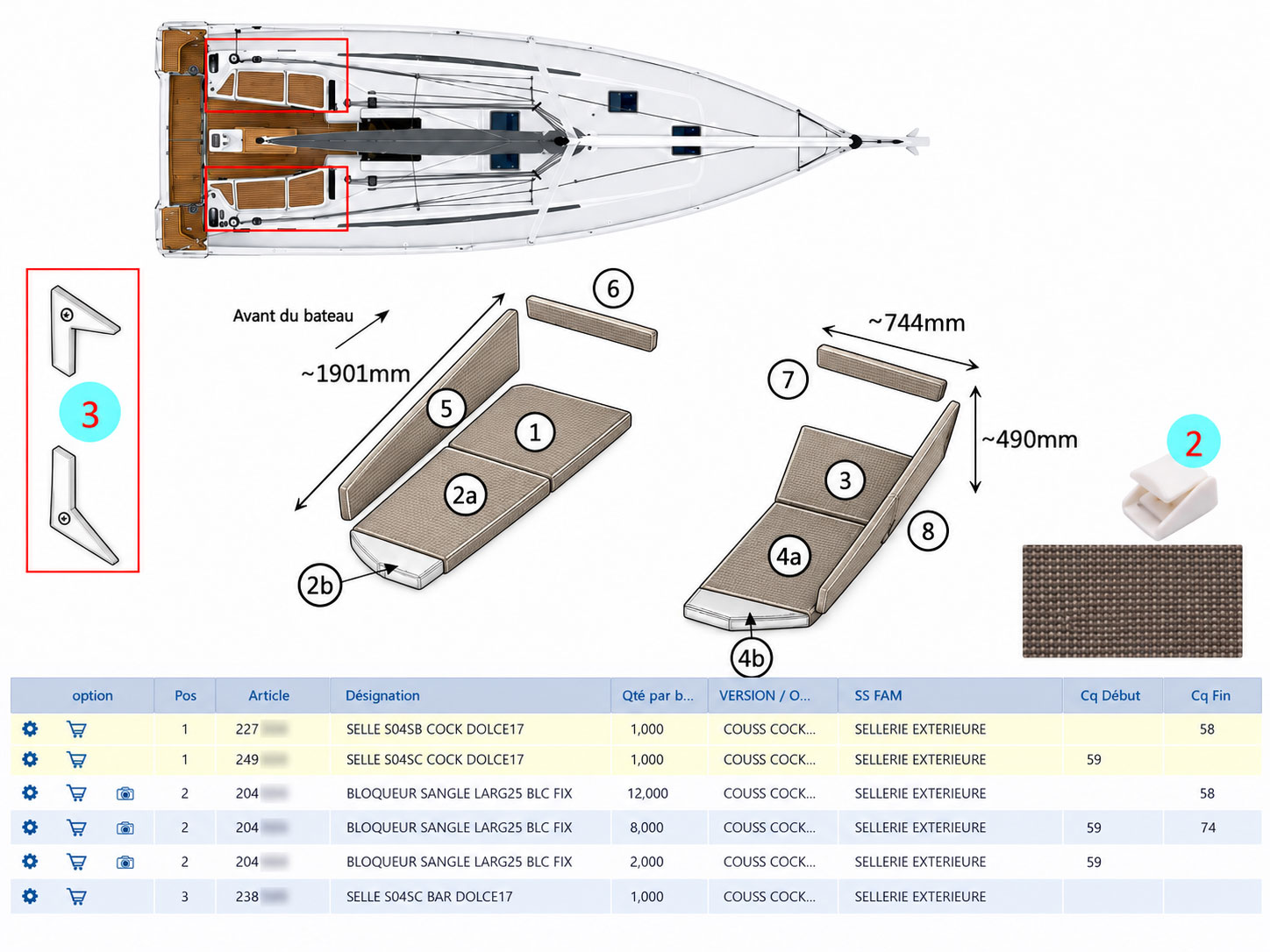
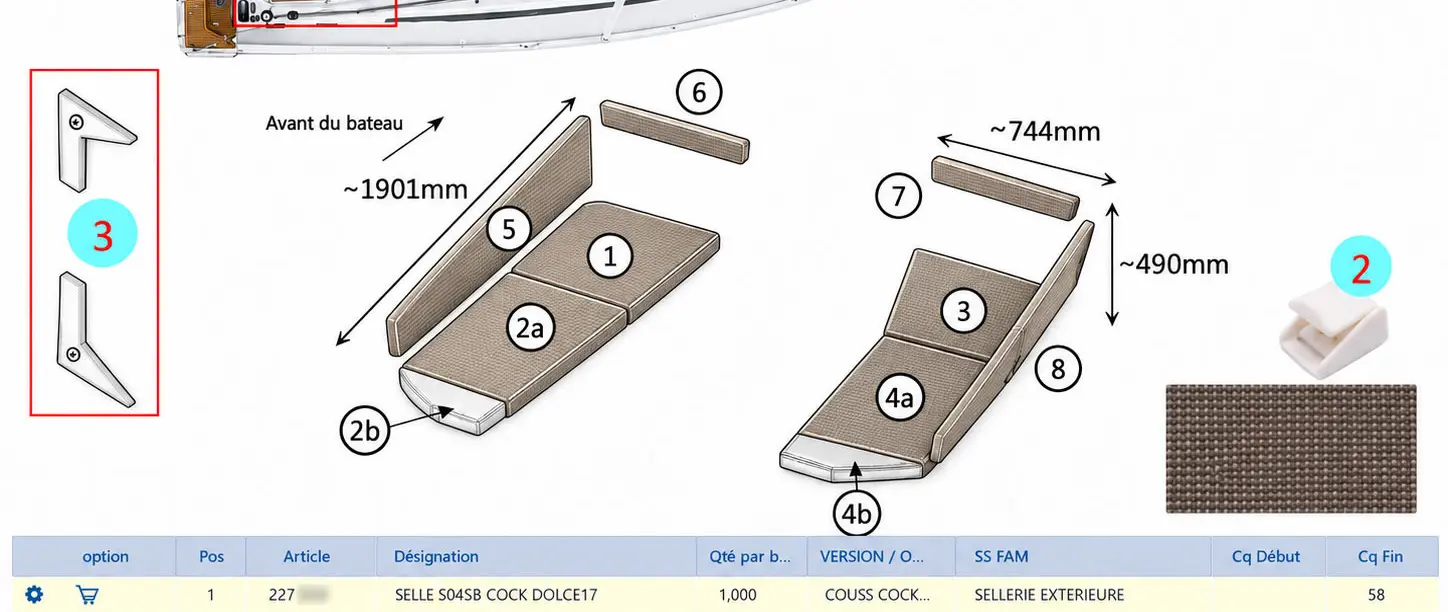
One of the most useful parts of the system is the availability of exploded views and technical illustrations prepared from the shipyard's design information. These drawings show how separate components relate to one another within an assembly. A mechanic or technician can use them to identify a missing clip, fastener, seal or fitting that would be difficult to describe by name. Jeanneau's official article illustrates this approach with parts diagrams and system screens from the dealer platform. The drawings also help clarify which pieces are supplied together and which are individual references. They should not be mistaken for permission to dismantle a safety-critical system without suitable expertise. A good diagram assists communication between owner, dealer and professional installer; it does not replace service instructions, correct tools or the manufacturer's approved method for the actual work.
The dealer network remains the owner's route
Jeanneau states that owners do not order the relevant factory parts directly from the yard through this system. Instead, their dealership is the principal contact. The dealer uses the vessel information to search Sp@rep@rts, may request photographs or an inspection, and can seek additional assistance from specialists for complex questions. This arrangement has advantages when a component requires interpretation rather than a simple match. It also means owners should supply a clear description of the fault, the part's location and any history of previous repair. If a boat is travelling, early coordination with a local or remote dealer can determine whether the component can be ordered to a convenient marina. The manufacturer does not promise instant availability everywhere; owners should ask for realistic lead times and shipping arrangements, particularly when an installation would leave the yacht unable to move safely until the replacement arrives.
Older boats still have a documentary trail
Jeanneau says records in its technical archives can extend back to 1985 and that a discontinued model may still be represented in the system. This is valuable for long-term ownership because a yacht can remain actively used well beyond the commercial life of a production model. The builder cites a request concerning a Sun Odyssey 37 more than twenty years old that was immobilised overseas following the loss of a rudder. According to the official account, the spare-parts team and dealer network used the archived information to identify and send a suitable solution. That example demonstrates the potential of a maintained historical record, not a guarantee that all old parts can be reproduced. Availability still depends on the original reference, the supplier and the possibility of a compatible replacement. Owners planning extended voyages in older vessels may want to establish which essential parts are difficult to obtain before departure.
The numbers behind a global service operation
Jeanneau describes a specialist support team of 50 people serving its dealer network and says more than 40,000 packages are sent to dealerships and service centres each year. Those figures should be understood as manufacturer-reported operating information, not independently audited service-performance statistics. They nevertheless indicate that parts support is an organised logistical activity rather than an informal favour to individual owners. For a yacht in a distant cruising destination, logistics can become the controlling element of a repair. A correct part identified immediately may still be delayed by international shipping, local customs or the availability of an installer. Experienced owners maintain accurate contact details for their home dealer and know how to provide photographs, a clear description and the yacht identifier without several rounds of correspondence. The aim is not to eliminate every delay but to reduce avoidable confusion.
Common components and configuration-specific searches
The factory says dealers have two complementary ways to find parts. A configuration-specific search uses the hull number and associated exploded views; a more general catalogue groups commonly used parts by technical characteristics. This distinction is worth noting because not every item aboard a yacht was manufactured solely for one model. Pumps, fittings and electrical accessories may be used across multiple ranges, while a moulded interior panel or a particular deck arrangement could be much more vessel-specific. A proper search begins by determining which category applies. Owners should resist buying a widely available component solely because it seems interchangeable with the original. Its exact materials, operating limits and connection details must still be checked. Conversely, a custom-looking item may have a documented common reference that a dealer can obtain more readily than an owner expects.
Planning a repair before the voyage is interrupted
The most effective response to parts problems is often preparation. Yacht operators can maintain a record of essential systems, serial numbers, previous replacements and supporting photographs in a secure vessel-maintenance file. Routine inspection may identify worn seals, corroded fittings or weakening hardware while there is still time to arrange delivery. The boat's HIN and any relevant machinery serial number should be included when asking the dealer for help. The crew should also identify which repairs can safely be completed afloat and which require specialist shore facilities or a lift-out. A replacement rudder component, electrical unit or rigging item may need more than the right parcel to complete the job. Clear documentation allows a marina, technician and owner to coordinate work without making risky assumptions. This is the practical value of the manufacturing records described by Jeanneau.
Original references, warranty and the limitations of substitution
Jeanneau recommends original parts or manufacturer-approved replacement solutions where available. That advice should not be reduced to a claim that every non-original component is necessarily unsafe. In some cases an equivalent product can be appropriate, but the relevant dimensions, material, certification and functional compatibility need to be demonstrated. The correct decision may also depend on warranty requirements, insurance conditions and the classification or flag rules relevant to the vessel. The dealer and installer should record why a substitute has been selected and which authority approved it if formal approval is required. After installation, commissioning and functional testing need to be documented just as carefully as the purchase. Keeping the vessel's maintenance history complete adds value when responsibility changes from one captain, technician or owner to another. Spare parts are part of yacht lifecycle management, not merely a purchasing task.
What the November guidance means for the market
The central message of Jeanneau's new explanatory article is that accurate identification and historical records are essential to responsible service. More than 80,000 references and over 280 model records offer a concrete view of the scale involved, while the manufacturer's explanation of hull-level variations makes clear why a generic model-year search can be insufficient. The practical takeaway for owners is to prepare the HIN, describe the problem accurately, photograph the relevant equipment and consult the appropriate dealer before ordering. For brokers, surveyors and fleet managers, the announcement reinforces the value of complete specifications and disciplined maintenance records. Modern luxury-yacht ownership depends as much on the availability of correct technical information as it does on the appearance and performance of a newly delivered vessel. Keeping that information accessible may help an older boat remain enjoyable, maintainable and ready for the voyages its owners still intend to make.
Sources and image credits
Reporting based on Jeanneau original 17 November 2026 factory spare parts owner guidance.
Lead rendering: Jeanneau Explains How Hull Numbers Help Owners Find Correct Yacht Spare Parts — manufacturer source photograph. © Jeanneau Original official image source.