The French sailing-catamaran builder Fountaine Pajot is marking fifty years in business with an unusually broad renewal of its cruising range and a renewed emphasis on the practical experience of living aboard. A manufacturer history released during the 2026 anniversary year connects the company’s origins in Charente-Maritime with the current FP41, FP44, FP48, FP51 and FP55. The story is significant for the 12-to-24-metre luxury-yacht market because it brings several established owner requirements together: seaworthy sailing performance, usable indoor and outdoor space, efficient energy systems, and the industrial capacity to build and support a substantial global fleet. This is an anniversary and range-development story, not a claim that every model was launched on the same day.
From a sailing ambition to an international builder
Fountaine Pajot traces its beginnings to 1976, when Jean-François Fountaine, Yves Pajot, Daniel Givon and Rémi Tristan combined their sailing interests and engineering skills, later joined by Pierre Fountaine. The company describes a close relationship with competitive sailing in its formative years. Its subsequent development illustrates how ideas created for performance can influence a boat designed for comfortable passage-making. That does not mean that cruising catamarans are racing craft in disguise. The balance between loads, accommodations and operating requirements is quite different, especially when a yacht is intended for family voyages rather than short competitive events. The relevant achievement is the gradual translation of technical knowledge into accessible boats.
The Louisiane 37 as an early landmark
In the official company history, the Louisiane 37 introduced in 1983 is highlighted as an important step towards production cruising catamarans that were intended for living aboard. Its significance lies in recognizing that a multihull could provide more than outright sailing speed or stability. Owners needed places to cook, sleep, relax and store provisions without sacrificing the qualities that made sailing attractive. The Louisiane belongs to an earlier technological period, so a contemporary buyer should not use it as a direct basis for comparing present-day construction methods or safety equipment. It is better understood as a milestone in the development of a design philosophy.
Five model names in the 2026 renewal
The anniversary announcement identifies the FP41, FP44, FP48, FP51 and FP55 as central to a new generation of sailing catamarans. These names signal different positions within the cruising market, with varying room arrangements and operating demands. The manufacturer’s current programme places emphasis on natural light, interior and exterior continuity, and the capacity to remain comfortable over longer periods aboard. Such themes are common in yacht marketing, but they have real practical consequences. A family that cruises with children, an owner planning longer passages and a buyer intending professional crew arrangements may each assess those features differently.
The smaller models and accessible luxury
The FP41 and FP44 sit at the more compact end of the renewed group, where efficient use of every metre becomes particularly important. Smaller sailing catamarans are often expected to combine manageable sail handling with generous accommodation relative to their length. Their appeal can depend on cockpit access, galley arrangements, visibility from the helm and how readily a couple can work the boat without outside assistance. A broad announcement does not establish that every owner will be comfortable sailing without crew. The correct assessment requires model-specific specifications, training and a thorough understanding of the boat’s planned operating area.
The FP48 and the middle of the range
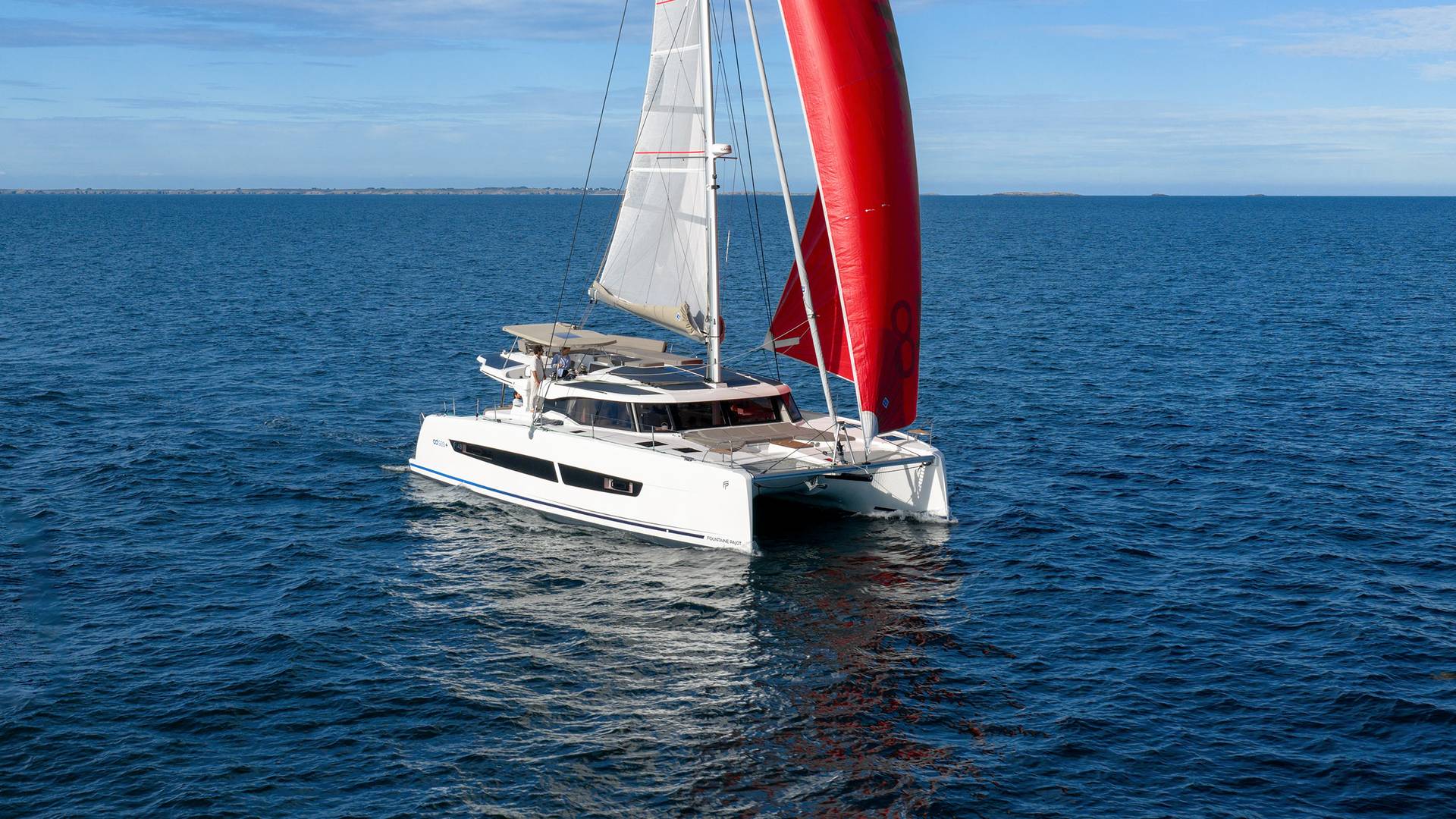
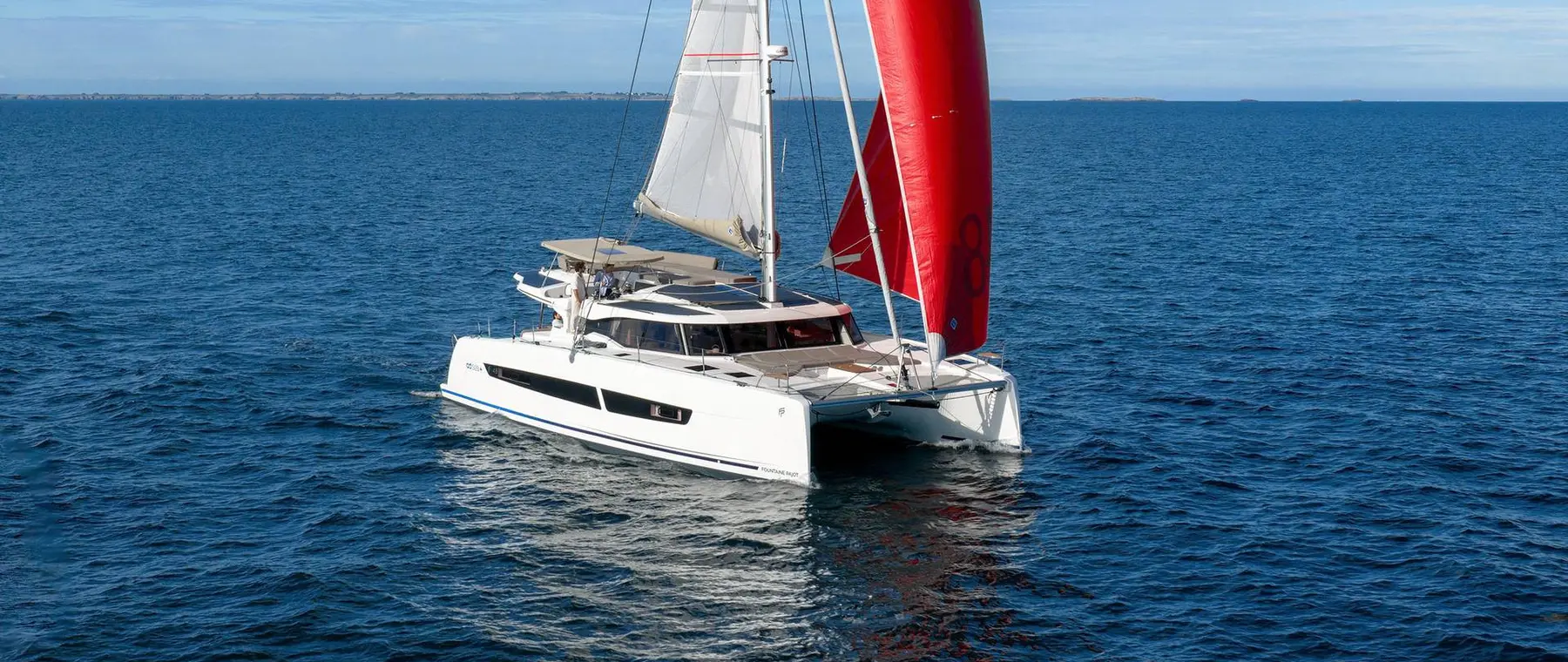
The FP48 provides a useful example of the builder’s present design language and is represented in the official anniversary feature by a photograph of the catamaran under sail. At this size, a yacht can offer substantial social areas without entering the operating and berthing conditions of a much larger vessel. Yet increased beam and volume come with their own constraints. Buyers need to consider marina availability, handling in crosswinds, anchoring requirements and service access as well as interior space. A genuine evaluation looks beyond the flattering exterior view towards the detail of deck circulation and systems maintenance.
FP51 and FP55 for extended life aboard
The larger FP51 and FP55 models broaden the range for owners who intend to spend more time aboard or entertain larger groups. Fountaine Pajot positions the FP55 as part of the new generation of flybridge sailing catamarans. With additional space, the decisions about guest accommodation, crew circulation and equipment become more complex. Owners may value a dedicated place to work, greater separation between guest and technical spaces, and more extensive storage. These are considerations rather than guarantees of a particular arrangement. The final configuration and the suitability of the yacht for long-range voyages depend on the exact version, its loading and how it is operated.
More than sixty models over five decades
Fountaine Pajot says it has developed more than sixty catamaran models since the company’s establishment. This figure demonstrates the breadth of design activity, although it should not be confused with the number of boats produced or currently in service. Each generation reflects changing owner expectations, technology and regulations. Earlier models may offer lessons in simplicity, while modern boats benefit from substantial advances in equipment, digital systems and accommodations. A manufacturer’s history can help buyers understand the direction of a design language, but it is not a substitute for independent surveys of any particular yacht.
Nearly five thousand catamarans sailing worldwide
The manufacturer estimates that nearly 5,000 Fountaine Pajot catamarans are sailing around the world. The size of an installed fleet matters because it creates a community of users, technicians, brokers and owners who have practical experience with the brand. It may also support market recognition and the availability of service knowledge. Fleet size is not, however, a guarantee that every replacement component can be obtained quickly in every cruising destination. Owners should still investigate local support, delivery times and specialist service capability. The company figure is a general fleet statement rather than a current registration census.
French production and regional expertise
The builder maintains strong links with the Charente-Maritime region, identifying its historic Aigrefeuille-d’Aunis facility and complementary operations at La Rochelle and Le Thou. These locations provide a basis for engineering, construction and interior craftsmanship. Yacht production depends on a complex sequence of design, materials, assembly, finishing and testing, often involving many specialist suppliers. A factory history highlights the people behind that process, but prospective owners should ask how quality assurance operates today. Production scale can improve consistency when processes are well managed, yet larger facilities do not automatically eliminate construction defects.
Design for life between cockpit and saloon
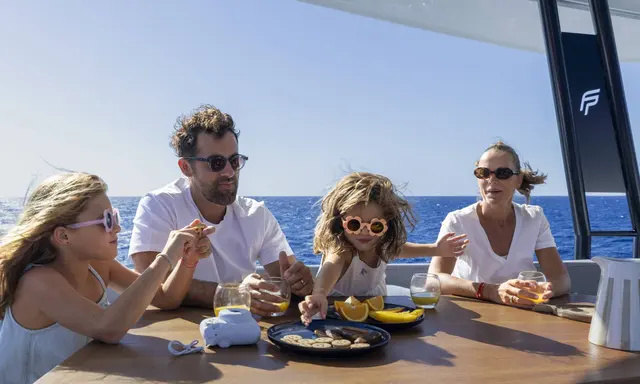
The contemporary catamaran market often places strong emphasis on moving easily between the cockpit, galley and saloon. Large openings, continuous sightlines and similar levels between living spaces can make a relatively compact yacht feel more open. They can also improve the enjoyment of an anchorage, where guests spend much of their time moving between the interior and deck. Good arrangements must still account for secure handholds, weather protection and safe movement when underway. Photographs taken in calm conditions can communicate the space but do not convey how the layout performs during a passage.
Energy autonomy becomes a larger discussion
Fountaine Pajot’s anniversary release refers to hybrid-electric solutions, renewable energy integration and its ODSea+ programme. These initiatives are associated with efforts to reduce reliance on fossil fuels and improve electrical autonomy through solar power, storage and energy management. The precise savings depend on the yacht, its equipment and use. A solar array that supports hotel loads at anchor may contribute less during extended cloudy conditions or when air-conditioning demand is high. Owners should request clear system diagrams, battery specifications and realistic energy budgets rather than assuming that a general sustainability claim applies identically to every model.
Practical limits of hybrid propulsion
Hybrid or electric assistance can alter the experience of low-speed manoeuvring and onboard power generation. Yet the engineering is not simply a question of adding batteries to an existing vessel. Weight, cooling, electrical protection, charging arrangements and service access must be considered together. A buyer exploring such a solution needs to understand the relationship between propulsion and hotel loads, including the consequences of component failure. The official announcement outlines the direction of research and product development rather than publishing universal performance guarantees. Sound engineering requires vessel-specific figures and relevant testing.
A new Fountaine Pajot Foundation
The company has also announced the Fountaine Pajot Foundation under the auspices of the Fondation de France. Its priorities include widening access to the sea, promoting awareness of ocean-related challenges and supporting marine biodiversity. These objectives form a social dimension to the anniversary, but their long-term outcomes should be assessed through future activity rather than assumed from the foundation’s creation. Yacht builders have a particular relationship with the marine environment because their products are used in it. The practical value of a foundation will depend on the programmes it supports, the people it reaches and how it measures its work.
Celebrating adventure in La Rochelle
The anniversary includes a partnership with the La Rochelle International Adventure Film and Book Festival, known as FIFAV. This connection makes sense for a builder whose customers often value travel and the experience of unfamiliar places. Films, books and conversations can stimulate interest in seamanship and exploration beyond the product showroom. They can also remind prospective owners that cruising begins with planning and curiosity, not simply choosing equipment. The partnership is a cultural initiative, not a guarantee of access to a particular voyage or event. The value lies in its link between sailing and wider ideas of adventure.
Questions for buyers of a new multihull
A buyer comparing the five current models should examine loading capacity, access to machinery, sail handling, berthing dimensions and the actual number of people expected aboard. Inspection of weather protection and movement around the helm is especially valuable. The most attractive saloon layout may not be the best one for every passage plan. Buyers should also consider crew training, marine insurance and resale preferences. A factory anniversary can provide useful context, but decisions should be grounded in the exact yacht and its intended use.
What the official source verifies
The manufacturer’s fiftieth-anniversary account confirms the 1976 origins, the 1983 Louisiane 37 milestone, more than sixty designs, a fleet approaching 5,000 catamarans and the five-model 2026 renewal. It also identifies the French production bases, ODSea+ energy work and the establishment of the foundation. Those statements are company-reported information. The release does not independently prove energy savings, establish an individual yacht’s resale value or replace a survey and sea trial.
Fifty years and a continuing design challenge
The lasting significance of Fountaine Pajot’s anniversary is the challenge it places before the next generation of cruising catamarans. More comfortable living areas and more sophisticated energy systems have to coexist with seaworthiness, sailing enjoyment and maintainable equipment. The renewed FP41-to-FP55 family reflects the company’s response to those priorities, while its manufacturing heritage explains how the approach evolved. For owners and prospective buyers, the anniversary offers a reason to look carefully at what has changed in fifty years—and what remains essential whenever a yacht leaves the marina.
Sources and image credits
Reporting based on Fountaine Pajot official 50th anniversary and range-renewal editorial release, November 2026.
Lead photograph: Fountaine Pajot FP48 sailing catamaran under way — official manufacturer 50th anniversary photograph. © Fountaine Pajot Sailing Catamarans Original official image source.