A practical space becomes central to the layout
Australian motor-yacht builder Maritimo has published a detailed account of its signature aft-galley design, explaining why the kitchen is positioned between the saloon and cockpit on several of its yachts. The first-party article, dated 30 October 2026, highlights models including the M50 Flybridge and S50 Sedan, alongside larger examples from the range. The subject is design philosophy rather than the announcement of a newly launched vessel. Nevertheless, it has practical importance for buyers assessing how a yacht will function on ordinary days away from port.
An aft galley can connect food preparation with the areas where people gather, allowing the person preparing a meal to remain part of the social activity. That may sound like a simple spatial decision, but a yacht is a moving and often compact environment in which circulation, safety and storage all compete for limited room. The builder's article explains the intended benefits, not independently measured satisfaction across every owner. A good evaluation should consider how the arrangement works in the specific model and the conditions in which the boat will be used.
Cooking and entertaining no longer need separate rooms
Traditional yacht layouts sometimes position the galley away from the main entertaining areas, creating a distinction between food preparation and guests. Maritimo's approach seeks to place those activities near one another. An aft galley opens toward the cockpit while remaining connected to the main saloon, making it easier to transfer food and drinks between different parts of the boat. This arrangement may appeal to owners who use a yacht primarily with family or close friends and want the entire group to share a relaxed atmosphere.
A combined social zone also requires thoughtful management of noise, heat and cooking odours. Ventilation and adequate separation from walkways remain important, particularly when the vessel is underway. The source's description is an explanation of design intent, not a promise that every guest will find an open galley preferable. Some owners may value a more private cooking area, especially when employing crew. The most useful comparison considers who will operate the yacht and how meals are ordinarily prepared. The right galley arrangement depends on individual use rather than a universal rule.
The cockpit is part of the galley's working area
When a kitchen is positioned at the aft end of the saloon, the cockpit can become an extension of the dining and entertaining arrangement. People may move between protected indoor seating and fresh air without a long journey through the vessel. That can make short trips and meals at anchor feel more connected. Yet opening the two areas together does not eliminate the need for secure doors, safe thresholds and weather protection. The way these spaces join should be examined on an actual yacht rather than assumed from a photograph.
An owner planning to cruise in changing conditions may use the cockpit less during poor weather, placing greater importance on the interior saloon. The galley therefore needs to function effectively when the outdoor area is closed. Counter space, seating proximity and the ability to secure items under way are relevant. The builder's concept is attractive because it tries to maintain a relationship between the areas in several circumstances, but each layout will have its own limitations. Viewing the model at a show or on a trial can reveal how the connection actually works.
Storage matters for longer passages
Maritimo identifies refrigeration, integrated appliances, work surfaces and storage as central to its aft-galley approach. These are practical details that can be overlooked when a buyer focuses on the style of the cabinetry. A weekend cruise and a longer passage require different provisioning plans, including how food is stored, how waste is managed and which appliances remain available when power is limited. Generous storage is valuable only if the space can be used safely and accessed without unnecessary effort.
A yacht's galley equipment also draws energy, which must be considered as part of the electrical system. Refrigeration may run continuously, while cooking equipment can create substantial short-term demand. The available power, whether from shore, generators or battery systems, varies by vessel and specification. A buyer should ask what is fitted to the exact hull and how the system behaves away from a marina. The official article describes a design philosophy, not a tested energy budget for every boat in the Maritimo range. Operational planning remains essential.
The M50 Flybridge illustrates the approach
Maritimo uses the M50 Flybridge Motor Yacht as one of its examples, describing an aft galley intended to connect the saloon and cockpit. The model combines living accommodation with an elevated flybridge arrangement, creating several areas that can be used for different purposes. A family may prefer sheltered indoor meals during certain parts of the day and the cockpit when weather allows. The galley acts as a point between these activities, rather than being isolated at the forward end of the main deck.
The company's article also refers to its enclosed Sky Lounge, which offers an additional protected living area. Such a feature can be useful when conditions make the open deck less comfortable. However, the precise layout and equipment of an individual M50 should be verified from current specifications. A design article cannot show every optional arrangement or change made for a particular order. Buyers should walk through the vessel to understand circulation between galley, saloon, cockpit and upper spaces. That direct experience may be more valuable than simply comparing total interior area across rival models.
The S50 offers a different deck arrangement
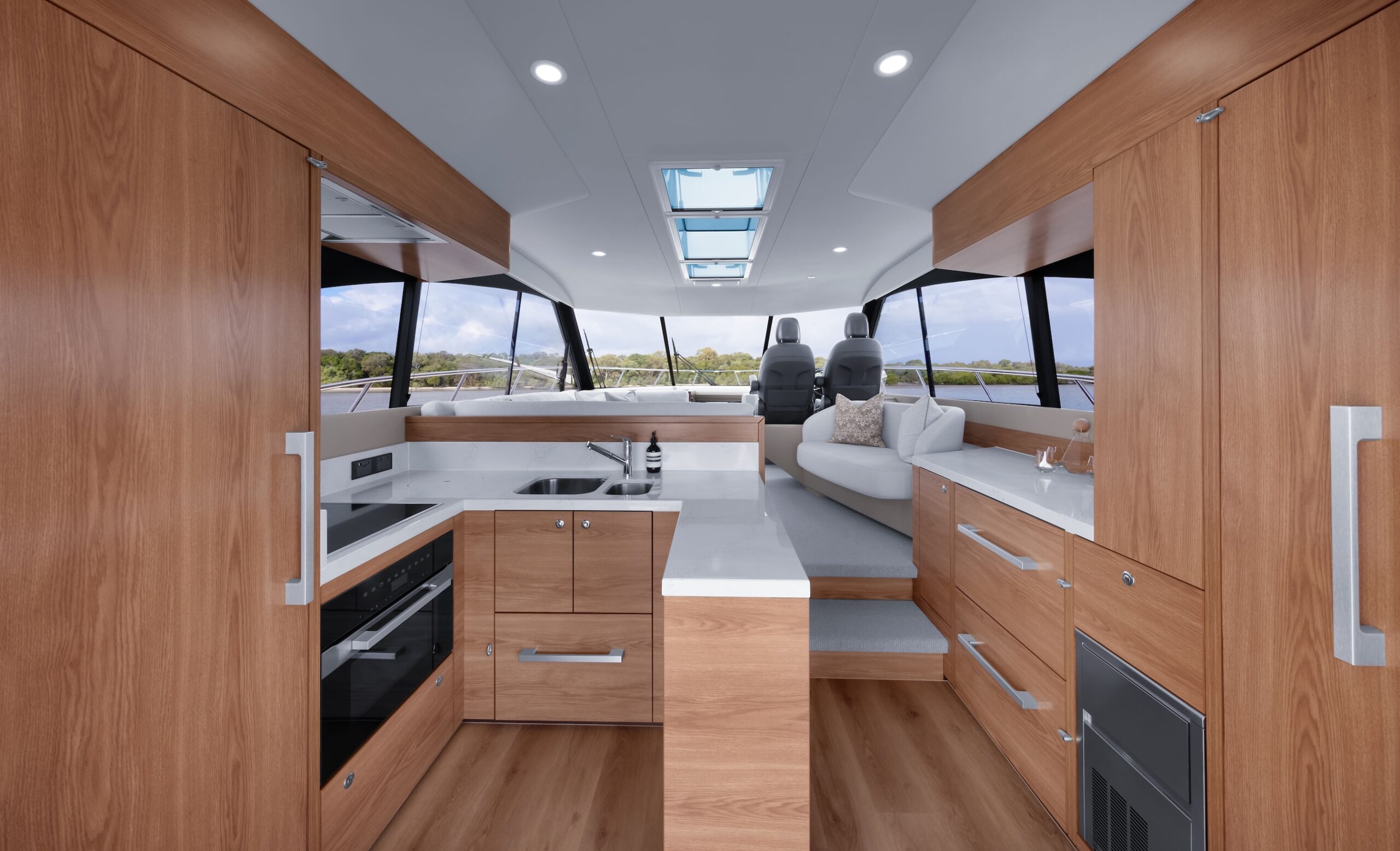
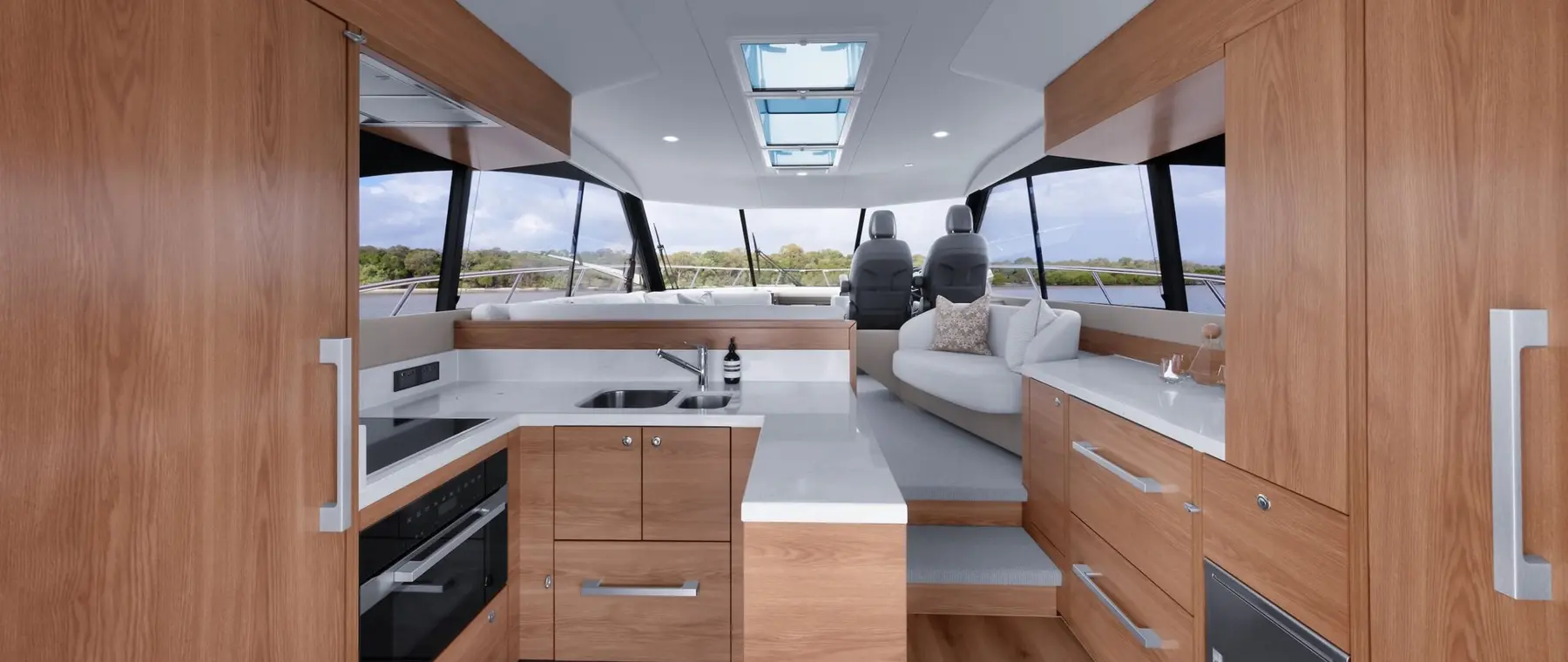
The S50 Sedan Motor Yacht provides another example of Maritimo's galley concept. Without the same elevated flybridge arrangement as the M50, the sedan design places more emphasis on the relationship between the main living spaces and the cockpit. The builder's official photograph of the S50 galley accompanies this article, illustrating the arrangement it describes. The image is useful for understanding the visual relationship between working surfaces and nearby seating, but it does not establish the experience of operating the yacht at sea.
For some owners, a sedan yacht may offer a straightforward progression between indoor and outdoor areas, while other buyers prefer the additional separation and vantage point of a flybridge model. Neither approach is necessarily more comfortable in every climate. The value of the S50's galley will depend on details such as visibility, natural light, refrigeration access and how food is carried to the seating area. Those practical considerations can influence satisfaction after delivery more than the design language used in a brochure.
Everyday life shapes interior preferences
Maritimo explains the arrangement through ordinary activities such as making morning coffee, preparing lunch after time on the water and serving dinner at anchor. This emphasis on everyday routine is valuable because a yacht is not used only during formal receptions. Owners may spend many hours aboard without a large group of guests, and the galley becomes part of their normal living environment. A well-planned space should support those smaller moments as effectively as it supports entertaining.
A kitchen connected to social areas may also allow people to share tasks more easily. Family members can prepare food while others remain nearby, subject to safe movement and suitable supervision. Yet cooking aboard a moving vessel is not identical to cooking ashore. Equipment must be secured, hot surfaces controlled and storage arranged to avoid injury. The company's emphasis on convenience is best understood alongside those responsibilities. A design can encourage social connection without removing the need for careful operation.
The larger Maritimo range provides useful contrasts
The first-party article also discusses models beyond the M50 and S50, including the M600 Offshore Flybridge and larger Maritimo yachts. Such examples can show how a core layout principle is adapted to different hull sizes and intended programmes. A large motor yacht may have greater space for storage and several separate living areas, while a smaller vessel requires more intensive use of each metre. The aft galley can remain a common design idea, but the surrounding spaces will not be identical.
For Luxury Yacht Guide's focus on yachts under 24 metres, the relevance is strongest where the concept applies directly to vessels in that category. The mention of larger models provides wider context rather than turning this report into coverage of a vessel outside the publication's core range. Buyers should avoid assuming that a feature presented on a large flagship is fitted in the same way to a smaller yacht. The exact model matters. Scale can change the practicality of everything from counter space to guest circulation.
Owners should look beyond an attractive photograph
An image of a carefully finished galley may create an appealing first impression, but practical evaluation requires more than appearance. Buyers should open storage compartments, check access to appliances and understand how doors and drawers are secured. Work surfaces need to be suitable for their intended uses, while the relationship between the galley and seating should be comfortable for the people who use the boat. Someone who cooks frequently may prioritise features quite differently from a buyer who usually eats ashore.
Maintenance access is another important consideration. Refrigeration equipment, plumbing and electrical appliances require periodic service, and some components may need replacement during the yacht's lifetime. A beautiful interior can become frustrating if essential systems are difficult to reach. Maritimo's article does not provide a detailed serviceability audit of each model, so that assessment must be undertaken separately. The design philosophy is useful because it directs attention toward how the yacht will be lived in; the next step is to establish whether the chosen specification delivers that promise.
Design choices interact with cruising conditions
Where a yacht operates can influence the usefulness of open connections between cockpit and saloon. A sheltered Australian coastal journey, a tropical anchorage and an extended passage in cooler weather create different demands. Heat, rain, wind and humidity may all shape where people prefer to spend time. A galley that serves both indoor and outdoor spaces can offer flexibility, but doors and glazing must still provide protection when necessary. The design should function when the vessel is closed up, not only when the cockpit is open.
Owners also need to plan for safe movement and secure storage while under way. A dining arrangement that works beautifully at anchor may require different procedures in waves or during manoeuvring. Captains and owners should be familiar with the equipment fitted to their vessel and avoid treating a marketing photograph as operating guidance. The most successful layout is one that supports normal life while remaining practical under the conditions in which the yacht will actually travel. That is a more useful measure than an abstract claim about luxury.
What the official Maritimo article establishes
Maritimo's 30 October 2026 first-party design report identifies the aft galley as a recurring principle across its motor-yacht range, placing cooking and storage close to the saloon and cockpit. It names the M50 Flybridge and S50 Sedan among relevant models and emphasises refrigeration, work surfaces, provisioning and the way shared spaces function on longer stays. The source describes the builder's design intention, not new sales totals, independent performance tests or a newly launched model. Those distinctions are maintained in this report.
Luxury Yacht Guide covers the subject as a concrete yacht-design update relevant to buyers comparing layouts in the 12–23.99m segment. The lead photograph is an official Maritimo S50 galley image attributed to the builder and original photographer. The point is not that an aft galley is the only valid solution, but that its placement can meaningfully influence daily life on board. Owners should balance social connection with safe operation, suitable storage and the maintenance demands of the exact yacht they select.
Sources and image credits
Reporting based on Maritimo: first-party official 2026 announcement or model record.
Lead photograph: Maritimo Explains Aft-Galley Design for Its M50 and S50 Motor Yachts — original Maritimo official photograph, LYG 25 November 2026. © Maritimo and original creators or photographers. First-party publisher photograph. Underlying rights remain with original holders. Original official image source.