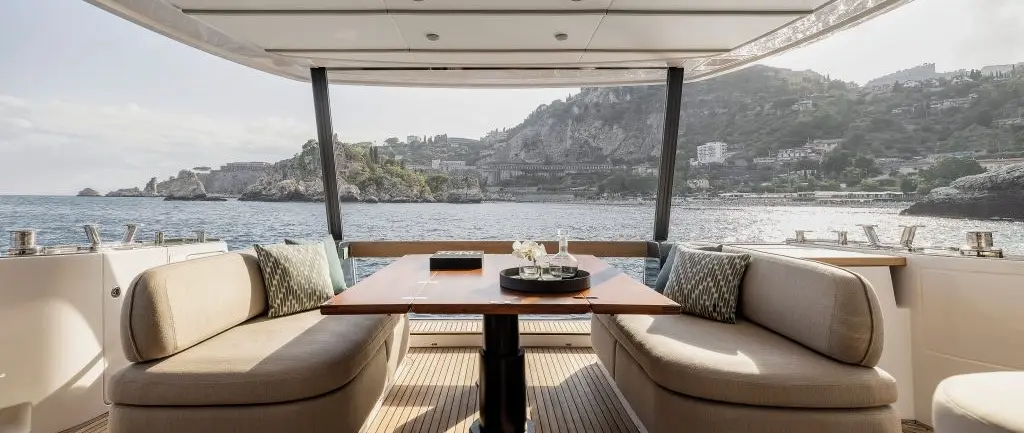
Azimut Yachts has published its line-up for the Hong Kong International Boat Show, scheduled from 3 to 6 December 2026 at Club Marina Cove in Sai Kung. The Italian manufacturer names the Fly 62, Fly 78 and Magellano 60 for the display. All three are substantial motor yachts below 24 metres overall, making the planned exhibition particularly relevant to owners assessing the transition from a mid-size family flybridge cruiser to a more generously equipped yacht with longer-distance aspirations. The Magellano 60, at 18.47 metres, is the most distinctive of the group because it uses Azimut's semi-planing Dual Mode hull and a crossover approach to cruising. The Fly 62 and Fly 78 offer different interpretations of upper-deck living. The announcement is not a statement that these yachts are new world premieres, but it gives regional buyers a confirmed chance to view three styles together and prepare the practical questions that matter in Hong Kong's marina environment.
The dates and venue are confirmed
Azimut's official event page identifies 3–6 December 2026 as the show dates and provides opening hours of 2pm–6pm on Thursday 3 December and 10am–6pm from Friday to Sunday. It lists Club Marina Cove, 380 Hiram's Highway, Sai Kung, as the location and provides a regional contact address for enquiries. Buyers should confirm appointment availability and the position of the individual yachts within the marina rather than assume unrestricted access throughout the event. The source does not attach a price or delivery guarantee to any of the boats. It also does not identify the display as a new model launch. These are existing models offered for examination at a particular upcoming exhibition, and a visit should establish precisely how the hulls shown compare with the configurations currently being sold.
Three sizes, three different ownership propositions
The Fly 62 is 19.22 metres overall, the Fly 78 measures 23.64 metres and the Magellano 60 is 18.47 metres. This creates an instructive group because the model names alone do not tell a buyer everything about usable space, operational complexity or annual costs. The Fly 62 is a conventional flybridge yacht of substantial size for private family use, while the longer Fly 78 offers additional volume and greater scope for separating social areas from service arrangements. The Magellano 60 is shorter but reflects an emphasis on crossover cruising and a particular hull approach. Buyers should compare actual beam, draft, tank capacities and access to machinery rather than treating length as a proxy for every useful feature. A show that places the three together can reduce the risk of choosing by appearance alone.
Why the Magellano 60 is worth particular attention
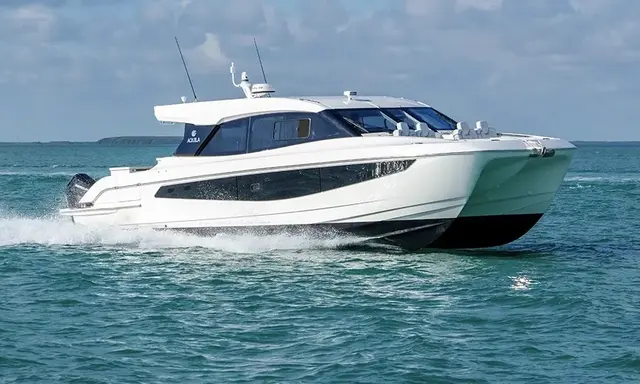
Azimut's official technical description gives the Magellano 60 a length of 18.47 metres, a 5.15-metre beam and a draft of about 1.37 metres at full load. Its standard published propulsion comprises two MAN i6 engines rated at 730 horsepower each. The builder describes a three-cabin arrangement plus crew accommodation and an 18-knot cruising reference point. What distinguishes the yacht is the Dual Mode hull, a semi-planing form intended to support operation across more than one speed range. The manufacturer also highlights the use of alternative fuel in its development work. That combination makes the model interesting for owners who may cruise at moderate speeds for extended periods rather than always seeking the highest possible passage speed.
Published performance figures require context
Azimut provides unusually detailed reference information for the Magellano 60. At a slow-cruise test condition of 11.2 knots it lists consumption of 7.1 litres per nautical mile and a range of 464 nautical miles. At a faster 22-knot reference point, the published consumption rises to 10.1 litres per nautical mile with a range of 326 nautical miles. The builder states that the results come from trials carried out according to ISO 8666:2020 and witnessed by Lloyd's Register. These are useful benchmarks, but owners still need to understand test displacement, reserves, weather, engines and equipment before applying the figures to their own voyages. Actual fuel use varies with hull condition, trim and sea state. A sea trial at realistic loading remains appropriate even when a manufacturer publishes measured data.
The Fly 62 invites a different comparison
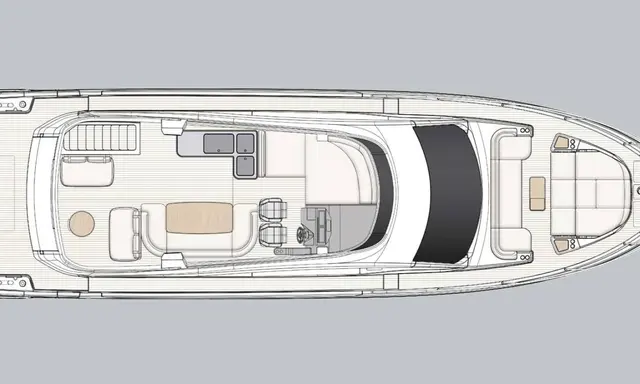
The Fly 62 is presented as a 19.22-metre yacht with a beam of about 5.09 metres and an upper-deck arrangement designed for social life and cruising. Its dimensions are close enough to those of the Magellano 60 for buyers to make meaningful comparisons without ignoring differences in intended role. The space and equipment offered on the flybridge deserve close inspection, particularly the connection between the outdoor helm, seating and access stairs. Buyers should assess the effect of optional equipment on weight and maintenance. A flybridge can provide an attractive social environment but can also create additional exposure to sun and weather. The selection is therefore less about declaring one layout superior than choosing the vessel whose combination of living space, passage style and systems best fits the owner's programme.
The Fly 78 raises crew and cost questions
At 23.64 metres overall, the Fly 78 approaches the upper end of the segment covered by this publication. Its size makes it an excellent reference point for buyers who are considering whether they need the additional accommodation and onboard services associated with a larger yacht. That decision often brings changes in crew expectations, insurance requirements and berthing availability. The exact regulatory position depends on registration, operation, certification and jurisdiction; nominal length alone does not settle the matter. Prospective owners should seek professional advice rather than assume that remaining just below 24 metres simplifies every obligation. They should also compare crew spaces, access to machinery, storage for cruising equipment and the practical movement of guests through the yacht.
A Hong Kong berth is a design constraint
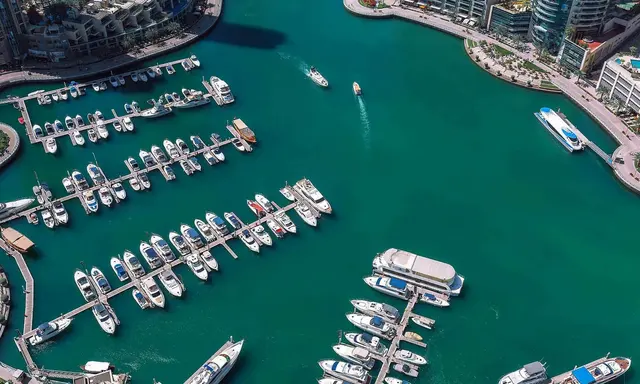
The geography of Hong Kong makes marina planning a substantial element of yacht ownership. Beam and depth limits, availability of annual berths, weather exposure and distance to service yards can influence whether a particular model is convenient to keep locally. A buyer should request exact drawings and a documented operating draft for each boat, including propulsion appendages and loaded condition. For a yacht that will be used around Sai Kung, Lantau or farther afield, check the availability of fuel, shore power and suitable anchoring areas. It is also worth investigating where haul-out and specialist repairs can be arranged. Larger yachts require careful planning for lifting, access and manoeuvring even when their maximum draft seems manageable. The show provides a local opportunity to discuss these issues with the regional representatives.
Energy, air conditioning and living aboard
Hong Kong's warm, humid seasons place significant demands on cooling, ventilation and the ability to manage condensation in enclosed cabins. The three Azimut models may have different electrical architectures and optional equipment packages, so buyers should ask about their actual generator ratings, battery capacities, shore-power requirements and climate-control systems. A larger vessel does not automatically have more useful energy autonomy if its hotel loads rise at the same time. The location of air-conditioning outlets, noise from machinery and ventilation in cabins matter when the boat is used overnight. Ask which systems can remain operational if a generator or part of the electrical network is out of service. These considerations become increasingly important when the yacht spends substantial time at anchor rather than connected to a marina berth.
Examining the builder's environmental statements
Azimut describes the Magellano 60 as employing a Dual Mode hull to improve efficiency at lower and medium speeds, and it has publicised trials involving HVOlution fuel. The company states that combining its hull approach and the fuel produced by Eni Sustainable Mobility can reduce well-to-wake carbon dioxide emissions substantially relative to a comparable fossil-diesel-powered yacht under the assumptions of that demonstration. That is a manufacturer-specific claim, not a blanket promise for every fuel supply, vessel configuration or cruising programme. Owners should investigate the fuel's availability, engine compatibility and documentation, and distinguish between tailpipe emissions and lifecycle calculations. A responsible comparison will look at actual operations and verified conditions rather than adopting a headline percentage without qualification.
The usefulness of side-by-side inspection
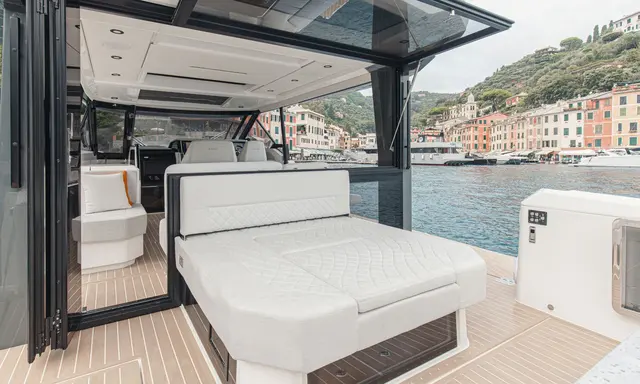
A visitor considering the Fly 62, Fly 78 and Magellano 60 should inspect each model in a consistent order. Begin at the boarding point, move through the cockpit and main deck, test passageways and stairs, then examine the cabins and machinery. Check visibility from each helm, secure handholds and ease of reaching dock lines. Look at space for a tender or water equipment and evaluate the service access needed for routine work. Make notes on standard equipment versus options fitted to the show hulls. The practical differences may become clearer when the same owner imagines loading luggage, bringing guests aboard and preparing for an overnight passage on each yacht. An exhibition is valuable because it turns abstract specifications into an observable layout.
Questions for the regional sales team
The official Hong Kong notice provides a contact point, but buyers should seek written answers to substantial questions. What is the build status of the yacht being offered? What equipment is included in the price and which options are subject to availability? Who undertakes final commissioning, and which companies support the propulsion, electronics and domestic systems? Are warranty repairs available in the intended cruising region, and what is the response procedure if a fault occurs abroad? Ask for current dimensioned plans, fuel-consumption data tied to the chosen installation, delivery windows and contract terms. If the yacht is a demonstrator, clarify its service history and the extent of any warranty that remains. A polished display should be the beginning of diligence rather than the end.
A December display with real buyer value
The Hong Kong International Boat Show is an opportunity for Azimut to show three quite different motor yacht solutions in the same marina. The choice between the Fly 62, Fly 78 and Magellano 60 extends beyond whether an owner wants a larger flybridge or a more explorer-oriented hull. It affects passage speeds, crew requirements, energy use, access to local berths and the recurring cost of maintenance. The manufacturer has confirmed the dates and models but has not claimed a new launch or an immediate delivery offer. For buyers in the 12-to-23.99-metre luxury segment, that is exactly the kind of event worth using for a structured comparison backed by official specifications, a realistic budget and later sea trials.
Sources and image credits
Reporting based on Official manufacturer's dated announcement, verified yacht show or technical feature.
Lead photograph: Azimut Magellano 60 archival original maker gallery image, not a new Hong Kong boat show photograph.. © Original manufacturer and photographer or creator. Rights remain with their holders. Original official image source.