Canadian manufacturer Open Waters Solar is presenting SolaDek, a composite-encapsulated photovoltaic product intended to integrate electricity generation into parts of a boat's deck or other marine surfaces. The company's official METSTRADE 2026 catalogue entry describes the panels as lightweight, walkable, non-slip and adaptable to custom shapes. It also makes specific comparisons with conventional rigid solar panels, claiming 75% lower weight, ten times greater strength, 95% lower thickness and 24% efficiency. Such figures deserve close examination because they describe properties of a supplier's product, not independently verified performance on every yacht. For owners of 12-to-23.99-metre sailing and motor yachts, the central question is whether photovoltaic equipment can contribute meaningfully to everyday electrical demand without compromising safe movement, deck maintenance or the yacht's design.
A different place to collect sunlight
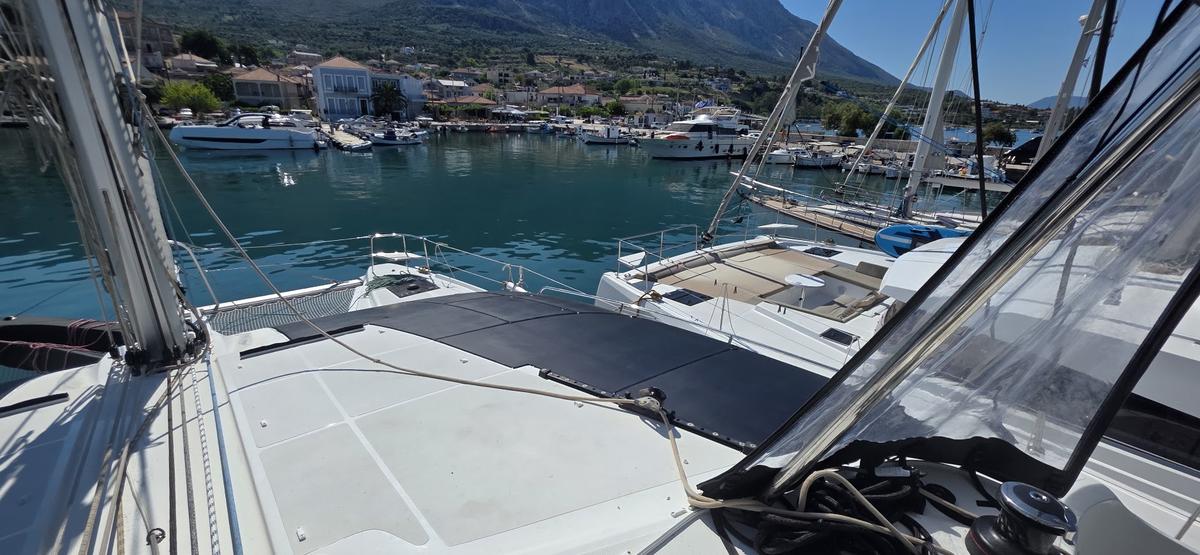
Conventional solar installations are often positioned on coachroofs, arches or rigid biminis, where they may compete with hatches, antennas and equipment. SolaDek approaches the problem by treating a surface that already occupies part of the vessel as a possible location for generating power. The original manufacturer photograph shows dark solar elements arranged on a yacht deck, illustrating the proposed visual integration. That arrangement can be attractive, but it introduces a different set of questions from mounting panels overhead. Decks are walked on, washed, exposed to hardware and sometimes obstructed by sails, ropes or people. Any product claiming to combine traction and electricity generation must be evaluated against all those conditions.
What the manufacturer actually claims
Open Waters Solar describes SolaDek as composite-encapsulated solar decking engineered for marine and mobile applications. Its catalogue states that the product is 75% lighter, ten times stronger and 95% thinner than rigid solar panels, while offering 24% efficiency and verified resistance to cracking. Those claims are reproduced as manufacturer statements, not as findings from a test commissioned by this publication. The baseline for each comparison is not fully explained in the short catalogue entry, and results can differ with the rigid panel selected. A buyer considering a substantial installation should request the relevant test procedures, sample construction details and technical data before relying on the percentages.
Why weight matters on a smaller yacht
Every additional kilogram above the hull can affect a yacht's loading and, in some situations, its motion. Reduced equipment weight can be desirable, especially where solar generation is added after the vessel was designed. However, the installed weight must include wiring, supports, protective components and any changes to the surrounding deck. A lightweight panel alone does not establish that the finished system is lighter than a competing solution. Designers must also consider the structural location of the installation. Weight saving can be useful, but it should not become a justification for changing the deck without the yard's approval or suitable professional engineering assessment.
Walkable does not remove the need for traction
The catalogue uses the terms walkable and non-slip, which are important for a surface exposed to wet footwear, salt spray and the movement of a boat. Yet those words do not specify a particular coefficient of friction or performance under every marine condition. Different footwear, cleaning products and surface contamination can affect grip. Owners should obtain test information for the finish they intend to install and check whether it remains appropriate after repeated exposure to sunlight and cleaning. The ability to step on a panel is not necessarily the same as permission to use it as a critical working area during heavy-weather operations.
Strength and resistance to cracking
A composite-encapsulated panel may be engineered to tolerate loads differently from a traditional glass-faced module. That is the broad promise behind SolaDek's reported strength and crack-resistance claims. But the meaning of stronger depends on the type of test: bending, impact, compression, fatigue and environmental cycling are not interchangeable. A marine installation may face concentrated pressure from a dropped fitting as well as repeated ordinary foot traffic. The official product entry provides no universal impact rating for every installation. A technically informed owner should review what has been tested and whether those results correspond to the proposed yacht application.
Understanding 24% efficiency
Photovoltaic conversion efficiency is a measure of how much incoming solar energy a cell or module converts into electrical energy under defined conditions. A stated 24% efficiency can be a useful comparison figure, but it should not be confused with the amount of energy that will arrive in the batteries every day. Real output depends on shading, panel orientation, temperature, wiring, charge conversion and battery acceptance. On a yacht, a boom, radar arch or furled sail may shade areas unpredictably. Consequently, an energy budget should use expected generation for the actual cruising area and season rather than multiply a laboratory efficiency figure by the total deck area.
A custom fit changes design decisions
SolaDek is described as available in custom shapes and an all-black appearance. A panel designed around existing deck geometry could avoid the protruding edges of an ill-fitting retrofit. There may also be opportunities to coordinate solar areas with nonslip walkways, hatches and drainage. But a custom outline must still preserve an effective electrical layout and adequate paths for cabling and maintenance. The source does not describe the minimum bend radius, edge-treatment requirements or the full choice of available shapes. These details require a proper design drawing and approval from the relevant supplier or qualified installer.
How deck hardware complicates the installation
A working yacht deck carries cleats, blocks, handrails, winches and other fittings that experience repeated loads. Solar equipment should not obstruct maintenance access or cause crew to step around essential hardware in an unsafe manner. The routing of cable penetrations must protect the structural and watertight integrity of the deck. Even where an encapsulated panel appears thin, a poorly placed installation could interfere with a hatch or drainage channel. The practical approach is to map deck use and service routes before deciding where power-generating surfaces belong. Appearance should follow these engineering requirements rather than dictate them.
Electrical planning is still essential
The panels are only one part of a solar system. A yacht also needs suitable charge controllers, overcurrent protection, isolation arrangements and correctly sized wiring. The installation should be compatible with the existing electrical architecture and the battery chemistry already fitted. A professional must assess how circuits behave during a fault and whether replacement parts will remain accessible. Marine electrical standards and builder instructions matter here; the manufacturer photograph is not a wiring diagram. Owners should ask for a complete installation specification, including any limitations relating to maximum system voltage or permitted panel combinations.
Water, salt and long-term exposure
Marine surfaces are subject to ultraviolet exposure, temperature swings, seawater, foot traffic and cleaning chemicals. The term marine-grade is not a substitute for a stated environmental test regime. A product may resist water entry well when new but still require attention at seams, edges and cable joints after years of use. Cleaning instructions should be obtained before installation, especially if abrasive products or pressure washing are common on the yacht. Maintenance staff should know which areas can be walked on and which cleaners or tools are restricted. The source does not publish a verified service-life figure, and that omission should be resolved before assuming long-term savings.
Comparing roof-mounted and deck-integrated solar
A fixed rigid panel on a high structure may receive more unshaded light than a panel built into a frequently occupied deck. Conversely, a deck surface may be available when roof space is limited or already used for equipment. Neither arrangement is universally superior. The correct comparison must include shading, total area, weight, labour, service access and the chance of damage. A yacht with a large rigid bimini may obtain excellent generation from ordinary panels; another with unusual deck geometry may benefit from a tailored solution. The relevant question is the effective energy produced per day and the safe way of achieving it.
Applying the idea to a 12-to-24-metre yacht
In this size range, space has significant value. A cruising yacht may need to power refrigeration, navigation, communications, pumps and lighting while at anchor. Even a modest contribution from solar can reduce the frequency of engine or generator operation, provided consumption is managed. Yet a panel installation cannot be sized solely from the boat's length. Guest numbers, climate, air-conditioning use and available battery capacity make major differences. Owners should begin with measured or realistically estimated electrical loads, then determine how much usable panel area exists. The proposal can then be evaluated on technical and financial grounds.
An international marine supply chain
Open Waters Solar identifies itself as a Canadian designer and manufacturer of composite-encapsulated photovoltaic products. Its appearance in the international METSTRADE catalogue places the company among suppliers seeking relationships with yachtbuilders, refit specialists and marine equipment distributors. That is a useful connection because a custom solar-deck product may require cooperation between the original manufacturer and the company responsible for the yacht's installation. Questions about warranty responsibility, repair methods and international shipping should be addressed before purchase. A promising product needs reliable support as well as attractive photographs.
Safety and liability after a refit
A deck alteration can potentially affect slip resistance, structural integrity and electrical safety. A yacht owner should therefore involve the builder, surveyor or qualified specialists where changes are substantial. Insurance coverage may also depend on proper documentation of electrical modifications. It would be misleading to assume that a product marketed as walkable is automatically certified for every deck location or load case. The approval process should match the type of vessel and the applicable standards. Careful documentation creates a record of the materials used, the installation method and the tests performed after commissioning.
What remains unknown from the catalogue
The original listing confirms the SolaDek name, Canadian origin, composite-encapsulated concept, custom-shaped black appearance and manufacturer-reported comparisons for weight, thickness, strength and efficiency. It does not give a fixed retail price, an independent yacht-specific energy yield or a complete installation manual. Nor does it document a particular customer yacht whose output has been audited over a full season. Those gaps do not negate the value of the idea, but they define what a buyer must investigate before committing. This article reports a supplier's technology and its possible uses, not a completed independent performance assessment.
A thoughtful alternative to conventional panel placement
SolaDek illustrates a wider marine design trend: equipment is being incorporated into the fabric of the yacht rather than added as an obvious afterthought. The approach is appealing because a deck has to serve several purposes at once. If the manufacturer can demonstrate reliable traction, durability and useful energy generation in the proposed application, integrated solar may help smaller yachts reduce dependence on shore power or generators. Its value will ultimately be decided by installation quality and measured performance. The strongest takeaway for owners is to examine the whole system, including safety and maintenance, before focusing on the headline efficiency figures.
Sources and image credits
Reporting based on Open Waters Solar original SolaDek composite solar decking specification in the 2026 METSTRADE exhibitor catalogue.
Lead photograph: Open Waters Solar SolaDek wide yacht coachroof and deck photovoltaic installation — official 2026 manufacturer photograph. © Open Waters Solar; manufacturer image of solar deck installation on a sailing yacht. Original official image source.