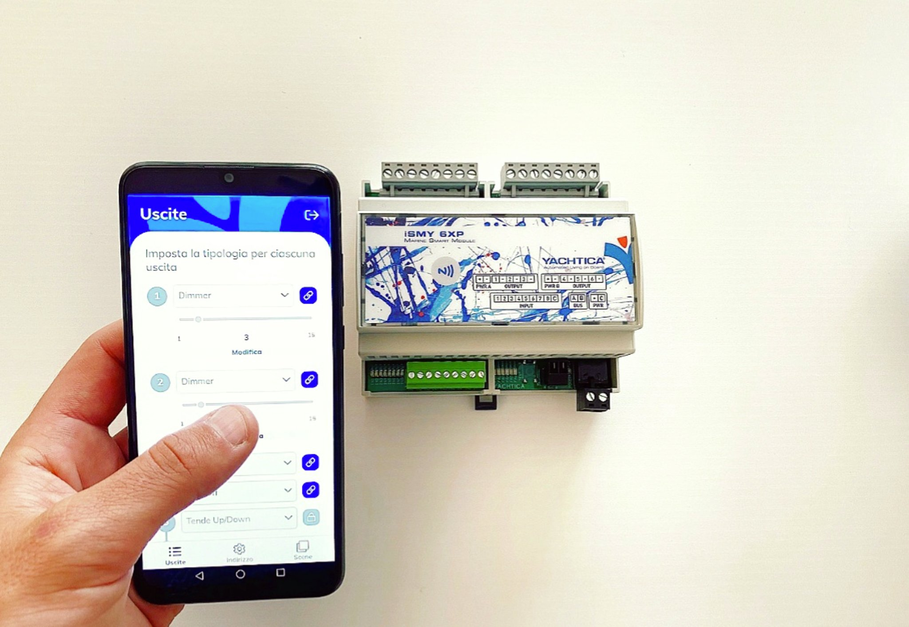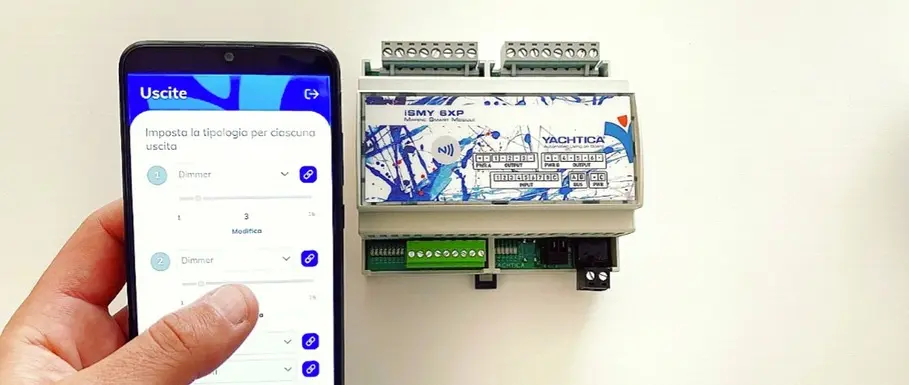
Italian marine-electronics company Yachtica is presenting its iSMY lighting-control module in the METSTRADE 2026 equipment catalogue, focusing on programmable outputs and app-based management of cabin and room functions. The manufacturer describes the product as a multifunction control platform intended to allow an installer to configure lighting behaviour to suit the requirements of a yacht. An official catalogue image shows the electronic module alongside a handheld mobile-device interface, illustrating the relationship between the concealed technical equipment and the controls used by occupants. For owners of 12-to-23.99-metre luxury yachts, that relationship is important: the appearance of an interior can depend on many individual light sources, while the system that operates them must remain reliable and simple to use. The catalogue documents the company's product capabilities but does not supply an independent installation assessment or state that the module first became available in November 2026.
Why lighting control matters aboard
A modern yacht can have numerous lights serving different tasks: moving through corridors, cooking, reading, dining, observing instruments or creating a relaxed ambience at anchor. The needs of the person at the helm are not the same as those of guests in the saloon. A control system can coordinate some of these functions instead of requiring many individual switches. Yet complexity can become a disadvantage if an ordinary user cannot find the correct control. The engineering goal is not necessarily to automate everything. It is to make the right lighting available predictably and in a manner that suits the yacht's interior arrangement.
What the iSMY description establishes
Yachtica describes iSMY as a lighting-control module with fully programmable multifunction outputs. The catalogue says it can be used to create an installation that responds to the lighting-control and room-management requirements of yacht cabins and spaces, with an app for operation. These are manufacturer descriptions, not independent confirmation that every lighting fixture or room service can be connected. Compatibility depends on the specific hardware, electrical loads and interface protocols. A designer or installer should request the detailed technical documentation before committing the system to a new build or refit.
The role of programmable outputs
A programmable output allows an installer to assign or adjust how a connected circuit responds to control commands, within the module's technical limits. This may make it easier to organise groups of lights and create distinct operating arrangements for different rooms. However, the phrase multifunction does not disclose the current rating, switching method or number of outputs supported by each model. Those specifications must be confirmed from the actual product documentation. Overloading an output or connecting an incompatible fixture can create faults even if the software configuration appears correct. Good programming and sound electrical engineering are inseparable.
A control app changes the user experience
The first-party photograph places a mobile-device interface beside the module, consistent with the manufacturer's reference to app-based management. A familiar touchscreen can make complex functions accessible without creating a large wall of switches. But owners should ask what happens if the phone is unavailable, its battery fails or a software update creates a problem. Critical lighting should remain accessible through appropriate controls that do not depend solely on an individual's personal device. A yacht's guests may also need a clear way to use the system without learning a complicated app or obtaining administrator permissions.
Different lighting scenes aboard a yacht
A saloon can benefit from different light levels for preparing food, entertaining guests, watching the sea or moving safely at night. Programmable controls can potentially make such changes more convenient where the installed hardware supports them. The specific number and type of presets are not given in the catalogue, so no fixed scene library should be attributed to iSMY. A designer planning an interior should decide what occupants actually need before choosing a controller. Simple, well-labelled arrangements often work better than a large number of options that are rarely used and difficult to remember.
Connecting technology with interior design
Yacht interiors are designed around materials, light reflection and the movement of people through relatively compact spaces. Controls that are invisible when not needed may help preserve a clean appearance. At the same time, designers should avoid hiding essential switches so effectively that guests cannot find them. The manufacturer’s general portfolio includes lighting control, keypads and curtain-management technology, but the iSMY listing should not be interpreted as proof that every one of those products is supplied or integrated as standard. The exact scope of a proposed installation needs to be documented and agreed in advance.
The importance of equipment compatibility
LED lighting equipment varies in electrical requirements and control methods. A module that works with one fixture may need additional interfaces for another. Dimming performance can also depend on the driver and how the system behaves at low output. Owners should ask the supplier and installer to demonstrate the exact combination of lights and controllers selected for the yacht. An attractive app demonstration with a test fixture does not guarantee perfect performance throughout a finished boat. Compatibility testing should take place before final panels and furniture make access difficult.
Wiring still matters
Software-based control does not remove the need for correctly designed electrical circuits. Lighting cables must be routed safely and protected against damage, moisture and excessive current. Connections need to remain accessible for service, and the system should be documented for future technicians. If multiple rooms depend on a central module, the consequences of a common failure deserve special attention. Installers should consider how essential areas can be illuminated if the control system has a fault. The official catalogue provides a product description, not a complete electrical installation schematic or an endorsement of any particular wiring arrangement.
Owner and guest access can differ
The owner may want detailed access to settings, while guests usually need straightforward controls for the lights in their cabins. A programmable system should support the practical patterns of use aboard the specific yacht, whether through an app, installed keypad or another approved interface. It is important to ask how permissions are managed and what the manufacturer supports rather than assume that a particular user-role structure is included. A charter operator may have different needs from a private owner who uses the same boat with family. Clear operation and good documentation reduce frustration in both cases.
Software longevity and updates
An app-based component may remain in service for years while mobile operating systems and network equipment evolve. A prudent buyer should ask how long the manufacturer expects to provide updates, whether settings can be backed up and how a technician can restore operation after hardware replacement. The catalogue does not give a formal long-term software-support commitment. This is a significant consideration because a lighting system built into joinery is less convenient to replace than a portable accessory. Owners may find that documentation and access to qualified installers are as valuable as the original features.
A practical refit decision
Retrofitting a programmable lighting system can be more difficult than adding one during construction. Existing cable routes, drivers and wall controls may have been designed around simple switches. Replacing them could require opening finished panels and assessing available space. The best solution might be limited to selected areas rather than attempting to automate every light at once. An installer should evaluate the existing wiring and explain what can be reused safely. The manufacturer’s flexibility claims are not a guarantee that every older yacht can be converted without substantial work.
Energy management and efficient operation
Dimming lights can reduce energy consumption in some configurations, but the result depends on the fixtures, drivers and control scheme. A programmable system may encourage users to switch off unneeded lights or use suitable levels at night. Yet the controller itself requires power, and a claim of significant energy savings would need measured data. The iSMY source does not supply such a measurement. Owners should separate the value of convenience and ambience from any financial savings that have not been independently demonstrated. A well-designed lighting installation can deliver comfort even if its total energy impact is modest.
Reliability in marine conditions
Electronics installed aboard a yacht may face vibration, salt-laden air and temperature changes. A control module should be installed in a location consistent with the manufacturer's environmental specifications and with access for inspection. The catalogue does not provide a universal ingress-protection rating or detailed climatic test results for every installation. Owners should ask for the relevant documentation and make sure the installer understands the equipment's limits. Good workmanship includes protecting connections and ensuring that the unit cannot be exposed to conditions outside those limits. The reliability of the software depends partly on the reliability of its physical environment.
Keeping essential functions separate
Cabin ambience is convenient to automate, but emergency and legally required lighting may need different treatment. The design should not assume that a general interior controller can automatically substitute for a certified emergency-lighting system. Those requirements depend on the vessel and applicable regulations. A responsible designer will separate essential safety functions where necessary and provide appropriate manual or backup controls. The catalogue does not establish that iSMY is certified for every safety-critical use. That limitation should remain clear when the system is discussed with owners interested in a comprehensive interior-control solution.
Service and handover documentation
When a yacht is delivered, the owner should receive clear instructions describing how to operate the lighting and who to contact if there is a fault. The technical file should identify connected circuits, output assignments, configuration settings and any specialised tools required for future maintenance. Such information becomes especially important if the yacht is sold or moves to another region. A programmable system without an accessible configuration record may be much harder for a new technician to understand. The long-term value of the installation therefore depends on a proper handover as well as on the quality of the original equipment.
Why the smaller luxury-yacht market is relevant
A 12-to-23.99-metre yacht may have a sophisticated interior but only limited space for technical cabinets and wiring. The owner may also expect the convenience of a much larger yacht without employing a full-time technology specialist. A configurable control system could help make that possible, provided the equipment is sized correctly and supported locally. The best outcome is one in which guests can control the lights intuitively while technicians have sufficient access to maintain the installation. That balance is the difference between useful technology and unnecessary complexity.
What Yachtica has confirmed
The official METSTRADE listing identifies the iSMY product, its programmable multifunction outputs and the use of an app in managing lighting and rooms. It positions the module within Yachtica's broader range of marine controls. It does not document the exact capabilities of every possible configuration, an independent certification outcome, installed pricing or universal integration with all lighting brands. This article explains the product and the engineering questions it raises rather than inventing those figures. The accompanying image is the manufacturer's original iSMY control-module photograph.
Flexible technology should serve the people aboard
The attraction of programmable lighting is that a yacht's spaces can be used differently at different times without installing a separate switch for every possible arrangement. Yachtica's iSMY is intended to support that flexibility through configurable outputs and a modern interface. Whether it succeeds aboard a particular yacht will depend on design decisions, installation quality and long-term support. Owners should begin with the experience they want in each cabin and saloon, then work with specialists to determine the appropriate technology. The strongest result is a lighting system that occupants hardly have to think about because it does exactly what they need.
Sources and image credits
Reporting based on Yachtica original iSMY multifunction lighting control module product listing in METSTRADE 2026.
Lead photograph: Yachtica iSMY programmable yacht lighting control module — manufacturer product photograph. © Yachtica / V.Y.C. S.r.l., Italy Original official image source.