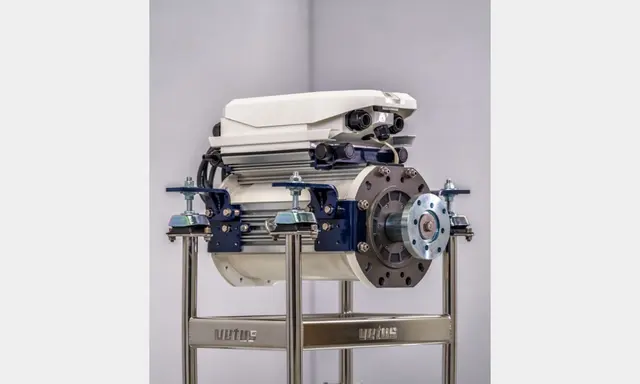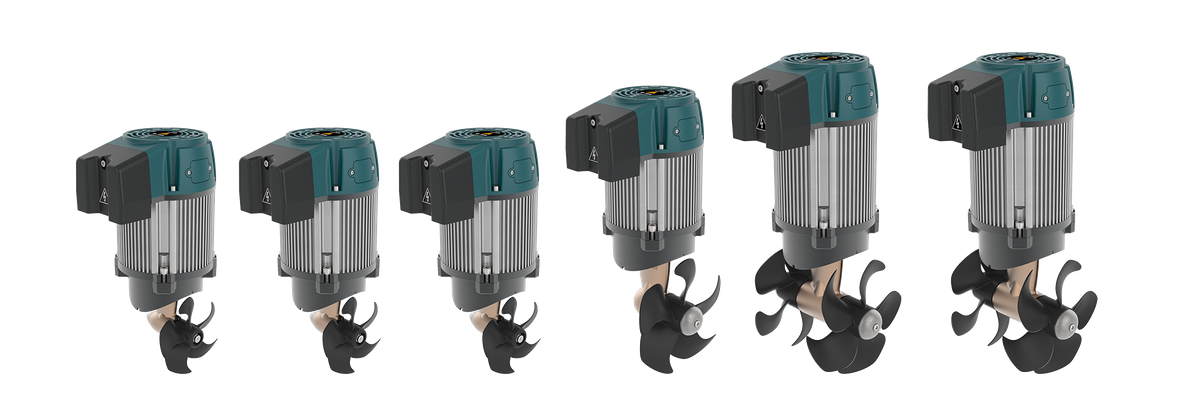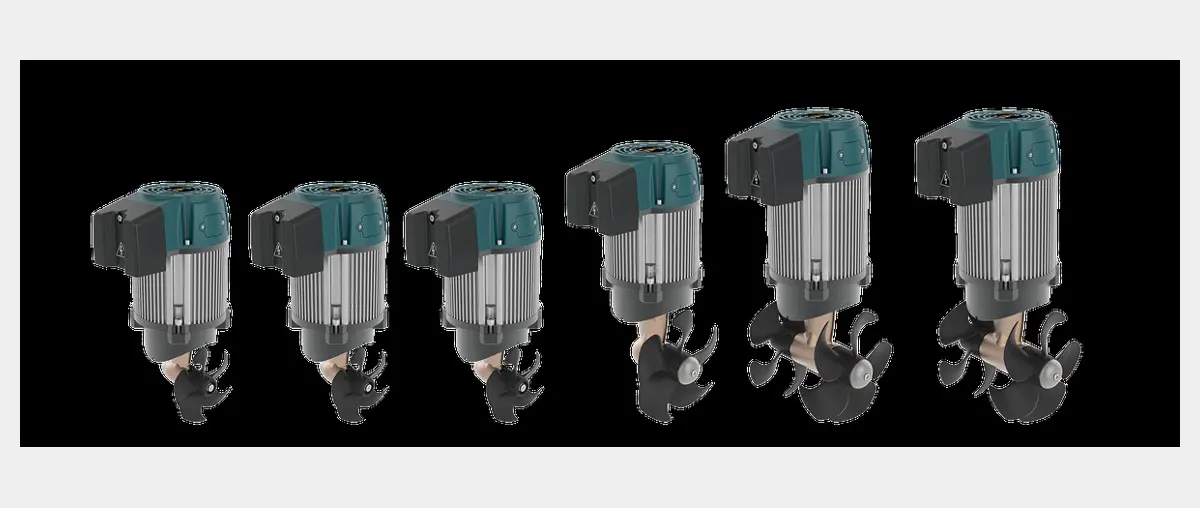
Norwegian marine-equipment specialist Sleipner is highlighting its E-series bow and stern tunnel thrusters in the METSTRADE 2026 product directory, describing a family of electric units with integrated electronics and proportional control as standard. The company positions the range for everything from smaller craft to larger vessels, with a compact design intended to simplify installation and improve usable operating time. The official product photograph shows a line-up of E-series thrusters in several physical sizes, illustrating that the design is not confined to a single model or hull type. For owners of 12-to-23.99-metre cruising yachts, the underlying question is whether an appropriately sized thruster can make close-quarters manoeuvring more predictable without adding excessive noise, electrical demand or maintenance. The catalogue supplies a product description rather than comparative sea-trial results for any particular yacht.
The role of a bow or stern thruster
A tunnel thruster creates a sideways force by moving water through a transverse passage near the bow or stern. This can help an operator adjust the yacht's orientation while moving slowly or holding position in a marina. It does not replace the main propulsion system and generally becomes less influential as forward speed rises. The assistance is especially useful when wind or current causes the bow to move away from an intended berth. But performance varies with hull form, draft and mounting position. A thruster should be regarded as an aid to sound boat handling, not as permission to approach a berth faster or more casually.
What proportional control changes
Traditional on-off thrusters supply force in relatively abrupt bursts. Proportional control lets the operator request varying levels of thrust, potentially making small corrections smoother and reducing unnecessary high-power operation. Sleipner states that this capability is standard across its E-series range. The benefit is intuitive when a yacht is manoeuvring close to a quay or alongside other vessels, but it still depends on the responsiveness of the installed system and the operator's technique. The original catalogue does not specify an independent comparative noise or energy test. Those effects should be evaluated on the actual boat rather than inferred from control terminology alone.
Integrated electronics and the system architecture
The manufacturer describes integrated electronics as a distinguishing feature of the E-series. Combining control and power-management elements can simplify the number of separate components in an installation, but it does not eliminate the need for sound wiring and electrical protection. Yachtbuilders must consider supply voltage, battery capacity, cabling, fusing, ventilation and the route to the helm controls. A compact motor assembly is helpful only if technicians can still access connections and service items. Prospective owners should request installation drawings and compatibility information for the particular model, not assume that every E-series unit is interchangeable.
A family of sizes for different vessels
The manufacturer's product lineup includes several E-series configurations and describes applications from small boats to larger yachts. That breadth is important because the appropriate thruster cannot be selected solely by overall length. A high-windage motor yacht may require more transverse force than a comparatively low-profile vessel of similar length. Beam, displacement, draft and projected side area all influence requirements. A supplier should calculate expected loads and explain the margin available for windy conditions. An oversized installation may impose unnecessary cost and power demand, while an undersized unit can disappoint at precisely the moment it is needed.
Efficient use of electrical power
Sleipner says the series is engineered for efficient performance and extended runtime. These are manufacturer claims, not independently verified figures for a particular boat. A thruster can draw substantial current, particularly at higher power levels, so system design matters. The available energy is affected by battery condition, cable losses and the electrical architecture of the yacht. Owners should understand any time limits or protective derating that may apply during repeated manoeuvres. A thruster intended for intermittent harbour use is not necessarily designed to provide continuous station keeping. Clear technical documentation is essential before setting operating expectations.
Why proportional force can improve precision
When approaching a berth, the operator may need a gentle sideways correction rather than full thrust. An adjustable response can make it easier to combine the thruster with the vessel's main engines and rudder. Yet the manoeuvre remains a dynamic interaction of wind, current and hull movement. A bow thruster can push the forward end sideways, but the stern may respond differently depending on the main propulsion arrangement. Practising in open water with a qualified instructor can help owners understand these interactions. The best equipment will not compensate for unfamiliarity with a boat's turning behaviour.
Noise and vibration remain relevant
Tunnel thrusters move substantial volumes of water through a relatively small opening. The resulting sound can include the motor, gearing and interaction between propeller blades and flowing water. Good installation can reduce transmitted vibration, but no operator should assume that an electric thruster is completely silent. The E-series product description speaks about performance and compact design without supplying a universal decibel figure. An owner concerned about noise in guest cabins should ask how the installation will be isolated and whether comparable boats can be inspected. Tunnel shape, mounting quality and hull structure all affect the final result.
Electrical protection in the machinery space
A thruster installation must be protected from faults involving excessive current, water ingress and damaged cables. The exact requirements depend on voltage and system design. Yachtbuilders should use suitable overcurrent devices, isolation and marine-rated connections in accordance with applicable standards. The equipment's location should also permit safe maintenance without dismantling large areas of the boat. Integrated electronics can assist control, but they cannot replace physical protection and correct installation. Owners of existing yachts should be cautious about adding large electrical loads to a battery bank that was sized only for its original equipment.
Retrofitting an existing yacht
Some owners consider adding or upgrading a thruster after experiencing difficulty in a marina. Retrofitting can involve significant work below the waterline and may require a specialist yard to cut and install a tunnel. Hull structure, watertightness, coating and access must all be assessed. A modern motor may offer improvements in control, but an electrical or mechanical retrofit should be approved by a qualified professional and documented for insurance and future maintenance. The catalogue's emphasis on easier installation is a product-design statement, not a guarantee that any hull can be modified cheaply or without significant downtime.
Bow and stern systems can work together
On some motor yachts, an additional stern thruster can help achieve more precise sideways movement or control during tight manoeuvres. The benefit depends on the arrangement of the main engines, rudders, propulsion drives and hull shape. A yacht with well-configured twin engines may behave differently from one with a single shaft. Operators need to learn what each control does and how combined inputs affect the boat. Proportional operation can make such adjustments more nuanced, but it increases the need for clear helm ergonomics and training. There is no universal rule that two thrusters are better than one for every yacht.
Marine controls need clear feedback
At the helm, a thruster should be controllable without taking attention away from the surroundings. The operator must be able to recognise which equipment is active and whether a command has been accepted. An unexpected loss of electrical power during a manoeuvre can create a difficult situation, so a crew should know how to continue safely without the auxiliary system. The Sleipner catalogue does not provide the full interface specification for every E-series configuration. Owners comparing controls should ask to see actual installations and understand alarms, protective limits and emergency procedures rather than judging solely by marketing photographs.
The 12-to-24-metre buyer's priorities
In this market, a yacht may be handled by a couple, a small family or limited professional crew. Marina access can involve crowded berths and highly variable crosswinds. An effective bow or stern thruster may reduce workload and help avoid unwanted contact, especially while the crew is developing familiarity with the vessel. But it also adds cost, weight, components and service obligations. The economic case depends on the operating pattern, size of yacht and availability of skilled maintenance. Buyers should consider how often the assistance is genuinely needed and what the installation requires over its full life.
Questions about tunnel position
Tunnel design affects efficiency and the way water reaches the propeller. Placing the thruster too close to the surface may allow air to be drawn into the tunnel, while an inconvenient location can complicate structural integration. The correct position depends on hull geometry and the manufacturer's instructions. A designer or professional installer should confirm the tunnel size, structural reinforcement and sealing method. Owners should not select a unit from an online photograph and assume that an existing aperture will be appropriate. The quality of the tunnel is part of the system, even though it may be much less visible than the motor.
Maintenance after installation
Regular inspections should cover the thruster's propeller, tunnel, fastenings, seals and electrical connections as specified by the manufacturer. Marine growth can affect water flow and create extra load, while damaged propeller blades may cause vibration. The precise maintenance procedure depends on the selected unit and its installation. Service personnel need access to equipment and documentation, which should be included with the vessel's records. An occasional failure can be inconvenient, particularly if the operator has become accustomed to relying heavily on the system. Maintaining basic manoeuvring skills without assistance remains important.
The difference between product claims and tests
The METSTRADE entry identifies the E-series range and reports proportional control, compact construction, integrated electronics and a design intended for efficient performance and extended runtime. It does not publish independently measured manoeuvring performance, noise or current consumption across all possible yacht configurations. Nor does it establish a fixed installed price or universal compatibility list. Such information would have to be obtained from the manufacturer and relevant technical documents. This article is a report on the range and its relevance to yacht ownership, not the outcome of a test aboard a particular vessel.
Modern manoeuvring still requires seamanship
Thrusters have become valuable tools because they offer additional control where a yacht's main propulsion may be awkward at very low speed. Sleipner's E-series seeks to improve that experience through more adjustable force and integrated design. For smaller luxury yachts, the potential advantage is not simply convenience; smoother control may also help crew manage stressful berthing situations more confidently. The ultimate result depends on selection, installation and training. A proportional thruster works best when the owner knows both its capabilities and its limits, and continues to navigate with the same care that would be needed without it.
Sources and image credits
Reporting based on Sleipner Group original E-series electric bow-and-stern thruster specification in the METSTRADE 2026 equipment directory.
Lead photograph: Sleipner E-series line-up of compact electric tunnel thrusters of different sizes — original manufacturer product image. © Sleipner Group; E-series product lineup supplied to official METSTRADE catalogue. Original official image source.