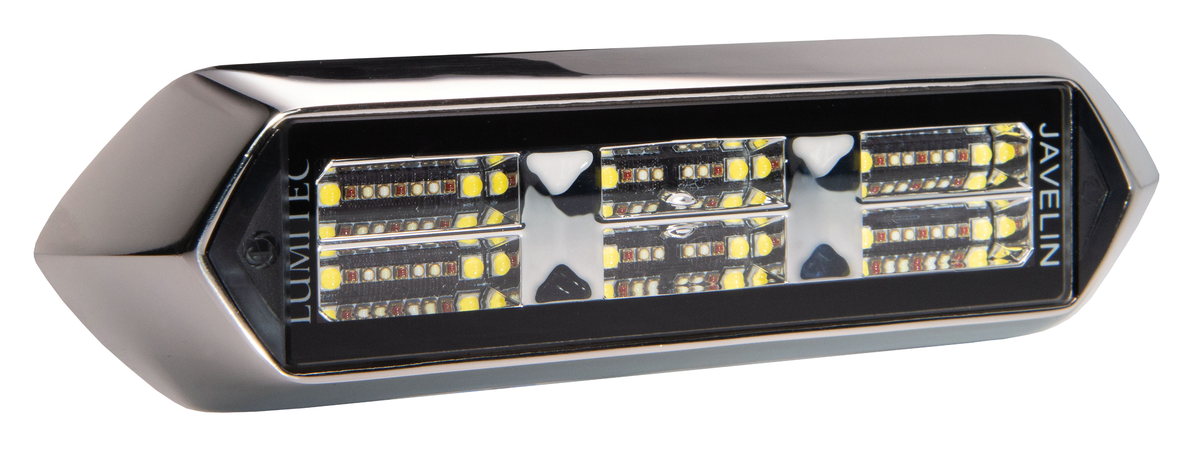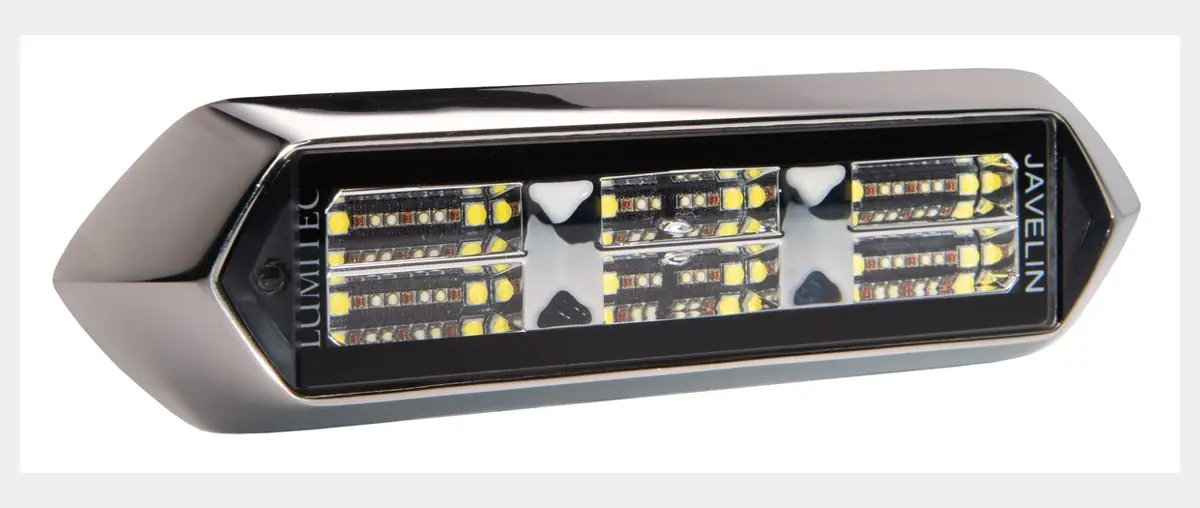
Marine-lighting manufacturer Lumitec is presenting the Javelin 600X underwater light through its 2026 METSTRADE product catalogue, combining a naval-bronze body, full-colour RGBW lighting and a manufacturer-reported output exceeding 6,000 lumens. The company describes the product as a surface-mounted fitting for high-performance boats, incorporating smart-light technology associated with its SeaBlazeX2 range. The original manufacturer image shows the elongated luminaire and its dense array of LEDs behind a protective front surface. For the owner of a 12-to-23.99-metre luxury motor yacht, an underwater light is principally a design and amenity feature. Nevertheless, choosing one brings engineering questions about waterline location, electrical protection, corrosion, heat and the effect of illumination on the marine environment. The catalogue establishes the supplier's product description; it does not document a universal underwater viewing distance or independent installation performance.
Why underwater lighting attracts owners
Illumination around the transom or stern quarters can change the way a yacht appears at anchor. The light may reveal nearby water movement and create a distinctive atmosphere for guests spending an evening on deck. The benefit is largely aesthetic rather than navigational. Such fittings are not a substitute for certified navigation lights or other equipment required by maritime rules. A yacht owner should consider the purpose of the installation and the conditions in which it will be used. A visually dramatic photograph taken in clear water may differ considerably from the effect in a turbid harbour.
What 6,000-plus lumens indicates
Lumitec states that the Javelin 600X produces more than 6,000 lumens. Lumens describe the total visible light emitted by a source under defined conditions; they do not measure how far light will penetrate every body of water. The actual impression depends on the beam pattern, light colour, mounting angle, water clarity and the presence of particles. High output can create a striking effect but also requires appropriate electrical and thermal design. Owners should request technical photometry and the conditions under which the manufacturer’s figure was obtained. The catalogue headline is not proof that the unit is brighter in every real installation than a different light with a lower nominal rating.
RGBW is more than a colour label
An RGBW light uses red, green, blue and white light sources to create different appearances. This can give owners flexibility when choosing a colour or a neutral illumination effect. However, colour settings may have different output and energy characteristics. A setting that looks bright in a demonstration room may appear subdued through greenish coastal water. If several lights are installed together, their spacing and control configuration influence whether the illumination looks consistent. The manufacturer describes full-colour RGBW output but does not promise that every colour will deliver the full quoted lumen figure simultaneously.
A solid naval-bronze housing
Lumitec specifies solid naval bronze as the material for the Javelin's body and refers to a proprietary plating process intended to provide a high-lustre finish. Material selection is important for a component exposed to seawater and potentially installed near other underwater metal fittings. Yet corrosion performance depends on the entire installation, including fasteners, connections and the yacht's bonding arrangements. Owners should follow the manufacturer's guidance and not assume that the word bronze removes all need for corrosion assessment. The appropriate precautions can differ between a fibreglass hull, metal hull and a structure with multiple underwater fittings.
The significance of surface mounting
The catalogue describes a surface-mount installation, which may be appealing when the hull owner wishes to avoid the depth of a more complex recessed arrangement. Surface mounting does not mean the installation is a casual do-it-yourself task. Cable penetrations, seals and fastener locations must remain watertight, and the hull structure must be suitable. Positioning also matters because a light that projects or sits near underwater appendages can potentially be exposed to impact or interfere with maintenance. A qualified installer should review the instructions and ensure that the unit remains accessible for future service.
Engineering the cable route
Underwater lighting usually involves cables passing into the yacht's interior, often near the stern where water, equipment and movement create difficult conditions. These penetrations deserve careful attention because they represent potential routes for water ingress if poorly installed. The cable must be protected against chafe, appropriate isolation fitted and the circuit designed for the correct voltage and current. The short catalogue listing does not provide a universal electrical schematic. Owners should require the full installation instructions and verify that the chosen mounting location can be maintained without dismantling essential equipment.
A shared control system can be useful
Lumitec says the Javelin uses smart-light technology found in its SeaBlazeX2 family. That relationship may help installers consider a coordinated lighting installation, but the precise control functionality needs to be checked against the selected hardware and system configuration. Owners should ask whether lights can be grouped, synchronised or adjusted separately, and what controls remain available if a central display fails. A sophisticated interface is attractive only when it is dependable and easy for guests or crew to use. Marketing language about smart lighting does not establish universal integration with every yacht's helm electronics.
Consider the colour of local water
Light travels and scatters differently through seawater depending on suspended particles and water composition. Blue or green effects may appear quite different between a clear Mediterranean anchorage and a busy marina with sediment in suspension. A prospective buyer should therefore look at examples in conditions comparable to those expected at their home port. The manufacturer's product image is useful for identifying the fitting, not predicting the nighttime effect in every location. Position, beam orientation and the number of lights may have a greater practical influence on the overall impression than one specification alone.
Battery and shore-power implications
Several powerful underwater fittings can create an electrical load that should be included in the yacht's energy budget. The actual consumption depends on the unit's electrical specifications and chosen operating mode; a lumen figure does not directly establish power demand. Owners who enjoy lighting at anchor should determine whether the system will run from batteries, a generator or shore power and for how long. A well-designed control arrangement can allow selective use rather than illuminating every fitting continuously. The supplier's brief listing does not give a full energy-use profile, so owners should obtain that information before specifying multiple lights.
Why placement must be carefully planned
Lights fitted too close together may produce uneven bright areas, while those positioned poorly can be obscured by hull shape or appendages. For a yacht with a bathing platform, the designer should also consider the effect on people swimming nearby. The right arrangement depends on the hull, expected waterline and where guests will view the lighting. A technical drawing showing mounting points is more useful than choosing the number of lights solely from photographs. Any installation should be assessed for watertightness, electrical safety and suitability for the vessel's operating conditions.
Maintenance below the waterline
A fitting exposed to marine growth can lose effectiveness as its front face becomes fouled. Cleaning procedures should follow the manufacturer's instructions so that optical surfaces and coatings are not damaged. An owner should also account for the fact that equipment mounted below the waterline may be inconvenient to inspect or replace while the yacht remains afloat. Regular checks may need to be coordinated with other underwater maintenance. The product's original release does not establish a maintenance-free service life. Design and servicing should be considered before the first mounting hole is drilled.
Light and the surrounding environment
Underwater illumination can affect how marine organisms behave around a vessel. The magnitude and consequences depend on species, intensity, location and duration. It would be unjustified to claim a universal environmental impact from this one product without research specific to its use. Nevertheless, owners have a responsibility to consider local guidance, protected areas and whether continuous lighting is appropriate near sensitive habitats. Decorative use can often be limited to the time guests are actually enjoying it. Brightness and energy consumption are only part of responsible design.
Appropriate use in busy marinas
A yacht's underwater lighting should never be mistaken for navigational signalling or used in a way that confuses other water users. The correct approach is to keep required navigation lights separate and maintain clear visibility when manoeuvring. Local marina rules may also govern exterior lighting, particularly where it could disturb neighbours or wildlife. The product listing does not override those rules. Owners should check the requirements of their berth and destination. A distinctive lighting scheme can be part of a yacht's personality while still being used with restraint.
What high performance does not guarantee
Lumitec markets the Javelin for high-performance boats, but that description should not be interpreted as evidence that every hull can accept the fitting. Faster yachts may experience different water flow, spray and mechanical exposure around the stern. Installation instructions and suitable mounting positions remain critical. The unit's physical shape and material are relevant, but long-term reliability also depends on the complete electrical and structural installation. Buyers should distinguish a product's intended market from an independently verified certification for their exact yacht.
Comparing underwater lights sensibly
When selecting between products, owners should examine output, beam shape, available colours, control methods, electrical demand, body materials and support arrangements. A lower-output light may be perfectly satisfactory for a modest stern area, while a more powerful fitting might be appropriate for a larger transom. The total cost includes wiring, installation and maintenance, not only the product price. A buyer should also consider whether replacement parts will be available in the yacht's cruising region. There is no universal best light for every owner or every type of water.
What the first-party listing confirms
The METSTRADE product record identifies the Javelin 600X, its naval-bronze housing, proprietary plating, full-colour RGBW capability, surface mounting and manufacturer-stated output above 6,000 lumens. It also associates the product with Lumitec's smart-light approach. The source does not supply a measured visible range in a named marina, independent corrosion trial or universal installed price. The original image depicts the actual fitting. This report explains the product and its ownership implications without inventing sea-trial results or implying that it replaces a regulated navigation light.
A considered addition to the yacht's appearance
The Javelin 600X demonstrates how a small piece of equipment can influence the atmosphere of a yacht at anchor. Its high-output RGBW specification provides design possibilities, while the naval-bronze construction and mounting method address the demands of an underwater installation. The final result will depend on water conditions, placement, control and careful technical execution. Owners should treat underwater lighting as a marine electrical project with an aesthetic objective, not simply as decoration. Done properly and used responsibly, it can enhance evening life aboard without compromising the fundamentals of safety and maintenance.
Sources and image credits
Reporting based on JAVELIN official manufacturer product specification supplied to the METSTRADE 2026 trade catalogue.
Lead photograph: Lumitec Javelin 600X naval bronze underwater LED yacht light — original manufacturer 2026 METSTRADE product photograph. © Lumitec Lighting Original official image source.