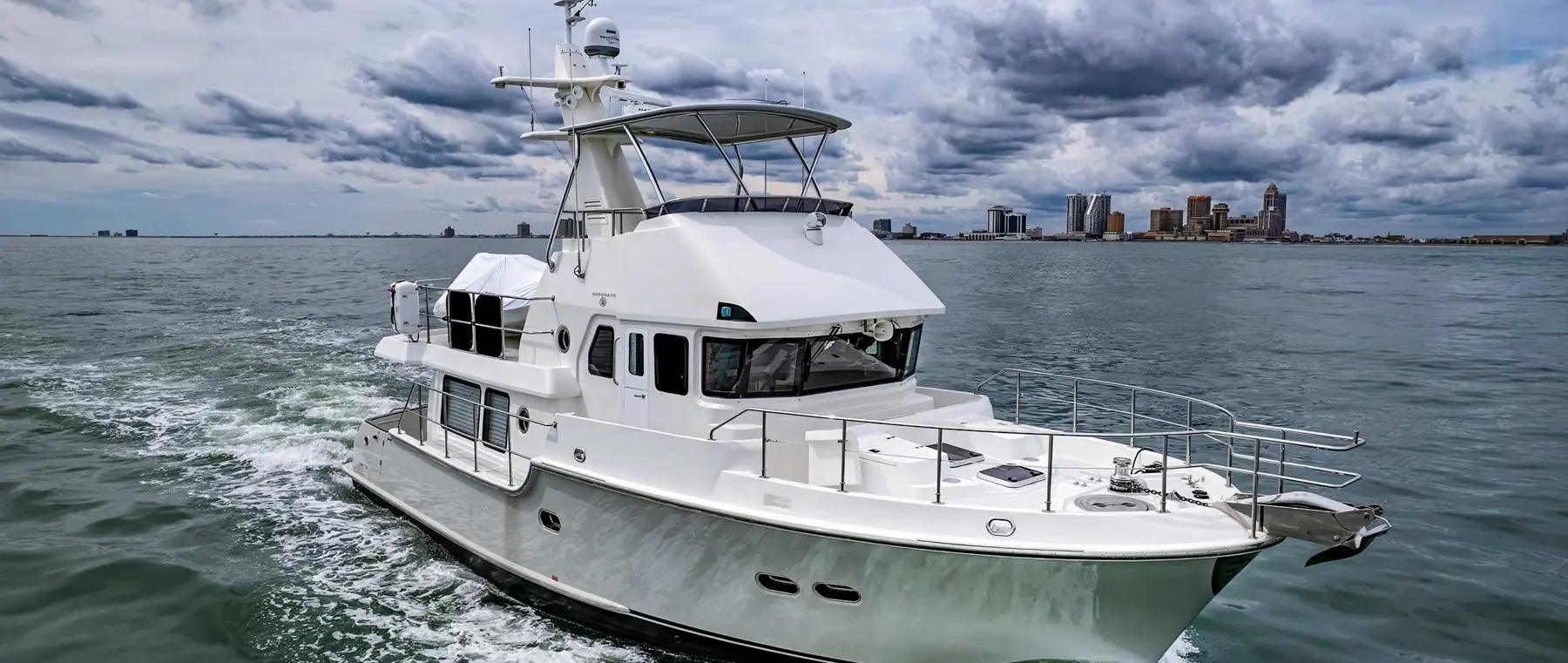
A larger boat from an established hull
The 475's roots lie in the Nordhavn 43, but the builder did more than extend the old plan. A redesigned deck and integrated flybridge produce a different silhouette, while additional length allows larger interior spaces and a more useful aft deck. This is a purposeful evolution: a cruising couple gains room to live aboard without stepping up to a vessel that necessarily demands an entirely different ownership structure.
Published principal dimensions are 14.47 metres overall, 4.52 metres in beam and 1.6 metres in draught. These figures place the 475 firmly in the smaller passagemaker category, yet it is substantially heavier and more equipment-intensive than many fast coastal cruisers of similar length. The distinction is important for owners calculating berthing, yard lifting, handling, insurance and maintenance costs.
Nordhavn describes the 475 as a comfortable couple's yacht able to host another couple or a few guests without feeling crowded. Standard accommodation includes two cabins and two heads, with flexibility in guest berths and an off-watch sleeping position. The owner's question becomes less about how many people can be entertained for an afternoon and more about how the same spaces work over successive weeks.
The logic of a single diesel
The published machinery centrepiece is a John Deere 4045 diesel rated at 180hp, with a stated range of roughly 3,000 nautical miles at around seven knots. A single main engine reduces the number of primary propulsion installations compared with twin-engine layouts, although that does not remove the need for careful maintenance and contingency planning. Experienced long-distance owners will examine the complete propulsion system, including auxiliary power and access to service points.
Fuel capacity is listed at about 4,543 litres, supported by a 1,136-litre freshwater capacity in the detailed specification. Those are considerable stores for a boat of this length, but published range estimates are always sensitive to load, fouling, sea state and chosen reserve margins. A responsible passage plan should be based on realistic consumption records for the individual vessel rather than the most optimistic number in a brochure.
The builder points to a re-engineered running-gear arrangement made possible by the longer cockpit, with the aim of quieter, smoother operation. This is not a trivial selling point: engine and propeller noise often determine whether an otherwise capable boat feels restful after many hours underway. Buyers should judge that claim during a sea trial over several engine settings, including the speeds they expect to use most frequently.
Living on deck and inside
The standard flybridge is integrated into the deck moulding and has two individual seats plus a bench, offering an additional operating and social position. From an anchorage it creates the sort of elevated view associated with much larger yachts. In exposed weather, however, the sheltered pilothouse remains the operational centre, underlining the importance of distinct spaces for different conditions.
A generous aft deck can accommodate loose seating and a dining table, with an optional barbecue arrangement mentioned by Nordhavn. The saloon also uses movable chairs rather than relying entirely on fixed seating. Such details may look modest in a brochure, yet they give owners practical control over circulation and daily use, especially when the boat serves simultaneously as a home and means of transport.
Below, owners can choose between two- or three-cabin concepts according to the specific build and configuration. A full walkthrough should pay attention to mattress access, air circulation, standing room, heads, galley workflow and storage for wet-weather equipment. True long-range comfort is measured in repeatable daily routines, not in how expansive a single photograph makes the lounge appear.
A different form of cruising value
The Nordhavn 475 is not competing to be the quickest way between neighbouring beach clubs. Its proposition is to let owners contemplate distant harbours, extended island circuits and slower passages without placing the entire programme at the mercy of frequent refuelling stops. That autonomy has real value to a buyer whose available time is measured in seasons rather than weekends.
The boat's apparently conservative single-engine layout may also appeal to owners who enjoy mechanical familiarity and an orderly maintenance programme. Equally, a prospective purchaser should examine emergency steering, electrical redundancy, communications, generator specification and service support in the regions they hope to cruise. None of those decisions can be settled by an attractive exterior profile alone.
In a market full of high-speed claims, the Nordhavn 475 offers a contrasting statement about luxury. It prioritises quiet life at sea, spaces designed for a small permanent crew and the possibility of genuinely long routes. Buyers should verify the vessel's as-built configuration, certification, survey condition and performance before using the published figures for real navigation.