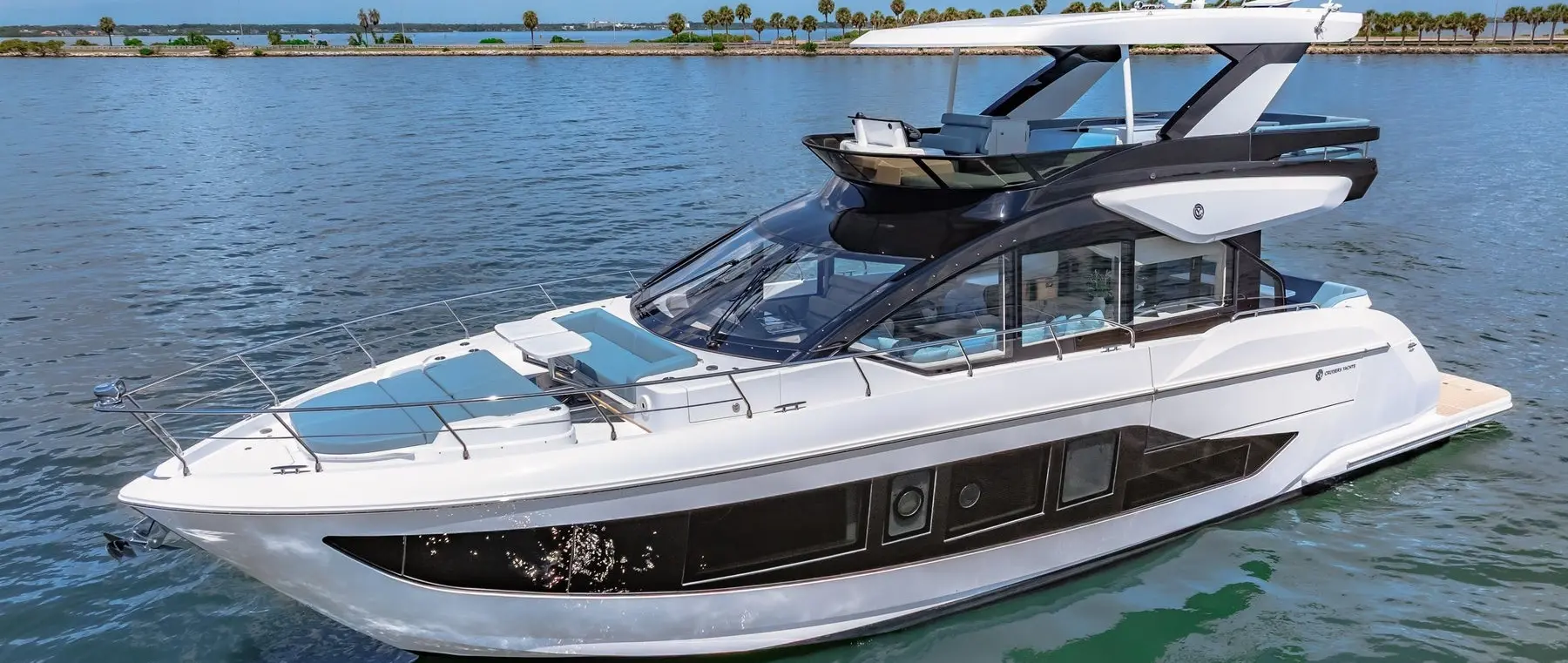
An approach built around the flybridge
At 17.4 metres overall with a beam of approximately five metres, the 57 FLY occupies a familiar berthing category, but the builder treats the upper deck as a primary social destination. Open seating, a raised helm and panoramic views are meant to make the flybridge useful throughout a day at anchor. This matters because many owners buy a flybridge yacht precisely to gain a second outdoor room rather than simply another place to steer.
The design process involved Luiz Debasto of De Basto Designs, whose contribution helps explain the emphasis on open sightlines and contemporary interior geometry. Large main-deck windows seek to maintain visual contact with the surrounding water. The combination makes the internal lounge feel more like a waterside pavilion than a conventional enclosed cabin.
Circulation between the main deck, aft veranda and swim platform is equally important to the layout. A well-designed social yacht must allow guests to move naturally from a seated meal to the water without constantly crossing the helm or passing through private accommodation. That quality is difficult to judge from dimensional specifications alone, so an in-person walkthrough remains essential.
A full-beam suite below
On the accommodation deck, Cruisers Yachts gives the owner a full-beam master stateroom with a queen berth, seating area, storage and an en-suite bathroom. The separate shower and optional laundry facilities are not decorative details; they make the yacht more comfortable when a weekend becomes a week away. Expansive hull glazing also helps turn a relatively low deck into a room with a sense of outlook.
Guest sleeping arrangements include a forward queen VIP and a third cabin fitted with side-by-side twin berths. This three-cabin arrangement should suit owners who want to host another couple and children without requiring an unusually large crew. It also presents choices about privacy, since sound separation and access to washrooms matter more as the number of overnight guests rises.
A yacht of this size is rarely all things to all people. Owners expecting to run with permanent crew should examine the optional crew accommodation and its effect on aft-deck storage or utility spaces. Those intending to cruise themselves may value the same volume differently, prioritising laundry, sports equipment or uncomplicated access to essential systems.
Dockside handling and waterside utility
The builder identifies advanced helm controls, dual Garmin displays and Volvo IPS joystick operation among the equipment shaping the upper steering station. Assisted close-quarters handling is a genuine benefit when arriving at an unfamiliar marina, but it is not a substitute for training. Owners still need to understand windage, current, propulsion limitations and safe procedures for passengers moving aboard.
A submerged-platform or waterside-access feature can dramatically improve swimming, tender transfers and water-sports activity in suitable conditions. For the 57 FLY, that connection is an important part of the design story rather than an afterthought beneath the stern rail. Equipment selection should be considered alongside the maximum permitted tender load and the storage available for safety gear.
The official specification records a draught of about 1.3 metres, a beam of five metres and fuel capacity of 611 US gallons. These figures help owners assess marina compatibility and the scale of regular coastal passages. They say less about usable range until matched with the installed engine option, actual speed, loading and reserve policy for the individual craft.
What a buyer should examine
The strongest argument for the 57 FLY is its ability to distribute social life across several distinct zones while retaining a proper private accommodation deck. Families may use the bow for quieter moments, the flybridge for open-air meals and the stern for swimming and tender activity. That flexible daily rhythm is the luxury promise behind the layout.
Trade-offs are inevitable in any 17.4-metre yacht, particularly where a generous flybridge and full-beam suite compete for engineering space. An independent inspection should concentrate on air-conditioning capacity, machinery access, noise isolation, deck drainage and ventilation in hot weather. A sea trial should include comfortable cruising, tight manoeuvring and repeated movement between steering positions.
Cruisers Yachts describes its 57 FLY as a showcase for modern entertaining, but the final judgement rests with the owner's intended use. A couple who hosts frequently may find the configuration highly persuasive, while someone planning lengthy remote cruising may evaluate stores and autonomy more critically. The point of the design is to make those priorities explicit through the way the yacht lives on the water.