Australian marine engineering company Muir has released a new volume in its Secrets of Anchoring Systems series, focusing on commissioning, handover, routine operation and maintenance of windlasses and associated anchoring equipment. Volume II, announced around METSTRADE 2026 and published on the manufacturer's own website, is intended primarily for professional crews managing larger yachts and ships. It addresses practical situations such as taking charge of an unfamiliar installation, understanding how the brake and chain stopper differ, and preparing an anchor system for passage. Although the guide's examples frequently involve vessels larger than 24 metres, the underlying need to understand equipment before relying on it is equally relevant to owners and skippers of 12–24-metre luxury yachts. The manufacturer makes an important distinction: the guide supplements a boat's operating manual rather than replacing model-specific procedures, inspections or professional instruction.
A guide written for people who operate the equipment
Many windlass manuals focus on electrical connections, installation dimensions or a specific mechanism. Those details are essential, but they may not answer every practical question that arises when a skipper takes command of a yacht fitted with unfamiliar anchoring equipment. Muir's new volume is intended to bridge the gap between design specifications and day-to-day seamanship. It explains the types of checks that belong in a commissioning handover and encourages operators to understand the system before departure. Such guidance is especially useful when a yacht changes ownership or moves between crews. The equipment may be perfectly serviceable while the people responsible for it lack a complete account of its configuration. A documented handover can reduce uncertainty, provided that it describes the actual vessel rather than a generic arrangement. Owners should recognise this as a management responsibility as much as a technical one.
What commissioning should establish
Commissioning is the process of testing and confirming that equipment has been installed and configured for its intended use. For an anchoring system, that may involve electrical or hydraulic power, control arrangements, chain handling, braking and associated structure. A successful initial test should generate documentation that the later operator can understand. The Muir guide discusses witnessing relevant tests, assembling a handover pack and taking command of an installation whose operating history may be unfamiliar. It is not appropriate to invent a universal test sequence or torque figure; these depend on the specific equipment and yacht. A captain should work from the manufacturer's documentation, relevant survey requirements and the installer or service engineer's instructions. A good handover also identifies who is responsible for later servicing and how replacement parts can be obtained when the yacht is away from its home port.
Understanding the windlass and the chain stopper
One of the guide's central messages is that a windlass, brake and chain stopper serve different functions. Their presence in one area of the foredeck can make it tempting to regard them as interchangeable, but their intended load paths are not necessarily the same. The manufacturer discusses why the chain stopper, rather than the windlass alone, is used to carry the load under specified anchoring conditions. That principle is important, although the exact configuration and operating sequence must be confirmed for the installed system. Some yachts use different combinations of windlass, chain stopper and snubbing arrangements. A crew should never assume that the method used on a previous vessel is safe on the next one. Understanding which component is designed to hold a particular load is a fundamental part of safe operation, and it belongs in both training and written procedures.
The brake is not simply an on-off control
Muir gives attention to brake handling because it can be misunderstood by operators who have not examined the design of their particular windlass. Brakes may be used during deployment or retrieval, while the chain stopper and other securing arrangements have distinct roles. The guide discusses why the order in which mechanisms are used matters, but readers should not treat a news article as a substitute for supervised training or product instructions. Different installations can impose different requirements, and incorrect handling of a heavy chain presents significant injury and equipment risks. Owners can use the publication as a prompt to ask clear questions during handover: which parts are load-bearing, what checks are expected before movement and which signs indicate abnormal operation? A crew that understands the reasons behind a procedure is usually better placed to recognise when an unfamiliar situation requires professional help.
Deployment and recovery as separate operations
Lowering an anchor and retrieving it are not simply reverse versions of the same task. During deployment, operators need to manage the movement of chain and the position of the vessel. During recovery, they may encounter changes in load, chain angle, seabed holding and the movement of the yacht. The guide covers both phases and discusses the importance of attending to unusual sounds, movement and resistance. The exact operating techniques depend on windlass design and the yacht's equipment, so a responsible skipper should consult the specific manual and established procedures. Crew communications are equally important, especially when the helmsman and the person at the bow cannot easily see one another. A good system should make the state of the anchor and chain clear enough for decisions to be made without guesswork. Technology can assist, but situational awareness remains essential.
Securing the system for passage
An anchor arrangement that is acceptable while lying at anchor may need additional measures before a yacht goes to sea. Muir's guide describes layers of underway security and encourages crews to confirm that an anchor is properly restrained and stowed before departure. This is a useful reminder for owner-operated yachts, where a single person may be responsible for numerous preparations at once. A departure checklist can reduce the chance of forgetting a critical item, particularly after a busy night at anchor. Yet the checklist must reflect the actual vessel rather than repeat a generic template without verification. A yacht with a retractable anchor or unusual bow arrangement may need different checks from one with exposed chain and a conventional roller. Reliable practice means understanding those differences and making sure the crew can identify a problem before it becomes an emergency.
Chain twist and the importance of inspection
Anchor chain is exposed to repeated changes in direction, load and environmental conditions. Twisting can affect how it travels through components and how it lies in the locker. The guide includes a section on preventing and addressing chain twist, but the correct remedy will depend on the equipment and severity of the problem. Owners should not attempt a repair while a chain is under uncontrolled load or moving. Instead, regular inspections can help identify changes early, including damage, corrosion, unusual wear and alterations in how the chain feeds. Visual checks should be supported by service records and, where necessary, professional inspection. A chain can appear sound from a distance while requiring closer assessment. The annual maintenance programme should include the anchoring system as a whole, rather than focus solely on the windlass motor.
Preparing for emergencies
A reliable anchoring system can still be affected by power loss, mechanical failure or unexpected loading. Muir includes material on abnormal situations and encourages crews to rehearse appropriate responses. The purpose of training is not to predict every failure, but to ensure people know where to find the correct procedures, who has authority to make decisions and how to keep clear of dangerous equipment. A heavy anchor chain stores significant potential energy, so improvisation can create severe risks. A skipper should know the vessel's emergency arrangements and seek specialist instruction where they are unclear. The guide is not a universal emergency manual; it must be interpreted alongside the actual equipment documentation and the yacht's safety procedures. The value for an owner lies in reducing the number of decisions that would otherwise have to be made from scratch under pressure.
What a yacht owner should retain in the records
A completed handover should leave more than a verbal explanation. The owner or management team should maintain operating manuals, equipment identification, drawings where available, service history and details of competent support providers. The appropriate files should be accessible to the captain or skipper when the boat is away from the builder. If a yacht is sold, the information can help the new owner understand its condition and operating requirements. Muir's publication can serve as a framework for questions to ask, but it does not replace records specific to the installation. This is especially relevant for yachts that have been refitted or modified. A replacement windlass, altered chain or changed control arrangement may make an older manual incomplete. Keeping the documentation consistent with the equipment is part of responsible ownership and supports safer decision-making.
How the three volumes fit together
Muir describes Volume II as the operational part of a three-volume series. Volume I addresses design, layout and installation, while Volume III offers a wider anchoring guide for recreational crews. Each has a different audience, but the subjects connect. Decisions made during design affect how equipment can be operated and serviced, while the crew's practical experience can inform later improvements. The manufacturer says the publications are intended as living documents, with feedback from users contributing to future revisions. That approach can be valuable if the company updates the material responsibly and makes changes clear. Owners should retain the edition and publication details of any guidance used during training. A living document is not a guarantee that all previous instructions remain correct; current technical documentation still takes priority whenever the manufacturer issues a change.
Relevance to the 12–24-metre fleet
The new volume often discusses superyacht-level systems, and it would be misleading to present every example as directly applicable to a smaller cruiser. The loads, number of crew and equipment arrangements of a 70-metre vessel can differ radically from those aboard a 16-metre yacht. Nevertheless, a smaller boat may have sophisticated windlasses, automatic controls and heavy ground tackle. Its owner may also operate without a full-time engineer, making clear documentation even more important. The principles of understanding equipment, inspecting components and preparing for failure are broadly useful. Where the guide discusses larger-system techniques, a skipper should translate them only with help from the manufacturer or qualified technician. Learning from professional maritime operations is valuable, but copying procedures across different equipment without assessment is not.
The people behind the guide
The manufacturer's material credits general manager Max Buckley and contributions from practitioners, including experienced maritime professionals. Muir states that the publication combines its engineering experience with lessons learned by crews and service teams. That combination matters because equipment makers and operators can observe different aspects of the same problem. A design may meet specifications yet create practical difficulties when accessed or maintained at sea. Feedback from experienced crews can reveal those issues and inform both instructions and future products. It should not be treated as a guarantee that every installation is trouble-free, but it is a constructive way to develop guidance. Owners can also contribute by documenting recurring problems and sharing them through appropriate service channels. Knowledge improves when operating experience is recorded rather than confined to the memory of a departing crew member.
A practical development beyond product marketing
The 16 November announcement places Muir's free Volume II guide within the METSTRADE 2026 programme and makes it available through the company's resource hub. Unlike a new windlass launch, this development concerns the knowledge required to use equipment that is already fitted to many yachts. That is noteworthy because mistakes in commissioning, documentation or procedure can undermine otherwise capable machinery. For Luxury Yacht Guide readers, the most useful response is to review the state of their own vessel's anchoring records and identify any gaps that require a professional explanation. The guide can inform that conversation, but it cannot authorise an unsafe operating method or replace the manufacturer's manual. Good seamanship depends on the relationship between well-specified hardware, clear information and trained people. This release addresses the information part of that relationship.
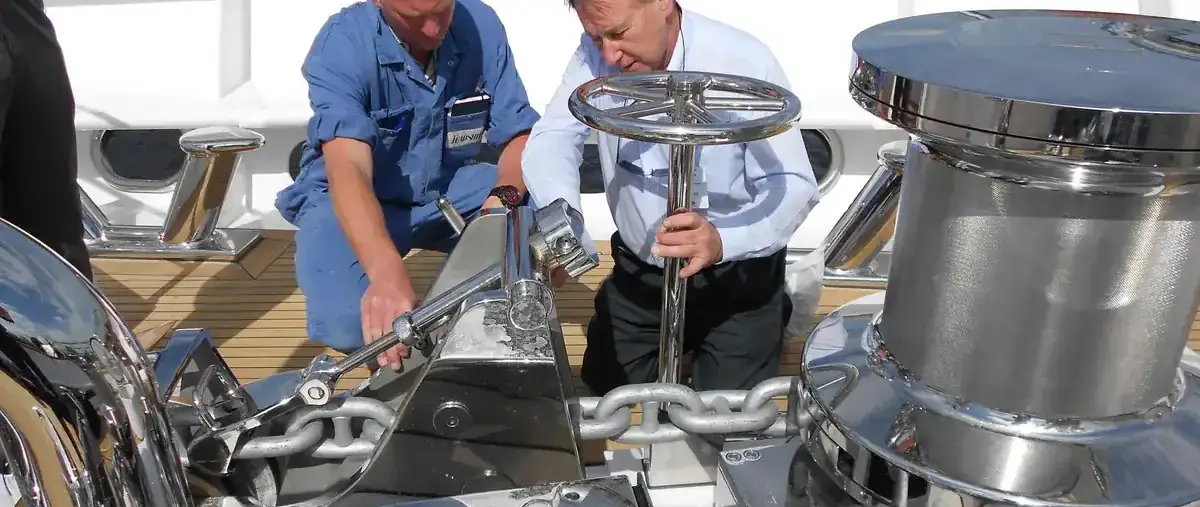
Sources and attribution: Muir Engineering's original Volume II publication and the manufacturer's 16 November 2026 release via METSTRADE. Lead photograph: Muir's own image of technicians examining a yacht windlass brake and chain-stopper arrangement. The article is educational news coverage; yacht-specific operating procedures must follow manufacturer instructions and qualified professional guidance.
Sources and image credits
Reporting based on Muir Engineering official 2026 Volume II publication, commissioning and operations chapters, Muir Anchoring Systems original 16 November 2026 trade release via METSTRADE.
Lead photograph: Muir engineering team operating windlass brake and chain stopper on a yacht deck, 2026 official guide image. Photograph: Muir Engineering, two specialists examining the windlass brake handwheel and chain stopper on a yacht foredeck; original image published within the new Volume II guide. Original official image source.