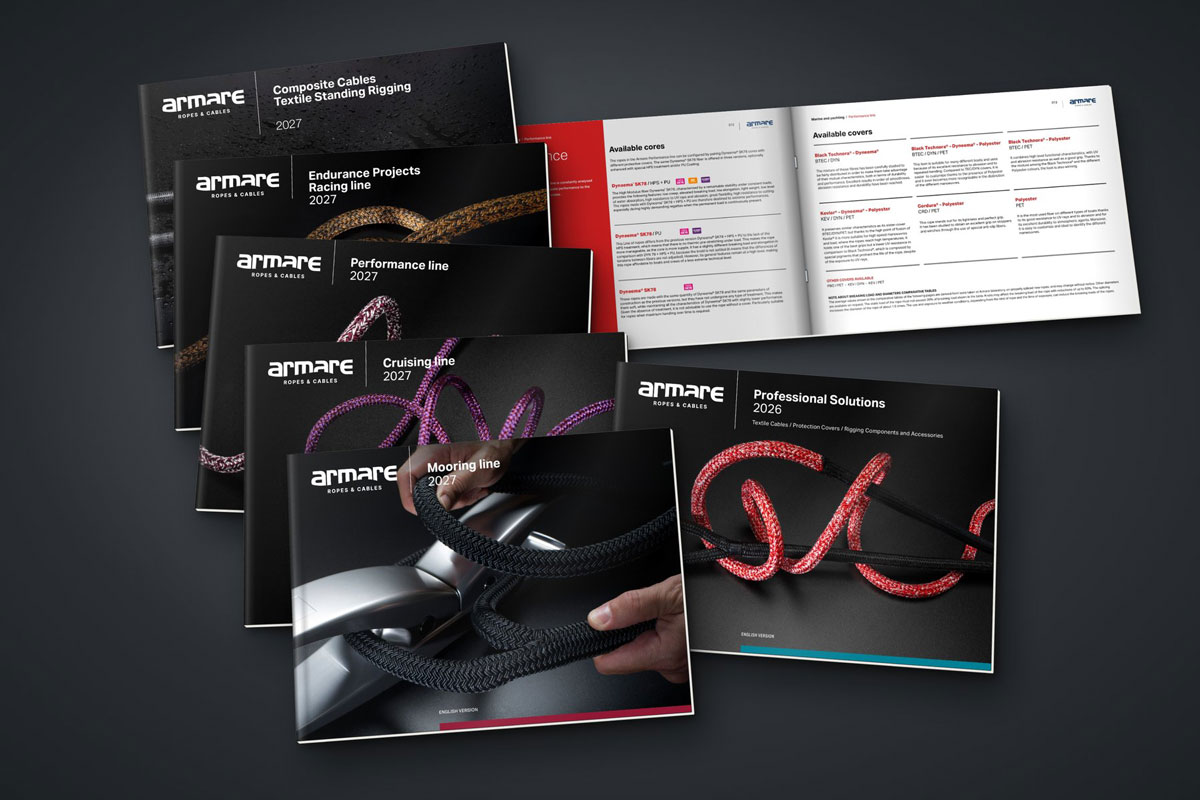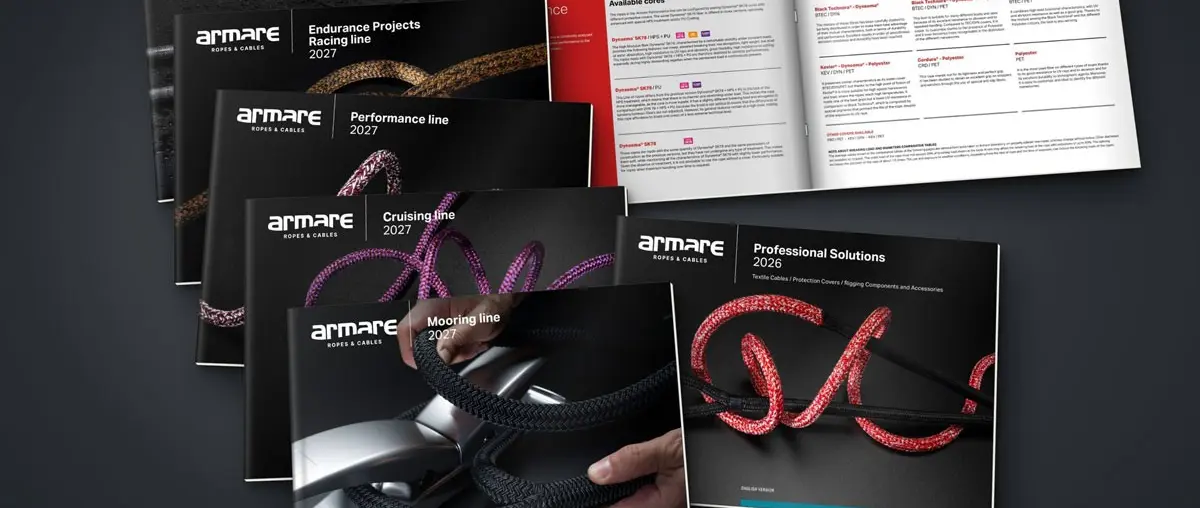
Italian rope and rigging specialist Armare Ropes & Cables has published its 2027 collection of product catalogues, giving yacht owners, riggers and technical teams updated information on lines for racing, cruising, mooring and more specialised applications. The announcement, released on 12 November 2026, covers six principal areas: Endurance Projects & Racing, Performance, Cruising, Mooring, Composite Cables & Textile Standing Rigging, and Professional Solutions. Each section brings technical information together with guidance about intended use, reflecting a market in which rope construction can be as important as diameter or price. For 12–24-metre luxury sailing and motor yachts, the practical significance lies in how carefully selected lines influence sail handling, berthing safety, comfort and future maintenance. The new documents are reference materials, not evidence that every listed rope has been redesigned or that one construction is suitable for all applications.
More than a collection of colours
Modern yacht rope comes in a wide range of appearances, but its important differences often lie beneath the cover. Core fibres, braid construction, stretch, abrasion resistance, handling characteristics and environmental exposure can determine whether a line is appropriate for a particular job. Armare says the catalogues aim to make those differences clearer through updated product sheets and technical information. Owners should not select a halyard merely because a colour matches the yacht's sail covers or upholstery. The line must withstand the expected forces and operate properly through winches, clutches and sheaves. Appearance can still matter when a bespoke interior or deck scheme is being planned, but it follows the engineering requirement. A good catalogue provides the information needed to ask the right questions before ordering.
Endurance Projects & Racing
The Endurance Projects & Racing catalogue concentrates on demanding competition and development programmes. Armare lists constructions using high-performance fibres including Dyneema SK78, SK99 and DM20, with technical covers involving materials such as PBO-Zylon, Technora and Kevlar. These names identify families of fibres rather than guaranteeing any one finished line's performance. Fibre selection must be considered together with construction, coating, termination and the forces experienced during use. Racing applications may prioritise low elongation and minimum weight, but those priorities may be less important than durability and ease of handling for a cruising owner. The catalogue's value is that it brings specialist options into a defined reference section. A yacht owner should discuss any proposed upgrade with a rigger familiar with the rig and its hardware rather than assume that the most expensive fibre is always the best choice.
Performance lines for active cruising
Armare's Performance range is aimed at fast cruisers and club racers, a category that can overlap with larger owner-operated sailing yachts. It includes configurable products using Dyneema SK78 and Vectran cores with different cover constructions. The aim is to balance performance, durability and functionality, rather than optimise one measure in isolation. A line that stretches less may improve sail-control precision but can also transfer loads differently through fittings. Some covers improve grip in a clutch while others may behave differently under repeated abrasion. Owners who change rope specifications should therefore check the effect on the complete deck arrangement. The catalogue is a tool for comparison; it cannot replace observing how a particular line behaves on the boat after correct installation and professional checking.
Cruising lines and everyday reliability
The Cruising catalogue addresses running rigging used for sheets, halyards, tackles, vangs and similar applications. Armare says it has drawn on racing experience while considering cost and practical life aboard cruising yachts. This is an important distinction because a vessel may sail for many seasons without needing the extreme performance characteristics specified for a competition programme. Owners may instead prioritise predictable handling, low maintenance and a reasonable replacement schedule. Some products incorporate high-modulus cores, while others use constructions better suited to general use. Clear guidance on each line's intended application helps prevent a purely cosmetic selection. The correct choice must still take into account winch compatibility, rope diameter, load and the owner's sailing style. Long-term reliability is often more valuable than a theoretical performance gain that cannot be used safely.
Mooring equipment for sailing and motor yachts
The Mooring catalogue is relevant to a particularly broad audience because both motor and sailing yachts rely on appropriate lines when berthed. Armare includes conventional and floating mooring ropes, along with options for custom lengths, diameters, colours and finishes. A dockline's suitability depends on the yacht's displacement, the berth, cleats, expected movement and exposure to chafe. The catalogue's availability does not mean that a line described as floating should be used in every mooring situation. It may have advantages in some arrangements and disadvantages in others. Owners should also consider the way lines are secured and protected at contact points. Good mooring practice combines correctly chosen rope with an understanding of the berth and weather, not simply a premium product label. Manufacturer guidance and competent seamanship remain essential.
Custom splicing and protective finishing
The company highlights splices and protective materials available across its mooring range. A well-executed splice can create a clean termination, but its design and strength must be appropriate to the rope construction. Improperly made or incorrectly specified terminations may compromise the system even when the rope itself is strong. Owners who want custom lengths should ensure that finished dimensions include the intended splice and any protective components. Abrasion sleeves or chafe protection can be useful where a line passes through a fairlead or contacts an edge, but they also need inspection. A line can become damaged beneath a cover if deterioration goes unnoticed. The benefit of customisation is not simply achieving a distinctive look. It is the ability to produce equipment that fits the yacht and berth when the requirements have been accurately established.
Composite cables and standing rigging
A separate catalogue covers composite cables and textile standing-rigging systems, drawing on Armare's experience with high-performance racing programmes. The range includes technical fibres, terminals, loops, strops and related components for demanding applications. These products operate in a different context from ordinary sheets or mooring lines. Standing rigging must support a structure under sustained and changing loads, so material selection and engineering review are critical. Owners should never substitute a textile component for a metal stay solely on the basis of its advertised strength. Fatigue, connection design, environmental exposure and inspection requirements matter as well. Armare describes engineering, quality control and maintenance support as parts of its wider offering. Those services may be just as important as the rope itself when a custom application is considered.
Professional Solutions for technical teams
The Professional Solutions catalogue gathers items used by riggers, sailmakers and technicians, including textile cables, soft shackles, webbing, protective covers, sewing materials and splicing products. These are the components and tools that support the maintenance and construction of modern rigging systems. A professional assortment can help standardise work, but the presence of a product in a technical catalogue is not a qualification to use it without training. Soft shackles, for example, must be made and applied correctly to work as intended. Owners can benefit from knowing that specialist supplies and support are available, while leaving critical fabrication and installation to qualified people. A yacht's maintenance programme should record relevant line specifications and replacement history so that later repairs do not depend on memory or guesswork.
Choosing rope for deck hardware
A line's performance depends partly on the equipment it passes through. Clutches, winches, sheaves and fairleads are designed around particular ranges of diameter and construction. A high-tech replacement may change how a clutch grips or how a rope winds onto a drum. Before upgrading, owners should review the manufacturer's specifications and inspect wear points on the existing arrangement. A line that is too small may slip or become difficult to handle, while an oversized one may not run freely. Surface finish and cover materials can influence friction and durability. The Armare catalogues provide a starting point for these comparisons, but a complete assessment may require advice from the rope maker and hardware manufacturer. The strongest result is a coordinated system rather than an isolated upgrade.
Practical inventory management for cruising yachts
Owners who keep yachts in more than one location or plan long passages can benefit from accurate rope inventories. Recording material, size, purpose, purchase date and condition makes it easier to order replacements and assess whether lines are approaching the end of their service life. Colour coding can help crew members identify controls quickly, but only if its meaning is consistent and documented. A catalogue with clear product information can help management teams distinguish similar-looking lines. Replacement planning should also reflect how equipment is actually used. A regularly loaded halyard may require different attention from a spare dockline kept in a locker. The goal is not to replace rope unnecessarily, but to avoid a critical failure caused by neglected inspection or an incorrect substitute.
Sustainability and the claims behind materials
Technical ropes may employ advanced synthetic fibres, each with different production and end-of-life characteristics. The fact that a construction lasts a long time can be relevant to resource use, but it does not automatically establish a low environmental footprint. Manufacturers should be asked for evidence supporting any particular sustainability claim. Owners may also consider practical measures such as purchasing correct lengths, protecting lines from unnecessary abrasion and avoiding premature replacement through poor storage. The 2027 catalogue announcement does not publish a lifecycle assessment for the full product range, so no quantified environmental advantage should be inferred. Responsible selection begins with fitness for purpose and continues through maintenance and disposal. For luxury yacht operators, those decisions can reduce wasted expenditure as well as material use.
Digital access and support
Armare says the catalogues can be browsed online and downloaded after registration through its website. This makes the documents accessible to international customers who may be unable to visit a distributor in person. However, a static catalogue may not reflect current stock or the details of a custom project. Buyers should obtain an updated quotation and check technical specifications with the manufacturer or an authorised supplier before ordering. A useful digital reference should also be preserved alongside the yacht's maintenance records so future crew can understand why a particular product was selected. Where a line is custom-made, the final production specification is more important than a generic catalogue description. Good documentation helps ensure that servicing remains consistent through changes of ownership or crew.
What the 2027 catalogue release establishes
The confirmed development is Armare Ropes & Cables' publication of six updated product catalogues in November 2026, covering racing, performance, cruising, mooring, composite rigging and professional supplies. The release demonstrates the breadth of the company's offering rather than documenting a single new yacht installation. For Luxury Yacht Guide readers, it provides an opportunity to revisit how ropes are specified and maintained, particularly as a vessel's sails, hardware and cruising programme change over time. A premium line is worthwhile when it meets a clearly understood technical need and can be serviced properly. The strongest value of the new catalogues lies in making informed comparisons possible. Owners and riggers should use them as part of a disciplined selection process, supported by the relevant manufacturers' current technical advice.
Sources and image credits: Armare Ropes & Cables' official 12 November 2026 announcement of its 2027 catalogues and original catalogue-cover promotional photograph. All product families and fibre references are attributed to the manufacturer; practical specification and maintenance commentary is independent Luxury Yacht Guide analysis.
Sources and image credits
Reporting based on Armare Ropes & Cables original 12 November 2026 catalogue announcement.
Lead photograph: Armare Ropes & Cables 2027 catalogue cover announcement, original manufacturer image. Image: Armare Ropes & Cables, official 2027 catalogue-launch graphic from its November 2026 manufacturer announcement. Original official image source.