Danish manufacturer Hundested Propeller has introduced its first five-blade controllable-pitch propeller, extending a range previously centred on three- and four-blade designs. The development, announced in November 2026 and presented through the BSI Marine Equipment Group at METSTRADE, responds to demanding propulsion briefs that combine low underwater noise, strong blades, high efficiency and the possibility of recovering energy while sailing. Hundested says its first version was engineered with a stainless-steel hub and built for Ice Class and Silent-R requirements. Those details make it a highly specialised project, not a universal replacement propeller that can automatically be fitted to every production yacht. For 12–24-metre sailing and motor yacht owners, the news is relevant because it illustrates the design trade-offs influencing quieter and potentially more flexible marine propulsion systems. Whether the new configuration is suitable for any particular yacht requires a project-specific engineering assessment.
What the fifth blade changes
A propeller creates thrust by transferring energy from a rotating shaft to the surrounding water. Blade count is one of several design variables, alongside diameter, pitch, section shape, rotational speed and the way water arrives at the propeller. Hundested says adding a fifth blade gives designers another way to distribute load across the propeller, reducing the demands on individual leading and trailing edges. The manufacturer links this to lower noise and improved performance without making each blade excessively large. That is the design intention, not a guarantee that adding one blade to any existing propeller will automatically make a boat quieter. The relationship between propeller geometry and performance is complex. A poorly matched five-blade design could be less efficient than a well-matched propeller with fewer blades, which is why the company emphasises balancing several requirements rather than chasing one headline measure.
Controllable pitch adds another dimension
The system is described as a controllable-pitch propeller, meaning blade angle can be adjusted rather than remaining fixed across every operating condition. Pitch control can be useful when a vessel moves between motoring and sailing or when the load on the propulsion system varies. It introduces additional mechanical and control requirements, however, and does not provide an automatic performance advantage in every installation. The designer must consider drivetrain compatibility, operating speed, intended pitch range and the consequences of a failure or servicing problem. Owners comparing propulsion options should distinguish the general concept from the exact Hundested product. A five-blade controllable-pitch unit built for an ice-capable vessel may differ substantially from the system appropriate for a moderate-displacement cruising yacht. The potential benefits are interesting, but they have to be established through the engineering brief and technical documentation.
Noise matters more than ever to yacht owners
Underwater noise has become an important part of marine propulsion design, both for comfort aboard and in wider discussions of environmental impact. Some noise comes from machinery and structural vibration, while propeller behaviour can contribute through pressure fluctuations and cavitation. A manufacturer may seek to reduce those effects by changing blade area, pitch or other characteristics. Hundested's announcement explicitly identifies low noise as a priority, and the Silent-R reference signals the demanding nature of its first brief. It does not provide a public decibel comparison between a new five-blade unit and a particular four-blade installation. A responsible report therefore cannot claim a numerical noise reduction. Yacht owners can still ask builders for measured acoustic data relevant to their intended operating speeds, rather than relying on a general promise of quietness. Comfort is best assessed in the complete vessel.
Strength for more demanding waters
The first propeller was designed for Ice Class requirements, according to the maker. Such classification constraints influence material choice, structural strength and the ability to withstand specified conditions. They should not be interpreted as meaning that a yacht fitted with the propeller is itself ice-classed. Classification applies to the vessel and its systems under particular rules, and one component does not confer a status on the whole boat. The manufacturer's challenge was to maintain efficiency while meeting strength expectations that can make blades heavier or more conservative in shape. That is a useful example of the competing demands encountered in marine engineering. A propeller may need to withstand difficult service conditions without imposing excessive drag or vibration. The result is achieved through a complete design process, not simply by selecting a stronger material.
Regeneration while sailing
Hundested also identifies efficient regeneration under sail as part of the brief. On some hybrid or electric sailing vessels, a suitable drivetrain can use the movement of water past the propeller to recover energy while the yacht sails. The propeller is then operating in a different mode from ordinary powered propulsion. The potential electrical output depends on many factors, including vessel speed, shaft arrangement, pitch control, generator efficiency and the drag penalty incurred. The new five-blade design was intended to perform across both propulsion and regeneration modes, but the announcement does not establish how much electrical energy would be available on any specific yacht. Owners should avoid treating regenerative capability as free power without a sailing-performance cost. An engineering comparison should include the energy recovered, equipment complexity and effect on boat speed in realistic conditions.
Computational fluid dynamics in the design process
Hundested says it uses computational fluid dynamics, or CFD, to assess how blade designs are likely to perform against the initial propulsion brief. CFD provides a way to model fluid flow and compare alternatives before committing to manufacture. It is a valuable tool, but its output depends on the assumptions and numerical methods used. Physical testing and later operating evidence remain important. The manufacturer describes balancing efficiency, noise, strength and regeneration rather than simply optimising one value. That is sensible because improvements in one dimension can create costs elsewhere. An owner looking at a custom propulsion system should ask what the brief actually prioritises: low-speed manoeuvring, long-distance efficiency, low acoustic signature, higher cruising speed or reduced drag under sail. The right balance may differ between a 15-metre cruiser and a much larger specialist sailing vessel.
Pitch, diameter and available space
Propeller diameter can be constrained by hull clearance, draft and other elements of the stern arrangement. A five-blade design may allow certain performance objectives to be pursued within those limits, but the final geometry must still respect the yacht's physical constraints. The wake arriving at a propeller is rarely perfectly uniform, especially behind a complex hull or close to appendages. Designers may need to consider the interaction with the rudder, shaft support and nearby structure. Owners should therefore resist the idea that the propeller can be selected independently from the rest of the yacht. A retrofit may involve changes to the shaft, controls or other equipment, making the total cost different from the price of the propeller alone. Good engineering begins with the complete vessel arrangement and its actual operating requirements.
The significance of the stainless-steel hub
The press release states that the first five-blade controllable-pitch propeller uses a stainless-steel hub. That material choice is one part of a wider design incorporating the blades, internal mechanisms and associated drivetrain. It should not be taken as evidence that every component is stainless steel or that corrosion can be ignored. Marine propulsion systems contain different metals, seals and moving parts that require appropriate protection and maintenance. A classed installation may also need documentation of materials, manufacturing and inspections. Owners comparing products should ask about service access, replacement components and how the pitch mechanism is maintained. These practical questions become especially important for yachts operating far from a specialist service base. A sophisticated propeller can support a capable vessel, but it must be accompanied by a realistic maintenance and spares strategy.
Where the new propeller fits within the market
Hundested's announcement addresses the superyacht and commercial marine sectors, and its first application is described through demanding class and noise requirements. It does not publish a full dimensional range or confirm that the system is available as a drop-in choice for a 12-metre yacht. Luxury Yacht Guide's editorial interest is therefore in the technical development and its potential relevance to future designs. Larger cruising sailboats and hybrid projects increasingly need to reconcile quiet propulsion with energy management, and new approaches from specialist manufacturers can influence the options available to naval architects. That does not mean every technology will migrate unchanged into smaller production yachts. Price, space, weight and service support can all determine whether a particular design becomes commercially practical. The sensible response is to follow further specifications and installations rather than announce compatibility prematurely.
A photograph of the actual development
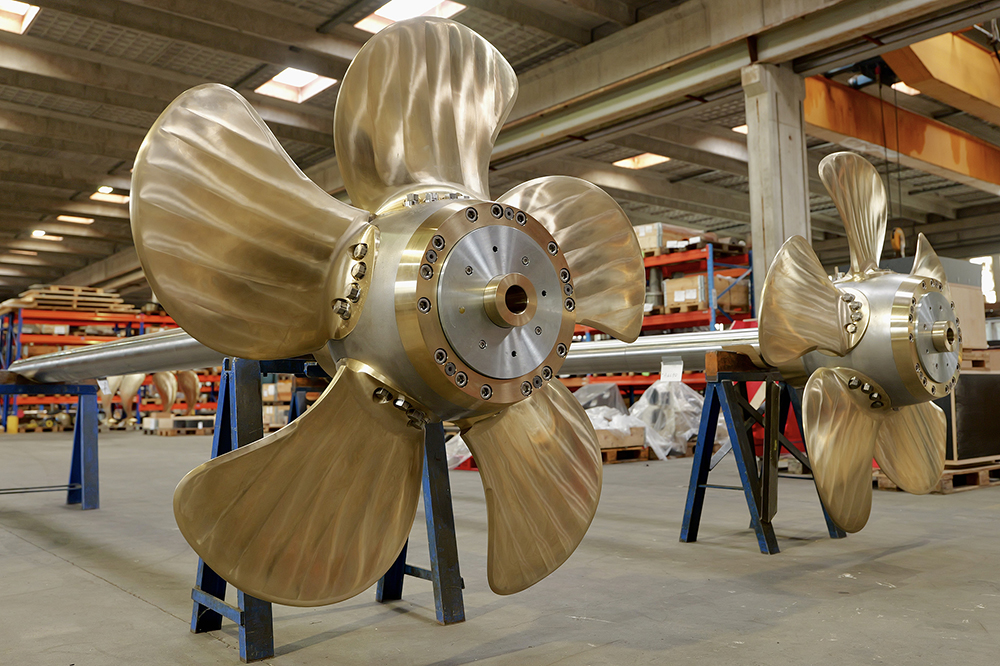
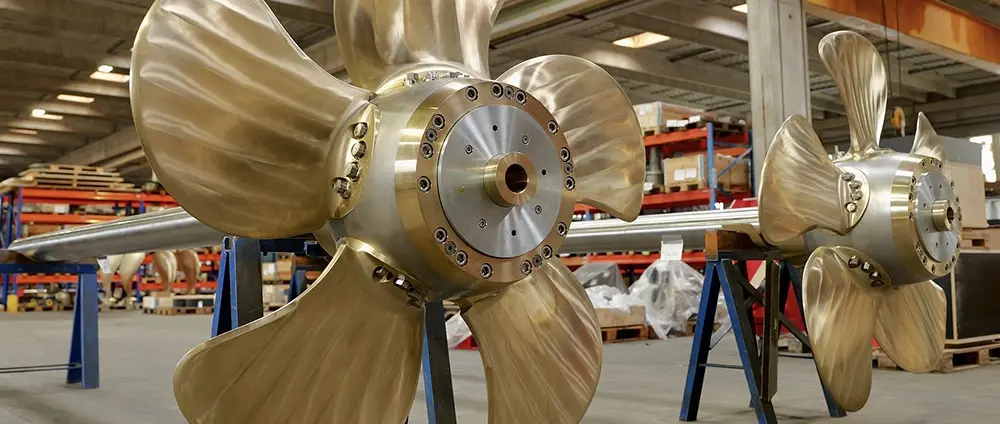
The manufacturer's official image shows large propeller assemblies in a workshop, including the five-blade arrangement described in the announcement. It is useful evidence of a physical product rather than merely a concept rendering. Still, a workshop photograph cannot demonstrate underwater performance or the outcome of acoustic testing. It shows form, scale and material finish but not the numerical values an owner would need for a final specification. This distinction is central to technical journalism. A product can be genuinely manufactured and still require independent evaluation before its performance claims can be generalised. The photograph should also not be confused with a completed yacht installation unless the maker identifies one. For readers, the image provides context for the blade layout while the text explains the manufacturer's engineering objectives and the remaining questions.
Why METSTRADE is a useful venue for this announcement
The development was presented within the BSI Marine Equipment Group's METSTRADE 2026 programme in Amsterdam, where propulsion and equipment specialists meet builders, designers and suppliers. Such exhibitions allow technical discussions that are difficult to communicate through a short promotional image. Engineers can ask about pitch mechanisms, classification requirements and the way a propeller would be integrated with a particular gearbox. The manufacturer's presence at the show does not establish a new sales contract or a production quantity unless separately announced. Instead, it provides a context in which an early technical development can be examined by potential customers and industry professionals. For a luxury yacht owner planning a new-build or extensive propulsion refit, the relevant outcome would be a properly documented proposal from qualified engineers, not a decision based on show publicity alone.
A careful approach to retrofitting
Changing a propeller can affect engine load, vibration, manoeuvring and the interaction of mechanical and control systems. A controllable-pitch installation may involve changes beyond the underwater component, so it should be assessed by the builder or a competent marine propulsion specialist. Owners should establish whether the current equipment is operating correctly before assuming that an alternative blade arrangement is necessary. Performance complaints may arise from hull fouling, damaged blades, shaft alignment or other causes rather than the propeller design itself. A detailed review can help avoid expensive modifications that fail to address the underlying problem. The maker's new five-blade design broadens the range of engineering possibilities, but it does not remove the need for diagnosis. This is particularly important for owner-operated vessels where reliability and local service access may be more valuable than maximum theoretical performance.
The next evidence to watch
The confirmed November development is Hundested's first five-blade controllable-pitch propeller, produced with a stainless-steel hub and designed to satisfy demanding noise, ice and regeneration requirements. The manufacturer describes the use of CFD and balancing several performance goals rather than optimising only efficiency. What remains unknown from the public announcement includes detailed performance curves, production availability for particular vessel sizes and results from a broad set of operating installations. Those would be the most useful next milestones for independent evaluation. For 12–24-metre luxury yachts, the story is best understood as an engineering advance that may inform future propulsion choices, not a new compulsory upgrade. The wider lesson is that quietness, strength and energy management must be addressed together within a complete vessel design.
Sources and attribution: Hundested Propeller's original November 2026 manufacturer announcement and the company/BSI Marine Equipment release published through METSTRADE. The lead image is the actual manufacturer workshop photograph of the new five-blade assemblies. Technical claims are attributed to Hundested, with independent explanation of design trade-offs and limits to the available evidence.
Sources and image credits
Reporting based on Hundested Propeller November 2026 official manufacturer five-blade propeller release with photograph, Hundested / BSI Marine Equipment official November 2026 product release at METSTRADE.
Lead photograph: Hundested first 2026 five-blade controllable-pitch propellers, official engineering workshop photograph. Photo: Hundested Propeller A/S, original manufacturer image showing the newly developed five-blade controllable-pitch propeller assemblies in the workshop. Original official image source.