British marine technology company RAD used METSTRADE in Amsterdam on 17–19 November 2026 to present an updated Power console alongside live demonstrations of Axon, its vessel-control and autonomy platform, and an updated mobile application. The manufacturer's 17 November announcement is notable because it brings propulsion, energy storage, helm controls and connected vessel systems into one discussion rather than treating them as separate products. For 12–24-metre luxury yacht owners, the immediate relevance lies in the operation of electric tenders, auxiliary vessels and the growing expectations placed on onboard monitoring. It would be a mistake, however, to interpret a trade-show demonstration as permission to operate an unmanned vessel in every harbour. Integration, operator training, safety assessment and the applicable rules remain essential.
The Power console combines several jobs
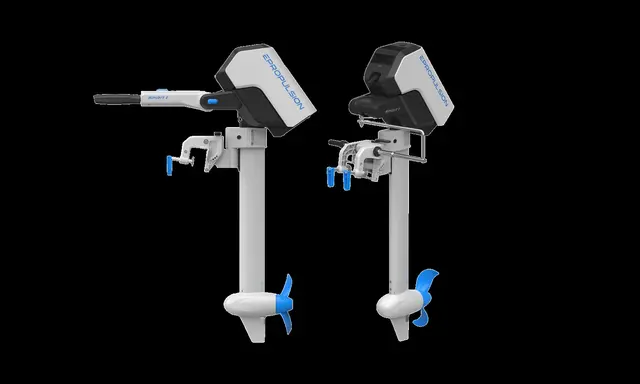
RAD describes its Power console as an all-in-one propulsion package that pairs the company's 40-kW RAD 40 electric outboard with a helm and onboard battery storage. The latest version has a refined layout, improved range and reduced overall weight, according to the manufacturer. The package is aimed at installations where the equipment needs to be deployed without designing a control architecture from the beginning. That proposition is relevant to builders of small working craft and high-end tenders alike, although the company has not supplied independently verified speed and endurance figures for every hull shape. A specified motor rating alone cannot predict how a boat will perform when loaded with passengers, luggage and cruising equipment. Purchasers need a sea trial and engineering proposal for the actual vessel.
Forty kilowatts is one figure among many
The RAD 40 is rated at 40 kW, which the company describes as roughly equivalent to 55 horsepower in the context of its outboard proposition. A simple comparison with horsepower can help buyers understand a product category, but it does not replace performance measurement. An electric motor's delivery of torque, a propeller's efficiency and the resistance of the hull all influence the resulting speed. Battery configuration and thermal conditions affect how much sustained power may be available and for how long. Owners seeking to replace an existing engine should therefore ask for predicted displacement, planing behaviour and realistic energy consumption at the intended operating speeds. A vendor's assertion of improved range is not a substitute for a published test protocol covering load, sea state and the configuration under discussion.
A console designed around deployment
RAD says the Power console offers a compact, flexible package intended for rapid deployment. It may be especially interesting to operators who need to develop or modify an electric boat without adding multiple independent vendors for propulsion, battery hardware and controls. An integrated package can simplify purchasing and troubleshooting, but only when the interfaces and installation limits are understood. Hull reinforcement, steering loads, emergency stop arrangements, cable protection and battery mounting remain specific to each boat. For owners of larger yachts, the potential attraction is a tender whose control and charging architecture can be serviced as a complete system. The manufacturer's METSTRADE demonstration is a starting point for an installation review, not an approval for a particular tender or boatyard to ignore engineering checks.
Axon is a control layer, not an independent captain
The Axon system sits at the centre of RAD's autonomy presentation. The company describes it as a platform for connecting vessel controls with remote operation and autonomous functions, and demonstrated it live at the Amsterdam show. The important distinction is between a control interface and the wider navigation decisions that may be made through it. A remotely controlled vessel still requires an appropriately trained operator, awareness of other traffic and a defined response when communications are interrupted. Greater autonomy may require further systems to interpret sensor information and follow approved operational limits. No prospective owner should assume that installing Axon makes a boat fully self-navigating or legally capable of passenger transport without a crew. The precise autonomy level must be established by the complete approved configuration.
Connections over different communication paths
RAD's broader Autonomy Core architecture is designed for networked control using communications such as cellular, Wi-Fi, radio or satellite connections where appropriate. Such flexibility is useful because a short-range demonstration in a sheltered harbour and an offshore deployment have very different communication demands. Operators should establish what happens when the signal is degraded, delayed or lost, and what safe state the propulsion system enters. A high-end yacht tender might never need remote operation, but managers evaluating experimental craft should insist on documented redundancy, supervision and test conditions. Network availability is a system-level property, not merely a feature of a radio modem. The company release outlines the technology's direction; independent assessment remains necessary before assigning operational responsibilities to it.
Demonstrations are not the same as certification
A live METSTRADE demonstration is an effective way to show engineers and distributors how an interface behaves, but it cannot prove compliance with every flag-state, local navigation or insurance requirement. A vessel operating near swimmers and marina traffic faces a different risk profile from a remote workboat in a controlled area. Buyers should ask what testing has been carried out with the exact propulsion arrangement, whether the operator retains positive control and how emergency intervention works. The same questions apply to remote steering, throttle and monitoring. Safety measures need to survive ordinary failures such as a flat controller battery or a network interruption. Where a manufacturer describes a system as ready for integration, the final responsibility for a complete safe installation still needs to be allocated clearly.
An updated mobile app enters the picture
RAD is also presenting an updated mobile application at the show. The app adds to the theme of connected operation, where a phone or tablet may provide useful information about propulsion status and system behaviour. It is attractive to owners who are accustomed to managing onboard equipment through a single interface, but a consumer device should not automatically become the sole safety-critical control. Operators must know which functions work offline, which require account access and what the fallback is if a handset fails. Software compatibility should be part of maintenance planning, just as mechanical servicing has always been. The release does not set out a full compatibility matrix or independent cybersecurity evaluation for the updated application, so those details should be requested directly before procurement.
What yacht builders may learn from the integrated approach
For a yacht builder designing a tender package, the attraction of integrated electric propulsion is the opportunity to plan components together. Instead of fitting a motor and then finding space for batteries and a separate helm, the builder can assess the package as an assembly. This can help with space planning, documentation and repeatability across production runs. It does not eliminate the need to evaluate water ingress, maintenance access, ventilation where specified, high-current wiring or electrical isolation. A tender stored within a luxury yacht's garage introduces further constraints: dimensions, lifting points, security at sea and charging access while stowed. RAD's demonstration raises useful design questions, and the right choice depends on the parent yacht as much as on the smaller boat.
Range must be linked to the operating profile
RAD's statement that the revised Power console offers improved range is a manufacturer claim that should be interpreted in context. Range varies according to load, speed, propulsion efficiency, temperature and battery capacity. Owners accustomed to comparing fuel capacity with expected consumption should apply similar discipline to electric energy storage. Start with the tender's typical route, allow for passengers and luggage, and establish a prudent return reserve. It is equally important to consider charging opportunities when the yacht is anchored away from shore power for several days. A fast electric tender may spend only part of its time at full power, yet repeated acceleration and long high-speed journeys can draw considerable energy. An installation is successful when real-life use fits the energy plan, not merely when the equipment looks compact at a show.
Ownership and service questions are changing
Connected propulsion makes a different set of questions relevant to after-sales service. Who holds configuration files? Can a dealer diagnose a fault without internet access? Are software updates documented, and can the crew tell when an update has changed behaviour? Are replacement parts and specialised technicians available in the cruising regions where the parent yacht operates? RAD's product presentation points toward tighter control over these systems, but buyers should obtain written support terms for the actual vessel. Warranty coverage, spare components, dealer training and response arrangements may matter more than a novel interface during an extended Mediterranean or Caribbean cruise. The engineering record should include component identities and software versions so later servicing does not depend on a previous owner's personal account.
Autonomy has uses beyond private leisure
Remote vessel-control technology is being developed for survey craft, utility boats and operational missions where reducing the need for personnel aboard may have practical benefits. Those applications can be relevant to marine-service companies that work around yachts, even if a privately owned luxury yacht has no reason to launch an unmanned tender. A marina might use monitored electric workboats in carefully authorised circumstances; a yacht builder might explore remote testing or handling methods. Each use case involves different regulatory and safety obligations, particularly around collision avoidance and supervision. This context helps explain why RAD presents Axon alongside propulsion and control hardware. It does not imply that a pleasure yacht will soon receive an unrestricted automated docking capability simply by installing the same product family.
The questions to put to RAD after METSTRADE
An owner or builder considering the new Power console should request dimensional drawings, an installation guide, electrical data, battery options, warranty information and a demonstration on a comparable vessel. For Axon, the questions extend to operator control, network failure, independent safety systems, software support and the boundaries of approved use. The manufacturer's own release describes a revised package and a live demonstration but does not resolve those vessel-specific issues. A sensible trial should record speed, range, charging time and fault response, with representative loads and conditions. Where a yacht carries a tender inside a garage, that trial should also include launching, recovery and charging arrangements. These practical tests are the bridge between an attractive trade-show idea and a dependable onboard system.
A wider shift in marine technology
RAD's November 2026 presentation shows how closely electric propulsion and digital vessel control are now developing. A relatively modest tender can contain technologies once discussed mainly in the context of larger commercial platforms, while the operator increasingly expects usable data about the boat's condition. For 12–24-metre yacht owners, the useful result is choice, not a requirement to adopt autonomy. Some will value quieter propulsion and a well-designed helm; others may have a genuine professional need for remote control. The key is to specify an equipment package around the real task, with the limitations documented as carefully as the claimed advantages. The METSTRADE news is an important product demonstration, but the final test remains safe and reliable operation on the water.
Sources and image credits: RAD Propulsion's official 17 November 2026 METSTRADE release and manufacturer press photography illustrating its Autonomy Core and Power console, plus RAD's May 2026 technical announcement of Autonomy Core for contextual comparison. Specifications and launches are attributed to RAD; operating, safety and ownership considerations are independent editorial analysis.
Sources and image credits
Reporting based on RAD original 17 November 2026 METSTRADE release, RAD original 19 May 2026 Autonomy Core technical release.
Lead photograph: RAD electric marine propulsion technology in official 2026 METSTRADE manufacturer announcement photograph. Photograph: RAD Propulsion, original company-supplied photograph used alongside its 17 November 2026 METSTRADE release. Original official image source.