Italian marine hardware specialist Amare Group has used METSTRADE 2026 in Amsterdam to introduce a group of glazing and access products, including the Lumyn hatch range for sailing and motor yachts, Classyc portholes and the Doory patio-door system. The company positions these products at the meeting point between marine engineering and contemporary interior design, with an emphasis on cleaner sightlines and carefully integrated hardware. For a luxury yacht owner, a hatch or glazed door may seem like a small design decision compared with engines or accommodation layouts, yet it influences daylight, ventilation, weather protection and how comfortably guests can move between spaces. Amare's announcement describes its engineering intentions, but the individual dimensions, approvals and installation requirements must be established from technical drawings and the yacht's design. The new range should therefore be seen as a set of specification options rather than ready-made solutions suitable for every boat.
Lumyn brings the hatch into the visual design
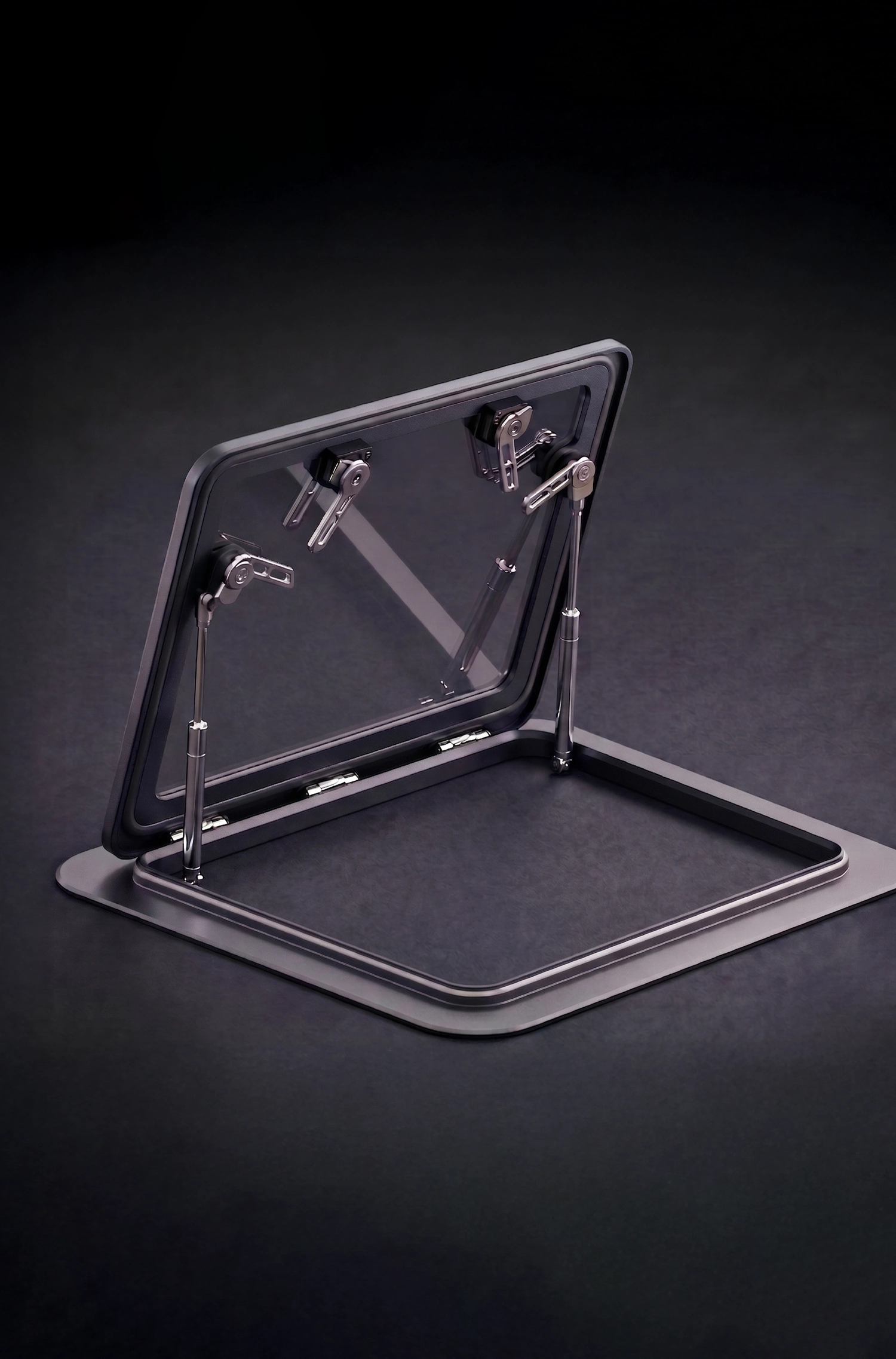
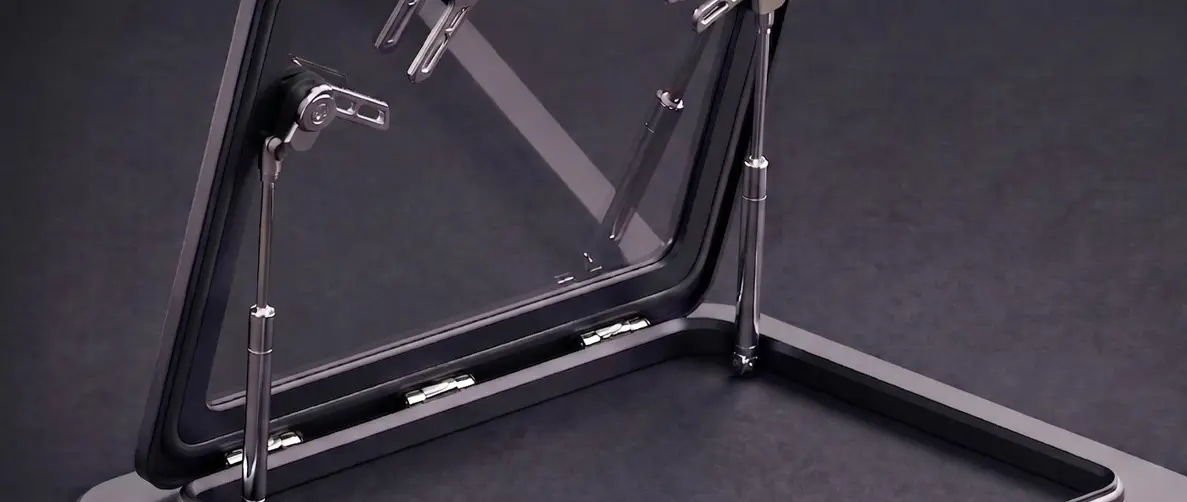
Amare's Lumyn product is presented as a marine hatch intended for sailing and motor boats. The official product photography shows a compact glazed opening panel with a relatively restrained frame and articulated supports. Such a form could suit deckhouses, cabin tops or other locations where a conventional hatch is required, but the photograph alone cannot determine the permissible mounting angle, installation depth or weather-tightness of any configuration. Those details should come from the supplier's technical data. The design interest is that the mechanism forms part of the overall appearance rather than being concealed behind a bulky structure. On a 12–24-metre yacht, where exterior and interior space are tightly coordinated, visible hardware can influence the impression of quality. A hatch must also remain simple to operate, secure at sea and maintainable over years of exposure.
The role of light and ventilation
Hatches often perform several jobs at once. They can admit daylight, provide ventilation and allow occupants to connect visually with the surroundings. Depending on their position and size, they may also be subject to safety or escape requirements. A designer should not assume that a product attractive in a showroom can fulfil each of those roles without engineering assessment. Natural ventilation may be welcome at anchor, but an opening also introduces risks from rain, spray and unexpected vessel motion. Good hardware has to combine smooth movement with reliable closure and clear indication of whether it is secured. Owners may be particularly interested in how easily a hatch can be operated from within a cabin, what force is required and whether the opening remains safely controlled. These practical questions are part of luxury because inconvenience becomes noticeable during repeated use.
Classyc reconsiders the porthole
The Classyc range is described as a superyacht-oriented porthole system, giving designers a new option for connecting interior rooms with the outside environment. Portholes have a long maritime history, but their appearance has evolved as yacht architecture moves toward larger glazed areas and thinner surrounding frames. The challenge is that the opening is not only decorative. It forms part of a hull or superstructure with structural, watertight and sometimes fire-related requirements. The supplier's reference to bespoke design and engineering support is therefore important. An owner commissioning a custom yacht or substantial refit should clarify how the proposed opening interacts with structure and class requirements. An attractive sightline is valuable only if the assembly remains suitable for its location. Classyc's styling may broaden aesthetic possibilities, but every installation must be approved for the particular vessel rather than assumed appropriate on the strength of brand positioning.
Doory connects the salon and aft deck
Amare also presented Doory, a patio-door system designed to connect enclosed yacht living spaces with exterior decks. Large glazed openings can make a salon feel more expansive and reduce the visual division between indoor and outdoor seating. On a yacht, however, the door must function in an environment where the structure moves, weather conditions vary and secure closure is critical. Large glass elements place demands on hinges, tracks, locking mechanisms and surrounding frames. They can also change the way guests circulate when the yacht is at anchor or in port. The company describes Doory as a modular, bespoke solution with glass-and-steel engineering. Those terms should lead to detailed questions about installation tolerances, access for service and how the system is locked for passage. A stylish opening is only successful when its operation is predictable for guests and crew.
Why customisation requires accurate measurements
Every yacht project has dimensional constraints, from the thickness of surrounding structures to the route by which a replacement component can be brought aboard. A custom hatch or patio door should begin with an accurate survey of the proposed opening, not simply a preference for a catalogue image. The designer and builder need to agree on tolerances, drainage, sealing surfaces and the movement of adjoining structures. A retrofit can be especially complicated because existing openings may have been shaped around earlier hardware. Even small changes in frame depth can affect interior finishing and how a window or hatch meets surrounding material. Amare's experience in glazing and mechanical systems may be relevant, but the manufacturer and yard must provide a project-specific solution. This is a practical reason to engage suppliers early rather than select the visible components after the major construction decisions are fixed.
Glass is not a uniform material
Glazing is often discussed as if the only variables are transparency and tint, but marine glass must be selected for its intended application. Thickness, lamination, curvature, thermal performance and resistance to impact can differ markedly. An exterior opening may be exposed to pressures that an interior partition never experiences. Where approvals are required, the glazing specification must be consistent with the structure and the relevant standards. Amare's commercial material highlights glass processing and specialist engineering, but this announcement does not provide the complete test data for every new product. It would therefore be inappropriate to promise performance figures not supplied by the maker. An owner should ask for drawings, material identification and the evidence of suitability needed by the yacht's builder or surveyor. The goal is to preserve clear views without compromising essential safety requirements.
Operation under way and at anchor
Opening a hatch or patio door can be a normal part of life aboard a yacht at anchor, but the same opening may need to remain fully secured while the vessel is under way. Crew procedures should make these different operating states clear. A motorised system may also raise questions about power loss, emergency release and manual override; a manually operated hatch has different requirements concerning force and accessible handles. The company has not stated that every product offers each of these features, so they should be verified rather than presumed. Owners who employ crew can incorporate the equipment into departure checks and routine maintenance schedules. On an owner-operated yacht, the arrangement needs to be equally understandable to the people on board. Good design reduces the chance of a guest inadvertently leaving an exposed opening unsecured.
Maintenance of hinges and sealing systems
Over time, yacht glazing hardware may be affected by salt, ultraviolet exposure, repeated use and changes in temperature. Hinges, gas supports, locking devices and seal materials can require inspection or replacement. A new installation should therefore be judged partly by how easily service staff can reach the working parts. A flush, minimal frame may look elegant, but replacing a damaged seal should not require excessive dismantling of surrounding finishes. Owners may wish to ask whether the supplier offers spare parts over an extended period and whether local technicians can service the mechanism. The answers can influence the real cost of a product over the yacht's operating life. An expensive opening that cannot be repaired conveniently would undermine the very comfort it was intended to provide. Longevity is achieved through design, materials and continuing support.
Integration with yacht interiors
An opening in the hull or superstructure is experienced from both sides. From outside, the frame influences the yacht's profile; from inside, it changes the balance of light, privacy and the view. Yacht interior designers therefore need to consider glazing and hardware alongside fabrics, timber finishes, blinds and furniture placement. A porthole situated beside a berth may offer attractive natural light but require privacy treatment and careful positioning. A large patio door may create a visual connection with an aft terrace while altering how the salon is arranged. Such trade-offs become particularly important on mid-sized yachts where every metre of space serves several purposes. A new product does not resolve the layout by itself. The opportunity is to develop a coherent design in which technical hardware and the interior work together rather than compete for attention.
Who benefits from the new range?
The most obvious audience includes custom yacht builders, refit yards, naval architects and designers seeking more choices in glazing and access hardware. An individual owner may not buy a hatch directly, but can still influence the specification by asking about available alternatives during design review. Some products may be more appropriate for large superyachts than for the 12–24-metre market, and a responsible discussion should recognise those limits. Lumyn is explicitly presented for sailing and motor boats, making it the clearest reference for smaller luxury yachts. Classyc and Doory may be relevant where their structural and dimensional requirements can be met, subject to the maker's assessment. Owners should not assume that a product aimed at the upper end of the market can simply be scaled down. The right choice must be fit for purpose.
A presentation rather than measured field performance
The Amsterdam announcement establishes the availability of new concepts and systems, but it does not by itself demonstrate years of operation in varied conditions. Early photographs are useful for understanding mechanical layout and aesthetic intent, while product data and experience from installations will become important over time. Buyers should distinguish a showroom prototype, a production design and a fully certified installation. Where safety-critical components are involved, the most appropriate evidence is documentary: test reports, installation guidance and acceptance by the relevant professionals. Amare has a broader portfolio of gangways, glazing and yacht automation, but the performance of a previous product should not be assumed for a new one. The value of an established manufacturer is access to experience and support, not a reason to skip specification review.
What the METSTRADE launch establishes
Amare's 2026 presentation brings Lumyn hatches, Classyc portholes and Doory patio doors into a public discussion about how yacht interiors connect with the outside world. Each product addresses a different opening, but all point toward the same challenge: combining clean architecture with the demands of marine operation. For owners of 12–24-metre luxury yachts, the hatch range is particularly pertinent, while the broader glazing and patio-door systems offer ideas for custom construction and substantial refits. The confirmed news is the manufacturer's launch and the products it has displayed or described. The next step is to understand dimensional options, certification, service arrangements and installations in actual yachts. Better views and simpler movement between spaces are worthwhile design goals, provided they are delivered through engineering appropriate to life at sea.
Sources and attribution: Amare Group's official METSTRADE 2026 product and press information and the company's original Lumyn and Classyc manufacturer pages. Lead photograph: Amare's Lumyn hatch product studio image. Technical installation and ownership analysis is independent Luxury Yacht Guide commentary; no unverified certification or performance claims are made.
Sources and image credits
Reporting based on Amare Group original 2026 METSTRADE press release and product presentations hosted on official exhibitor page, Amare Group original Lumyn and Classyc glazing product descriptions and official photography.
Lead photograph: Amare Lumyn marine hatch official 2026 manufacturer's studio photograph. Photo: Amare Group, 2026 Lumyn hatch original manufacturer product photography, illustrating the actual marine glazing hardware. Original official image source.