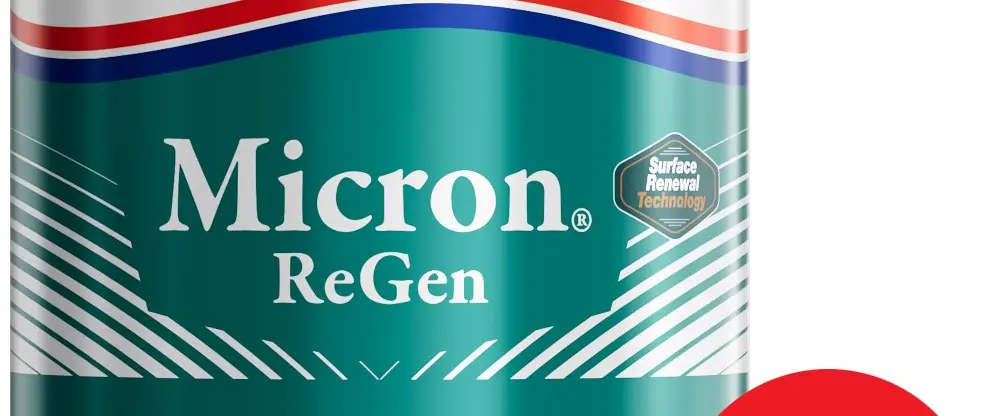
International Yacht Paint, part of AkzoNobel, has launched Micron ReGen, a biocide-free fouling-control coating designed to renew its surface while immersed and reduce the attachment of marine growth. Announced at METSTRADE in Amsterdam on 17 November 2026, the product is intended for recreational boat owners and professional yards that want a familiar application process without relying on conventional biocidal ingredients. The manufacturer says suitable existing antifouling can be overcoated without an additional primer or tie-coat, potentially reducing the complexity of a seasonal haul-out. It also reports fuel and speed improvements from one programme of on-water testing, although those figures should not be interpreted as guaranteed results for every vessel. For owners of 12–24-metre motor and sailing yachts, the interesting question is whether a lower-maintenance coating can preserve hull condition while fitting existing operating and refit schedules.
A new approach to the underwater surface
Most yacht owners think about antifouling when the boat is out of the water, yet the condition of the submerged hull affects performance throughout the season. Micron ReGen is presented as a fouling-control product based on Surface Renewal Technology, which AkzoNobel says maintains a boundary layer that is difficult for organisms to attach to. The company describes the layer as micro-porous and combining water-attracting and water-repelling properties. That is a manufacturer's account of the mechanism, not independent confirmation of every performance claim. The central distinction is that the product is promoted as biocide-free, unlike many familiar coatings that use chemicals intended to prevent marine growth. Owners comparing options should ask whether the new system suits their yacht's construction, cruising location, speed profile and time in the water. There is no single coating that behaves identically in all marine environments.
Surface renewal rather than an ordinary polishing claim
AkzoNobel says the coating responds to ions in the water and continually exposes a fresh outer surface, with the intention of preserving low adhesion and a smooth finish. The description can sound similar to self-polishing antifouling, but the manufacturer presents it as a different category of technology. For practical purposes, owners need to understand what happens after months afloat: how the finish behaves in water of varying salinity, what maintenance is allowed and how the system should be renewed before the following season. A good technical data sheet should provide those answers, together with application and safety instructions. Without that information, promotional language about intelligent renewal is not enough to make a purchase decision. The product's launch establishes a technology proposition; long-term operating experience across a broad fleet will be needed to demonstrate how reliably it performs under different conditions.
What the trial figures actually mean
The press release reports fuel savings of 4.7 percent and speed improvements of 1.7 percent at equivalent engine power in real-world tests conducted over three seasons on an in-service vessel. Those numbers are useful as evidence that the manufacturer has tested the coating outside a laboratory, but they should be reported with the qualification provided by AkzoNobel. They do not represent a guaranteed saving on a specific 15-metre cruiser or 22-metre yacht. A vessel's displacement, hull shape, propellers, loading, weather conditions, existing paint and sailing or motoring pattern can all influence results. Savings from a cleaner hull can also vary with time between haul-outs. An owner planning an annual operating budget should therefore treat the percentages as trial outcomes, not apply them mechanically to the fuel account. A measured before-and-after comparison on the owner's own boat would be more informative.
Overcoating and haul-out preparation
One of the most practical claims is that Micron ReGen can be applied directly over aged biocidal antifouling that remains in good condition. The exception expressly stated in the release is polytetrafluoroethylene, or PTFE, based antifouling. The manufacturer says a separate primer or tie-coat is not required where the substrate is compatible and the coating is sound. That does not mean a crew can simply paint over an unknown surface without preparation. Contamination, flaking, adhesion, moisture and the type of previous coating still matter. A competent yard should identify the current system, follow the relevant technical documentation and carry out required preparation before applying a new product. Poor compatibility can waste a season and create significant removal costs. The value of the new coating lies partly in the potential to simplify a properly planned job, not to remove the need for professional judgment.
A one-day application proposition
AkzoNobel says application and readiness for launch may be completed within one day. That could matter greatly for a yacht owner whose available cruising weeks are limited and whose haul-out is already crowded with inspections, servicing and other work. However, the claim should be understood as conditional on correct conditions and the work being ready to begin. Surface repairs, moisture, temperature, yard capacity and manufacturer-specified intervals may change the schedule. Application by brush or roller is offered for conventional use, while spray application is also supported for professionals. Yard operators may appreciate familiar techniques, but should confirm safety requirements, ventilation and personal protection from the current documentation. Speed of application is valuable only if the coating is correctly installed and remains durable over the season. A shorter yard stay should not be purchased at the expense of quality control.
Five colours and the appearance of a clean hull
Micron ReGen is offered in five colours with a semi-gloss finish, including Bright White. Owners of luxury yachts sometimes place considerable importance on underwater colours because they influence the appearance of the hull when the boat is hauled out or operating in clear water. Colour choice should nevertheless remain secondary to compatibility and effective fouling control. Different pigments and finishes can also appear different under varying lighting, and a semi-gloss technical coating should not be confused with a decorative topside paint. A boatyard should confirm current product availability, pack sizes and mixing requirements before finalising a schedule. The manufacturer's catalogue is the appropriate reference for the actual options in the target market. A visual sample can help an owner choose, but neither finish nor colour provides independent evidence of how much fouling will accumulate during the year.
Why Northern Europe is an important launch market
The initial distribution programme covers eleven European countries: the United Kingdom, Ireland, Norway, Denmark, Finland, Sweden, the Netherlands, Belgium, Germany, Austria and Switzerland. The company connects the launch to changing restrictions on biocidal antifouling in parts of Northern Europe. Owners should avoid assuming that regulations are uniform across that list or that the coating automatically satisfies every local requirement without further checking. Fouling-control rules can depend on the country, waterbody, vessel type and permitted product use. Dealers and yards should advise on the products currently approved and suitable in a particular location. For travelling yachts, the management challenge can be more complicated than for boats operating from one home marina. A vessel may move between different regulatory environments during the life of a coating, making accurate product documentation and service records particularly useful.
What a 12–24-metre owner should ask the yard
The most useful conversation is not simply whether Micron ReGen is new, but whether it is appropriate for the actual hull. The owner or captain should establish what coating is already present, whether it can be identified reliably, and whether the surface needs repair before overcoating. The hull's typical annual operating pattern should also be discussed: long periods static at berth, frequent high-speed passages, extended summer cruising and time in freshwater can create different conditions. A professional may also consider the effect of cleaning methods and whether any mechanical scrubbing is permitted. Owners should request the manufacturer's current application documentation and a written estimate that distinguishes preparation, materials and labour. The new technology may make the annual process easier, but the best way to verify its benefit is to record costs and results consistently.
Measuring performance without confusing variables
A credible assessment of hull coatings requires an awareness of the variables that influence yacht performance. If an owner compares fuel consumption after a haul-out with figures from the previous year, a new propeller, different load or change in engine maintenance may affect the result. Sea state and current also matter, while yacht speed through water is not always identical to speed over the ground. A useful comparison uses similar operating conditions and records engine load, fuel flow, speed, hull state and relevant weather. Owners do not need a laboratory to make better decisions, but should avoid drawing large conclusions from isolated trips. The manufacturer's reported percentages provide a reason to investigate, not a complete economic model for an individual boat. Maintenance and operational consistency are essential if the hoped-for savings are to become measurable.
The environmental proposition and its limits
A biocide-free formula responds to a real concern about the effects of conventional antifouling chemistry, but the absence of biocidal ingredients does not establish that a product has no environmental impact. Manufacture, solvents, application, removal and the fate of coating residues all matter. AkzoNobel describes Micron ReGen as a more sustainable option, but a comprehensive comparison would require independent lifecycle and field evidence. Owners should follow disposal and cleaning requirements rather than assume a new formulation removes every environmental obligation. Some locations may impose restrictions on in-water cleaning regardless of coating type. The responsible approach is to choose products permitted for local use, minimise unnecessary releases and work with competent contractors. Interest in lower-impact products can coexist with realistic scrutiny of technical performance and the full maintenance cycle.
Competitive implications for boatyards
A coating that is easier to apply over sound existing antifouling could be valuable for yards managing many vessels during a short seasonal window. Less time spent on complex preparation may free capacity for other maintenance work. Yet a technical innovation must also be supported by training, reliable stock and clear guidance on compatibility. Retailers and professional applicators have a role in making sure the product is specified correctly. A yard that promises a one-day turnaround without inspecting the actual hull would be taking an avoidable risk. The manufacturer says it developed the system in consultation with its distribution and application partners, and the real commercial test will be how easily it fits established workflows. A strong launch campaign can generate interest, but confidence develops when yards report consistent results across different customers and seasons.
A launch, not a universal replacement
Micron ReGen is a significant addition to the range of possible hull-maintenance solutions because it combines a new surface-renewal mechanism with a familiar application approach. The published facts are the 17 November introduction, its biocide-free positioning, the claimed compatibility with certain aged coatings, the reported trial figures and the eleven-country launch programme. The next evidence will come from yacht owners and yards using it across diverse cruising environments. For the luxury yacht market, the promising aspect is the possibility of reducing maintenance complexity without sacrificing a smooth hull, but it remains important to evaluate that claim on the actual boat. An owner should consult the technical data and local specialists before changing an existing coating programme. This is a development worth following, not a reason to abandon a proven system without evidence.
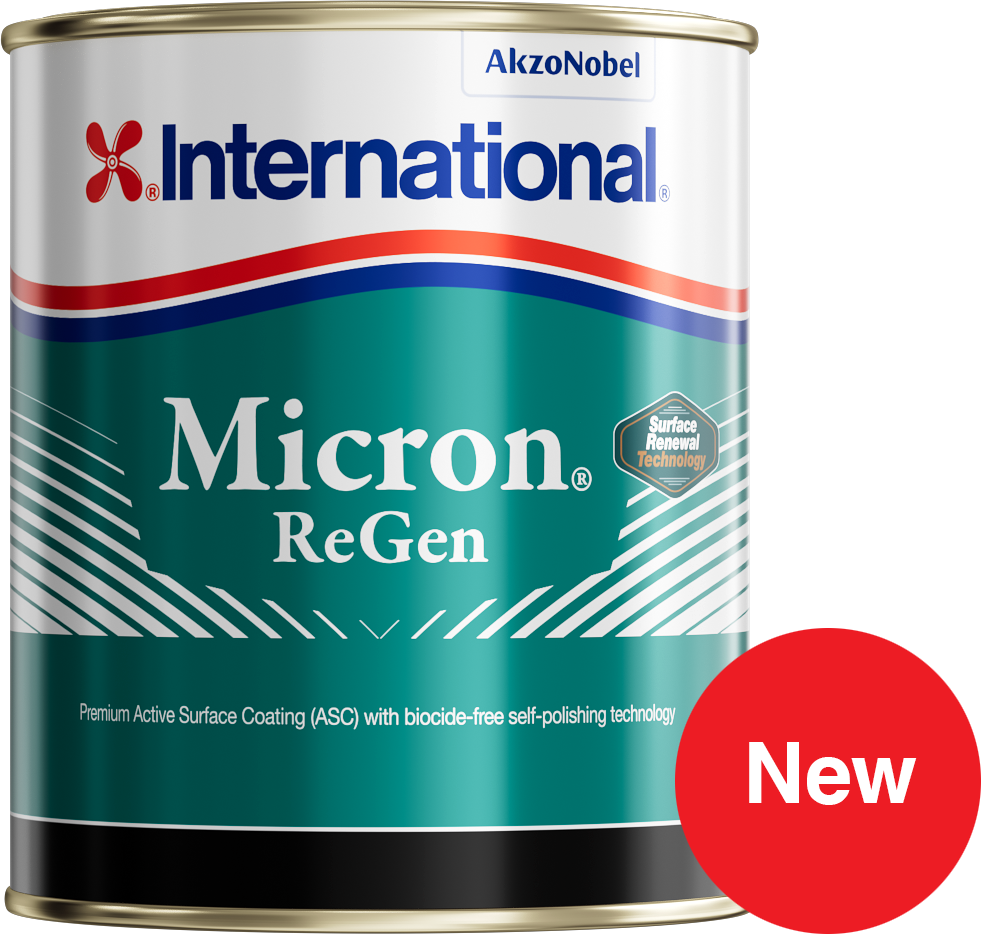
Sources and attribution: AkzoNobel Yacht Coatings' official 17 November 2026 release published through METSTRADE and the International Yacht Paint Micron ReGen product catalogue. The image is the original AkzoNobel Micron ReGen container photograph. All performance numbers are manufacturer-reported trial findings; operation and maintenance guidance is independent Luxury Yacht Guide analysis.
Sources and image credits
Reporting based on AkzoNobel Yacht Coatings original 17 November 2026 manufacturer press release, published on METSTRADE, International / AkzoNobel original Micron ReGen technical product page.
Lead photograph: International Micron ReGen 750ml official 2026 product-pack image. Image: International Yacht Paint / AkzoNobel, official Micron ReGen product packaging photo distributed on the manufacturer website; not an independently measured trial photograph. Original official image source.