Four equipment ideas to scrutinise at Metstrade
Metstrade has previewed a group of young marine-technology companies that will present products in Amsterdam from 17 to 19 November 2026. The organiser says its leisure-marine start-up area in Hall 5 will feature 17 companies, with another eight at the superyacht-focused start-up area in Hall 8. Among those profiled are Elvalen, YachtPass, NZero Marine and Vital Lyfe, which address different questions: charging a boat's battery, organising documents and maintenance records, choosing lubricants and producing drinking water. These are relevant topics for the operator of a 12–23.99-metre yacht, where crew time, space and reliable systems all matter. Crucially, an exhibition preview is not independent evidence that any of these products has been tested successfully on a particular yacht. The interesting question is what practical problem each device or service can solve, and what proof an owner should demand.
The wider start-up programme
Metstrade's start-up pavilions are organised with Yachting Ventures, a business accelerator that helps new marine ventures find customers, partners and investment. This year's participants encompass software, energy, maintenance and other disciplines rather than a single fashionable technology. That breadth is welcome, but visitors should distinguish established equipment with demonstrable service history from prototypes, early-stage products and marketing claims. A show stand is an opportunity to examine an item in person, meet its makers and obtain supporting documentation. It is not a certification or a recommendation by the event organiser. Luxury Yacht Guide is concentrating on four solutions that could intersect with the demands of an owner-operated displacement cruiser or a family yacht. Their usefulness will depend on exact power systems, cruising routines and maintenance arrangements.
Elvalen: harvesting movement for a 12-volt battery
The Slovenian company Primum is introducing Elvalen, a device described as converting a boat's rocking motion into small amounts of electrical energy. According to its founder in the Metstrade preview, a moving internal mass drives a generator through gearing, and associated electronics condition the output for a 12-volt battery. The reported production in moderate waves is about three watts. That is a small figure, and it should be interpreted honestly. It may contribute to maintaining a battery through inactivity or supplementing charging, but three watts is not a replacement for a yacht's generator, shore connection or substantial solar installation. The usefulness of the mechanism will depend on motion, battery chemistry, controller consumption and the actual load. The product is being presented as a battery-maintenance idea, not a complete energy solution.
What three watts might mean in use
At a constant three watts for 24 hours, an idealised device would deliver 72 watt-hours before electrical losses; the real output would vary with the boat's movement. That simple calculation helps explain both the appeal and the limit. A small trickle could be relevant to a neglected battery, but modern yachts often have continuous loads from alarms, monitoring, bilge equipment or electronics. Those loads can exceed the contribution of a very small generator, and a calm winter mooring may produce little movement. Owners should ask for independently measured output curves across wave heights and directions, information on mechanical wear, the device's duty cycle and compatibility with battery-management systems. A hand-operated handle is also described for manual generation, but its presence should not be confused with effortless high-output charging. Practical installation and reliability are the deciding factors.
YachtPass: a digital document history for a boat
The Dutch YachtPass concept gathers permits, certificates, registration papers, technical manuals and maintenance history into an application. Metstrade reports that the system aims to make documents accessible and to let users consult manuals through an AI-supported interface. Its proponents also describe QR-based access to certain records. For a 15-metre cruising yacht, the basic organisational proposition is clear: essential information is often scattered between binders, emails, contractor invoices and individual crew members' phones. A structured record could make servicing or eventual sale more straightforward. The most important caution is that storing a document electronically does not automatically make it accepted by a flag registry, customs official, harbour authority, insurer or surveyor. Owners should retain required originals and verify the legal status of digital records for every jurisdiction where they operate.
Testing a maintenance assistant properly
An AI interface capable of searching a manufacturer's manual might help an owner locate a fuse rating, filter procedure or service interval more efficiently. It could also misread an instruction or produce an unsafe suggestion when documentation is incomplete. YachtPass therefore raises questions about the provenance and version of each uploaded manual, document access controls, offline availability and how the software identifies the exact equipment installed aboard. An engine service procedure for one model is not interchangeable with a different revision. A sensible evaluation would include deliberately awkward queries, such as a system that has been modified or a maintenance task with a safety interlock. The answer should point back to the relevant manual, with uncertainty made explicit, rather than generating plausible but unverified steps. The operator, not a conversational tool, remains responsible for safe maintenance.
NZero Marine: looking again at maintenance consumables
NZero Marine, a Spanish venture, is introducing plant-based lubricants, grease, cleaning and protection products to the marine market. The company's representatives argue that boat maintenance needs alternatives that rely less on selected mineral-derived raw materials, particularly because equipment is used close to the aquatic environment. That proposition is worth examining, but the label plant-based is not enough to establish marine suitability, corrosion protection, environmental safety or the correct service interval. A windlass, steering component, hinge and propeller-shaft system can demand very different lubricant properties. Owners should compare the product's stated application and test data with the machine manufacturer's recommendation. The company describes an ambition to build international distributor relationships; the Metstrade preview does not establish that every proposed formulation already has broad manufacturer approval.
Compatibility matters more than a green label
Where a lubricant protects costly mechanical equipment, suitability is a technical matter. A responsible buyer should ask about salt-water exposure, operating temperature, viscosity, washout resistance, compatibility with seals and metals, corrosion protection, shelf life and any relevant biodegradability tests. Replacing a specified grease solely because an alternative sounds environmentally attractive could increase wear or jeopardise warranty conditions. Equally, a genuinely suitable lower-impact formulation could be worthwhile, especially for routine service work. The correct question is whether it meets the duty and performance requirements of the individual component. Manufacturers' technical data sheets and documented trials are therefore more persuasive than broad claims about being natural. The NZero announcement is a prompt to investigate options, not an authorisation to disregard existing service specifications.
Vital Lyfe: portable water production
Vital Lyfe's Access unit is presented as a self-contained watermaker in a box, weighing about 11.3 kilograms and measuring approximately 50 by 23 by 20.5 centimetres. Metstrade reports manufacturer figures of nearly 23 litres of potable water from seawater during an hour of battery-powered operation, or more than 45 litres from contaminated freshwater under the stated conditions. It can also operate using an external 12-volt supply. These figures make the concept interesting for small-crew cruising and as an additional water source, but they are the supplier's claims in an exhibition preview. Actual output will depend on salinity, feedwater condition, membrane performance, temperature and maintenance. Portable hardware may reduce installation complexity, yet the resulting water still requires correct handling and storage.
A watermaker is not a substitute for water planning
Even if a portable desalination unit produces the stated volume under favourable conditions, a yacht must still plan for the water needs of all people aboard. Drinking and cooking are only part of consumption; washing and other domestic uses can be substantially larger. A prudent owner should ask about membrane flushing, filter replacement, feedwater quality, reject-water disposal, cleaning chemicals, battery capacity and microbiological testing. A product that can treat seawater may have operating restrictions in oily, polluted or shallow marina waters. The term potable should be supported by relevant testing and clear instructions. It would be a mistake to treat an exhibition figure as a guaranteed output in every anchorage or a reason to reduce emergency reserves. The technology should add resilience within a properly designed water-management plan.
Where start-ups fit on 12–24-metre yachts
A yacht in this size band sits between simple dayboat equipment and the more complex systems commonly fitted to crewed superyachts. Owners want functions that are reliable, repairable and easy to understand, often with limited space and a lean crew. Each of the four concepts tackles an identifiable friction point. Yet the risk of adding complexity is equally real: an extra sensor, app or charger introduces something to maintain, update or replace. The best evaluation starts with a specific operational problem aboard the actual vessel. If shore power is reliable, a three-watt motion generator may offer little benefit. If documentation is already expertly managed, another database may add overhead. If fresh-water storage is ample, portability may not justify a second watermaker. The right fit is contextual, not universal.
What to ask at the November show
Metstrade runs at RAI Amsterdam from 17 to 19 November 2026. Visitors should request technical manuals, independent test results, known installation constraints, warranty terms, price and service arrangements for each device or software product. For the power generator, ask for energy output against defined motion conditions. For the document platform, ask how permissions, certificates, backups and data export work. For lubricants, request compatibility and performance evidence. For the watermaker, seek water-quality validation and consumable replacement costs. It is equally important to distinguish a product available to purchase today from one awaiting distribution or further testing. Luxury Yacht Guide's conclusion is that the preview offers useful ideas for owner-operated yachts, provided their claimed convenience is tested against the realities of the boat, rather than accepted as a finished solution simply because it is innovative.
Primary source: Metstrade's 26 October 2026 start-up preview. Figures attributed to company founders are not independently verified product tests. The exhibition is scheduled for 17–19 November 2026; any RAI Amsterdam photograph is an illustrative image of the venue or a past show, not a record of the 2026 products.
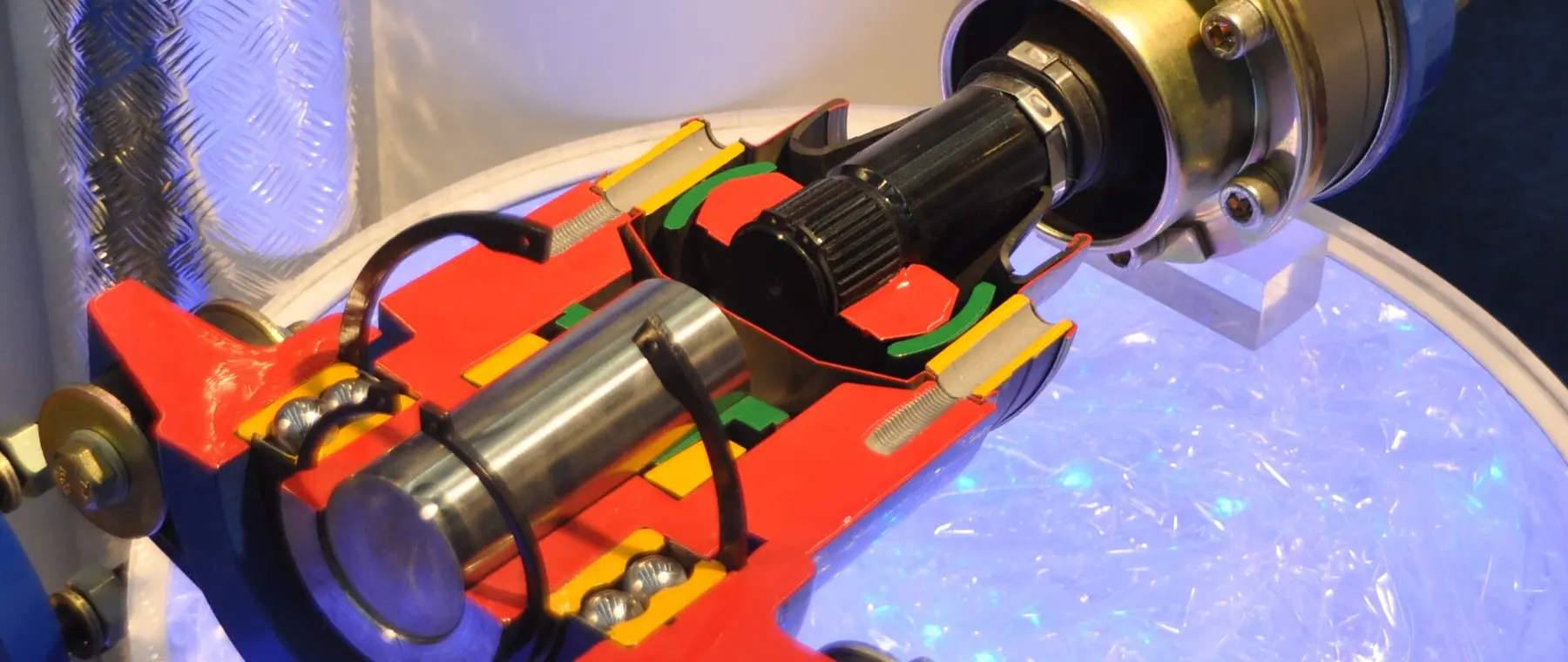
Photograph and rights: A historical Metstrade equipment photograph showing a marine drive-shaft display at RAI Amsterdam in 2011, photographed by S.J. de Waard, via Wikimedia Commons, licensed CC BY-SA 3.0. It is not an image of the exhibitors or products described for 2026.