A specific annual offer rather than a general marina promotion
D-Marin is advertising a limited annual-berthing arrangement at its Tribunj marina on the Croatian Adriatic, directed at experienced sailors with monohull yachts from 13.00 to 18.99 metres. The offer concerns Pier G, described as an outer pier, and the published promotion runs from 2 February until 31 December 2026. It remains listed within that period in early November. For Luxury Yacht Guide, the significance is its unusually precise boat-size and berth-position criteria. This is not a promise of a discounted place for every visitor to Croatia, and it should not be confused with short-stay packages advertised elsewhere in the operator's portfolio. It is a proposal that may be relevant to owners seeking an annual base for a yacht in the 12–23.99-metre segment, subject to the marina's published conditions and individual availability.
Why Pier G changes the decision
The operator presents Pier G as a place for straightforward arrivals and departures, especially for sailors who value quick access to cruising rather than a berth deep within the basin. That description offers a useful starting point but not a substitute for a berth plan. An outer-pier location can make movements more convenient in some conditions while also changing the exposure to wind, swell, passing traffic or wash. The actual suitability of any position depends on the yacht's profile, freeboard, manoeuvrability, mooring arrangement and the season. Owners considering the offer should ask for the exact berth orientation, dimensions and access route, and whether a vessel's draft or appendages introduce restrictions. A premium-sounding label is no guarantee that a particular hull will find a given mooring comfortable in every weather pattern.
The advertised length band is not negotiable by assumption
D-Marin specifies monohull yachts measuring 13 to 18.99 metres. That range excludes a 12.5-metre boat from the stated promotional criteria even though it falls within Luxury Yacht Guide's editorial coverage. It also does not describe a 19.5-metre yacht as eligible simply because the marina operates larger berths elsewhere. The website lists an overall maximum berth length of 40 metres for Tribunj, but that is separate from the limit on this particular package. Likewise, the offer makes no explicit commitment to catamarans. Multihulls can require different beam allowances and tariffs, so a catamaran owner should seek a separate quotation rather than infer that a monohull arrangement applies. These distinctions matter because an apparently attractive annual price has little practical value if the physical berth and the published terms do not match the boat.
The absent price is material information
The D-Marin page describes a special annual rate but does not publish a numerical charge. No public euro figure, deposit amount, tax breakdown or payment schedule can responsibly be inferred from that wording. A prospective customer should request an itemised written quotation that identifies the exact contract dates, berth category, included services and any exclusions. Electricity and water billing, visitor parking, laundry, waste handling, tender arrangements and service access can influence the effective cost of keeping a yacht at one marina for a year. It is also worth establishing how a late start date would affect billing within a 2026 campaign that has a published end date. The offer should be compared with the marina's normal annual quotation on the same assumptions, rather than with unrelated headline rates for different vessel lengths or berthing seasons.
Winter relocation is explicitly part of the terms
One condition is sufficiently important to be stated plainly: winter relocation within the marina applies. D-Marin includes that requirement on the offer page. The operator does not describe the complete relocation process in the short public notice. Owners should establish whether a move is mandatory, which months are involved, what type of winter berth is provided, how much notice is given and who undertakes or supervises the manoeuvre. They should also ask whether the winter location provides comparable shore-power capacity, walk-on access and protection from weather. For a boat used frequently outside the summer season, the difference between an outer-pier summer place and an internal winter position may be central to the purchase decision. The written contract, rather than an abbreviated marketing description, should settle those details.
Why annual planning differs from a seasonal visit
An annual berth decision is usually about more than the arrival on the first day. It can influence where the yacht is maintained, how a skipper travels to it, where spare parts are delivered and how often friends or family can realistically use it. For owners based outside Croatia, marina access must be considered alongside flight and road connections, winter travel patterns and local contractor availability. A boat that sits unused for extended periods still needs checks on batteries, bilges, mooring lines, fenders and onboard systems. Some owners employ a local caretaker or yacht-management service; others handle the work themselves during regular visits. Such arrangements belong in the annual cost and operating plan. Nothing in the promotional text establishes that these third-party services are included in the Pier G package.
Tribunj and the cruising proposition
Tribunj lies on the Dalmatian coast, in a part of Croatia that appeals to cruising owners for its islands, coastal harbours and opportunities for both short outings and longer itineraries. The attraction of a base is partly the ability to make repeat journeys rather than treating every visit as a one-off charter holiday. An owner might prefer protected day sails, while another may use the boat for multi-day passages between different marinas. These choices alter what constitutes a good berth. Easy departure has value if the yacht moves regularly; shelter and service access can matter more if it is left unattended for weeks. The ideal position is therefore a function of actual usage, not just a photograph of an attractive waterfront. A local trial visit remains helpful before signing a long agreement.
Assessing the mooring on site
Before committing to an annual contract, owners should inspect the proposed position from the water and from the pontoon if possible. Relevant observations include turning room, approach angles in the expected prevailing wind, mooring-line geometry, fender clearance, lighting and nighttime access. Shore-power socket type and available capacity should be checked against the yacht's installation; a connector that fits is not by itself proof that all intended hotel loads can be supplied together. The location of freshwater points, safe boarding arrangements and access to emergency equipment also deserve attention. For a yacht with a large swimming platform or tender arrangements, stern clearance can be particularly significant. Any survey should focus on the actual berth offered, because facilities elsewhere in the same marina may not answer the practical question.
Check the contract against the boat's operating profile
Annual-berth agreements can contain important provisions covering insurance, liability, weather, periods of absence, subletting, visitor use, registration details and the marina's ability to reassign a position. The short D-Marin promotion does not provide enough detail to reach conclusions on those subjects. Owners should request the full terms and confirm whether the rate covers a fixed berth or a category, and how allocation works during the winter relocation. If a yacht will be placed on the market, chartered, refitted or left unoccupied for part of the year, the owner should disclose that intended use and ask how the contract treats it. No one should assume that a marina's standard annual conditions are identical to a limited campaign's special terms. Written clarification is especially valuable when the arrangement spans changing seasons.
Safety and weather considerations for smaller yachts
A 13-metre yacht and an 18.9-metre yacht can have very different mooring characteristics. Displacement, windage, propulsion response, bow-thruster power and crew experience all shape the arrival. D-Marin's description of the offer as suited to experienced sailors is worth taking seriously. Owners should assess whether their usual crew can enter and leave the allocated berth comfortably in foreseeable conditions and how the marina provides assistance if weather changes unexpectedly. They should also understand the emergency response arrangements and the process for securing or repositioning a vessel when a severe forecast arrives. The phrase easy access refers to the proposition as marketed; it is not a substitute for proper passage planning, line handling, weather judgement or compliance with local marina instructions.
How to compare the value honestly
The most meaningful comparison is between fully specified annual offers for the same boat, not between promotional slogans. A practical worksheet would include the base berth rate, taxes, electricity, water, winter-move arrangements, additional services, travel expenditure, maintenance costs and the consequences of a shorter stay. Owners can then assign value to convenience: how many passages would actually benefit from the outer-pier location, and how much time might be saved on typical departure days? If the vessel rarely leaves its berth, the convenience premium may be less important than weather protection and year-round access. If it sails nearly every weekend, manoeuvring and departure logistics could carry more weight. The operator's public page does not provide the figures needed for a financial ranking, so the decision must start with a quotation and inspection.
The position as of November 2026
D-Marin lists the Pier G smart-value arrangement through 31 December 2026 and directs interested owners to contact the marina for details. The page does not verify real-time remaining berth inventory. Owners considering the offer should therefore ask for a written confirmation of availability, applicability to their monohull's exact length and beam, the annual price and the contract's treatment of winter relocation. This is a narrowly defined and potentially useful option for 13–18.99-metre yacht owners, rather than a blanket guarantee of cheaper Dalmatian mooring. Luxury Yacht Guide will treat any later price, renewal terms or availability as new information requiring confirmation. For now, the verified news is that the operator is advertising a size-specific annual offer at Pier G with an explicit seasonal relocation condition.
Primary source: D-Marin's Smart Value Berth in Tribunj offer, accessed 7 November 2026. Price and availability require confirmation directly with the operator.
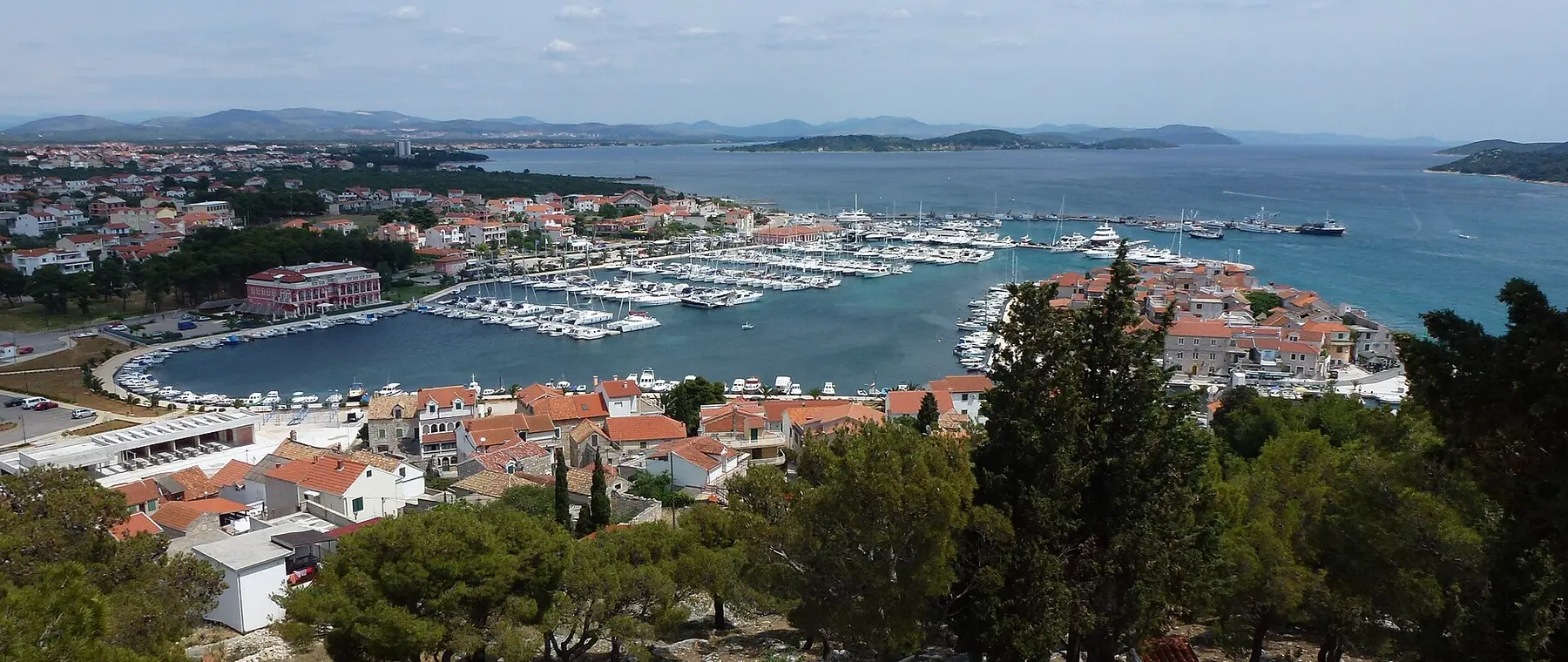
Photograph and rights: The accompanying image shows Tribunj, Croatia, photographed by LucianoZ and made available on Wikimedia Commons under CC BY-SA 3.0. The image illustrates the destination and does not depict a confirmed position on Pier G or a berth offered under this promotion.