A new Atlantic passage with a family purpose
British sailor Natasha Lambert and her sister Rachel are preparing to cross the Atlantic aboard Blown Away, the family's 46-foot Nautitech sailing catamaran. Their published plan is to leave Gran Canaria on 8 November 2026, sail first to São Vicente in Cape Verde and then continue to Grenada. The voyage covers approximately 3,000 nautical miles and is linked to a £30,000 fundraising target. Natasha and Rachel describe the passage as a tribute to their mother, Amanda, who died earlier this year. These are forward-looking plans announced before departure, not a report that the crossing has already started or succeeded.
The story belongs in Luxury Yacht Guide because the named yacht is a privately operated 46-foot, approximately 14-metre cruising catamaran, not a large superyacht or a small dayboat. It is also a story about how a real owner and crew have adapted a production yacht to make challenging offshore sailing accessible. The sisters' official website, their published fundraising page and their own recent account provide first-person sources for the itinerary and purpose. Weather and preparations may still change the actual departure or route, so the dates should be treated as intentions rather than guarantees.
How Natasha controls Blown Away
Natasha has quadriplegic athetoid cerebral palsy, which affects voluntary movement and speech. Her father, Gary Lambert, developed a system that allows her to command the yacht's steering and sails using breath and tongue inputs. The mechanism is often called 'sip-and-puff' control. In the reported arrangement, inhaling and exhaling provide steering commands, while tongue-operated controls help manage the sails. It is an adaptation enabling Natasha to act as skipper, not a suggestion that the boat sails itself or that the rest of the crew can be dispensed with on an ocean passage.
The distinction matters because adaptive technology and competent seamanship are complementary. Every ocean passage still requires navigation, weather assessment, watchkeeping, sail handling, maintenance and emergency planning. A family crew supporting an accessible yacht may also have to plan transfers, movement between spaces and safe access to the helm in rough conditions. Blown Away's arrangements were developed over years rather than purchased as a one-step gadget. The voyage shows what thoughtful engineering can make possible, while also illustrating that successful accessibility at sea depends on the entire boat and crew routine.
Why a 46-foot catamaran was chosen
The family says Blown Away is a Nautitech Open 46 selected after extensive research into a platform that could accommodate Natasha's equipment and movement requirements. A catamaran's wide deck footprint offers possibilities for circulation and on-deck work that are different from those of a narrower monohull. The team also values the ability to live aboard for weeks. These are the family's reasons for choosing the vessel; they should not be interpreted as proof that every catamaran is inherently accessible, or that identical arrangements will suit people with different needs.
An owner considering comparable adaptations needs to examine actual companionway geometry, door thresholds, steps, cockpit shelter, ventilation and ways to move a wheelchair or other support equipment between spaces. Heel, pitching and wave motion are not eliminated simply because a boat has two hulls. Power supply for controls, backup steering, emergency evacuation and access to essential systems are critical design questions. The Lambert family's experience provides an important case study, but an independent naval architect, medical-accessibility specialist and competent surveyor would still need to evaluate any proposed conversion.
The planned route and its uncertainties
The sisters intend to leave Las Palmas on Gran Canaria and sail approximately 850 nautical miles to São Vicente, using the Cape Verde stop to rest, check equipment and provision before the longer Atlantic leg. The onward passage to Grenada is planned at roughly 2,150 nautical miles. The combined route is therefore described as approximately 3,000 nautical miles rather than a direct great-circle distance between the starting and finishing points. The family expects to spend about three weeks at sea, although actual passage times will depend on weather, speed and any necessary changes to the itinerary.
A November departure is consistent with the seasonal period when many westbound Atlantic cruising yachts assess trade-wind passages, but a calendar alone is never a sufficient safety decision. The crew will need to evaluate current forecasts and sea state, and the first stop creates an opportunity to review systems before committing to the longer ocean crossing. The family's published information describes a route plan, not a guaranteed track or a live position report. Luxury Yacht Guide will distinguish a future departure confirmation from the initial announcement should subsequent reporting establish that the yacht has sailed.
An expedition in Amanda Lambert's memory
The planned 2026 crossing is personal as well as technical. Natasha and Rachel say their mother became ill before the family's intended earlier voyage and that the expedition was postponed. Amanda died in February 2026, and the sisters describe continuing to sail as a way of honouring her encouragement and her final wish that they keep exploring. Their fundraising campaign names three charities: the Ellen MacArthur Cancer Trust, the RNLI and Calvert Lakes. The target is £30,000, which is a goal rather than money already raised.
Each organisation connects to an element of the family's experience. Calvert Lakes is associated with the accessible activity centre where Natasha first discovered sailing, the RNLI supports lifesaving at sea, and the Ellen MacArthur Cancer Trust helps young people through sailing experiences during and after cancer treatment. The sisters invite support through their published JustGiving fundraising page. Any changing donation total should be checked directly on that page before being quoted; this article does not present the initial total as fixed or assume that the full target will be met.
What the 2020 crossing proved — and what it did not
Natasha has already crossed the Atlantic in Blown Away. In 2020, she completed the passage from Gran Canaria to Saint Lucia using the adapted controls, with a reported elapsed time of 18 days, 21 hours and 39 minutes. The earlier achievement helps explain why the 2026 plan is credible: the crew has experience of Atlantic conditions aboard the same type of yacht, and the control concept has been exercised over a long passage. It does not remove the need to inspect and prepare the boat afresh for another crossing six years later.
In a first-person account published this week, the sisters recalled a storm during the 2020 passage and the way the crew responded as conditions worsened. That account gives readers a more realistic impression of offshore life than a promotional photograph of a catamaran on flat water. It also underlines the human side of watchkeeping, fatigue and decision-making. A long voyage is not simply a comparison of nautical miles and average knots. Crew trust, reliable systems and an agreed plan for difficult conditions are central to the endeavour, whatever the skipper's physical abilities.
The value of practical adaptive design
The Lambert family's work is notable because it starts with a specific skipper's capabilities and ambitions. The equipment was designed around what Natasha can reliably control, rather than requiring her to fit a standard helm arrangement. That approach has relevance beyond disability sailing: boatbuilders increasingly discuss owner ergonomics, reducing physical strain and making complex functions more manageable from a small number of positions. However, it would be misleading to treat the family's custom control system as a commercial feature that can simply be ordered on any Nautitech 46.
A more useful lesson for yacht owners is that adaptation must be integrated into the complete operating system. Controls need predictable feedback, appropriate redundancy and crew understanding; moving through the yacht requires access to safe spaces; equipment must remain serviceable away from shore. When those elements are planned together, the result can extend independent participation in sailing. The family's public account shows what they have achieved, while leaving the detailed engineering and certification of any similar future installation to qualified professionals and the actual vessel's requirements.
An upcoming voyage to follow, not a result to assume
As of 6 November, the next significant milestone is departure from Gran Canaria. The announced route then runs via Cape Verde to Grenada, with the fundraising campaign continuing alongside the sailing. The crew has not claimed that the second Atlantic crossing is complete, nor can an editor infer departure merely because the intended date arrives. Reliable follow-up reporting should use direct statements from the Lambert family, recorded positions when available and confirmation of arrival rather than assuming the schedule was met.
For readers interested in 12-to-24-metre cruising yachts, the significance goes well beyond one family's itinerary. Blown Away is a working example of a private sailing yacht adapted for a capable skipper who navigates the world differently. The 2026 challenge brings together long-distance seamanship, adaptive engineering and a memorial fundraising purpose. Those facts are sufficiently strong without exaggerated speed claims or a manufactured milestone. The immediate news is that Natasha and Rachel Lambert are preparing to undertake a second Atlantic passage in the 46-foot catamaran with a clearly stated route, mission and charitable goal.
Sources: www.thesailingsisters.com; missisle.com; www.justgiving.com; marineindustrynews.co.uk.
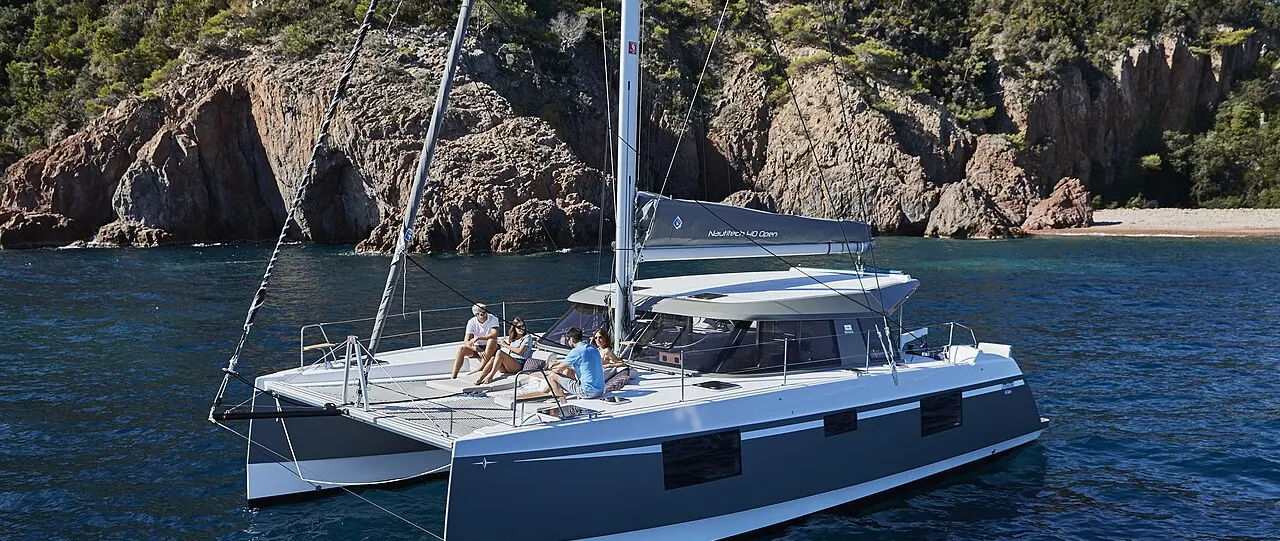
Image: Manufacturer photograph of a Nautitech 40 Open catamaran. This is illustrative of the yacht brand, not Natasha Lambert’s 46-foot Blown Away or the planned November 2026 Atlantic voyage. Photograph: BavariaYachtbau, CC BY-SA 4.0. Web-sized adaptation; licence and credit retained.