New route to the existing helm
MARITRONIX has announced an update to its SCOUT AI camera-based obstacle detection system, extending its ability to deliver video to compatible Raymarine multifunction displays and selected equipment from other manufacturers. The Lithuanian marine electronics company described the update in a 9 November 2026 exhibitor release ahead of METSTRADE, where it is exhibiting at stand 01.483 from 17 to 19 November. The announcement concerns a change to display integration rather than the introduction of an entirely new collision avoidance system.
For the owner of a luxury yacht between 12 and 24 metres, the development addresses a familiar refit constraint. A helm that already accommodates navigation displays, engine instrumentation and controls may have little room for another dedicated screen. Delivering an additional source of visual information to compatible equipment already on board can change the installation discussion. It does not mean that every chartplotter will accept that information or that a yacht equipped with the system can navigate without a proper lookout.
What the Ethernet update actually does
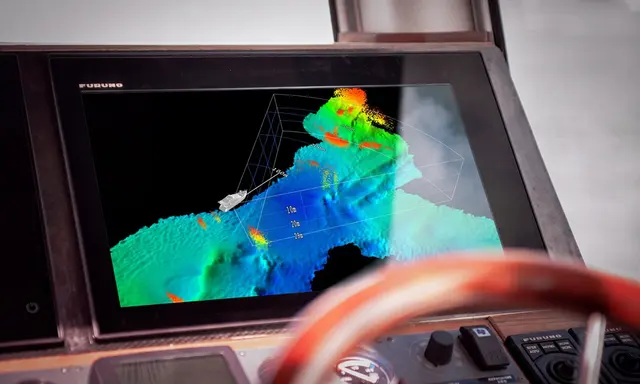
The manufacturer states that its dedicated M-Core marine computer processes the live camera signal, identifies objects in the picture and transmits the resulting video feed over Ethernet to a compatible chartplotter. The operator can view the image with detection indications and receive warnings when a detected object enters a warning zone configured for the system. This is different from transferring a conventional charted position or an AIS report into a navigation application. The source of the additional information is what the camera sees, and the receiving screen displays the processed video.
The significance of the update is therefore primarily architectural. Physical display connectivity, network configuration and software compatibility have an important bearing on any installation. MARITRONIX's product documentation also lists HDMI output for a directly connected monitor, while its November announcement specifically concerns compatible chartplotters receiving video over Ethernet. Owners should establish which arrangement applies to the precise model, software version and network configuration of their yacht.
The supplier has not published a universal compatibility table in the announcement. A general reference to Raymarine support is not confirmation that every Raymarine product, including older units, is suitable. An assessment made before ordering should identify how the video is selected on the display and what other information remains visible when it is shown.
A visual sensor is not the same thing as radar
A marine radar, an AIS receiver and a camera-based object recognition system provide information about a vessel's surroundings in different ways. Radar transmits and receives radio signals. AIS equipment receives messages broadcast by suitably equipped stations, including information that may help a crew identify another vessel and interpret its movements. A camera records light arriving at its sensor. Computer vision adds a layer of analysis to the image but does not alter the physical conditions governing whether the target is visible to that sensor.
The manufacturer's FAQ specifically presents SCOUT AI as a complementary means of awareness rather than a replacement for radar or AIS. This distinction is important when considering objects that may not transmit identification messages. An additional camera view may help a crew notice something, but an unnoticed target is still possible. The absence of a warning is not evidence that the water ahead is clear.
Visibility, camera placement, lighting, spray and the size of the target are among the variables affecting the usefulness of camera-based detection. The product documentation does not establish a single guaranteed detection distance for every installation. An owner considering the equipment should distinguish a manufacturer's demonstration under particular conditions from the performance expected during the actual yacht's voyages.
The implications for yacht refits
An established yacht often contains equipment installed in several phases over its working life. New electronic systems may have to coexist with older wiring, existing switches and devices, and a helm arrangement that was designed for a different generation of displays. The installer must first establish whether adding an Ethernet video stream is technically suitable for the particular installation, rather than simply assuming that all equipment with an Ethernet socket communicates in the same way.
MARITRONIX describes operation on a dedicated M-Core computer and expects the system to be professionally installed and calibrated. The camera arrangement can depend on the yacht, the coverage sought and the suitability of any existing cameras. A refit specification should identify those dependencies before decorative or structural work around the helm is undertaken. Access to the wiring, physical accommodation for the computer and the requirements of equipment located in exposed or enclosed positions are relevant to the scope and cost of the work.
There is also a difference between displaying useful information and making that information accessible under pressure. The crew may need to look at a chart, monitor radar returns and communicate by radio while manoeuvring. The location of warnings, their presentation and the number of actions needed to return to another screen should be discussed with the installer. Integration has value only if it supports, rather than complicates, ordinary watchkeeping.
Onboard computation and service support
The published FAQ describes processing on the vessel rather than dependence on a cloud service during normal operation. That architecture is relevant to owners whose yachts regularly travel beyond reliable cellular coverage. The availability of an internet connection for maintenance or updates should not be confused with the ability of the installed equipment to operate at sea.
The product page describes passive cooling in an aluminium enclosure and lists several communications interfaces in addition to the video connections. These specifications are useful when evaluating the computer as part of a refit, but they are not a substitute for confirming the details of the supplied installation. In particular, availability of a connection does not establish compatibility with every device using a nominally similar interface. The manufacturer describes the current M-Core offering as a dedicated appliance for the detection software, rather than an unrestricted computer on which the owner can install other applications.
An appropriate commissioning discussion would include the loss of camera coverage, how equipment failures are indicated, the responsibilities of the dealer and the procedure for future updates. The manufacturer's FAQ says that camera faults can be indicated to the captain. On a particular vessel, the way that indication appears should be demonstrated as part of acceptance. The buyer also needs to understand which equipment can be repaired or substituted locally and what support is available when the yacht is outside its home waters.
Operational limitations and the role of the crew
Introducing an additional alerting device changes the information available at the helm, not the obligations of the person navigating. The company states that SCOUT AI is not an autonomous navigation solution in its own right. Its output should be understood as an aid to recognition. The system cannot determine on behalf of the skipper that a passage is safe, and this report does not establish that it meets the requirements of any particular flag administration or commercial operating regime.
The practical importance of alert presentation is often greater on a yacht with only one or two people on watch. An alert that is too frequent may become distracting, while a poorly understood alert can be overlooked. Training needs to cover the meaning of indications, the limitations of the installed cameras and the procedure for reverting to normal navigation arrangements when equipment is unavailable. The most relevant assessment is based on the actual boat, its crew and operating area rather than a marketing demonstration alone.
At METSTRADE, the new integration gives builders and electronics installers an opportunity to discuss whether a dedicated display is still necessary for their intended configuration. For owners planning a winter electronics refit, the useful next step is to obtain a confirmed compatibility assessment and a written installation scope. The November release does not supply pricing for a complete retrofit or guarantee that any particular yacht can be upgraded without additional equipment. It nevertheless marks a concrete development in the integration of visual detection with existing recreational yacht helms.
Sources and lead image
Source documentation: https://www.metstrade.com/exhibitors/maritronix/news/scout-ai-adds-plug-and-play-support-for-raymarine-and-other-chartplotters, https://maritronix.eu/en/faq/scout-ai-obstacle-recognition-system/, https://maritronix.eu/en/product/scout-marine-obstacle-detection/. Lead image: Official SCOUT AI detection-overlay illustration — MARITRONIX, issuer-supplied announcement artwork showing an illustrative warning corridor, not an independent sea-trial photograph.. Issuer-supplied media asset attached to the specific exhibitor press release made available through the official virtual press room for coverage of the announcement; copyright remains with the rights holder.