A manufacturing story behind the marina pedestal
As the marine equipment industry meets in Amsterdam this week, the question of how waterfront infrastructure is made deserves attention alongside the products themselves. British marina equipment supplier Rolec has set out its account of changes to manufacturing, energy and waste management in an exhibitor announcement dated 12 October 2026. The statement is available through the METSTRADE exhibitor newsroom. Unlike a product launch centred on a new specification, it describes the operation behind the equipment subsequently installed at a marina.
For the owner of a 12 to 23.99 metre yacht, the connection is indirect but commercially significant. The berth is part of the infrastructure on which the vessel depends, and the purchasing decisions of a marina can influence the availability, maintenance and eventual replacement of the equipment a skipper encounters on arrival. Rolec's announcement offers one company's perspective on how that infrastructure supply chain might change. It is not an independent audit of the company's performance, nor evidence that a particular harbour has achieved an environmental target.
Factory energy and the meaning of an annual estimate
The manufacturer attributes an estimated annual saving of about 76.4 tonnes of carbon dioxide equivalent to improvements in its solar installation and a reduction in heating oil consumption. It also describes storing excess solar generation in batteries for use at its manufacturing site, including electric vehicle charging. The significance of this statement lies in the steps identified, rather than in treating the estimate as a measured reduction in the footprint of each item leaving its premises.
A business evaluating the environmental performance of equipment suppliers needs to distinguish several different questions. Energy consumed by a factory is one component of a manufactured product's environmental impact. Raw materials and bought-in components are another; distribution, use, maintenance and disposal can add further impacts. The announcement does not allocate emissions to individual models of marina equipment or provide a comparative product life-cycle assessment. A procurement team therefore has reason to ask for more information before attributing a numerical environmental advantage to a particular installation.
Energy resilience is also an operational consideration. On-site generation and storage can change the extent and timing of purchases of electricity from the grid. They do not remove the need for dependable arrangements for periods of low generation, nor do they make energy-intensive activities inherently low carbon. In a manufacturing context, resilience depends on the relationship between the capacity of the system, demand patterns and the activities that must continue even when local generation falls. These questions are as important for a supplier as they are for a marina.
Freight and the less visible cost of packaging
Rolec also reports changes to packaging which allow half as many additional products to fit on the same pallet, and it attributes a one-third reduction in transport emissions to that change. These are the company's own reported figures. They do not establish the total transport emissions associated with all the products it sells or guarantee a similar improvement on every route.
The practical issue is familiar to yacht service companies. A relatively inexpensive item can become costly when it has to travel separately from other parts, particularly when ordered urgently. Consolidating suitable consignments may reduce freight movements and simplify handling. Nevertheless, packaging still has to protect the equipment on its journey through warehouses, loading areas and vehicles. A damaged enclosure or electrical component can produce more waste than appropriately designed protective packing would have created.
The scope for change also depends on what reaches the marina in a single consignment. A new pontoon development can receive multiple identical products through a carefully scheduled delivery. A service technician replacing one failed unit during the cruising season has different requirements. A meaningful supplier comparison should take both circumstances into account. Efficient packaging for a large project is welcome, but it is not a substitute for a distribution arrangement capable of supplying replacement parts when a yacht basin is busy.
A distinction between landfill diversion and recycling
The announcement describes a factory waste arrangement in which 70 per cent of manufacturing refuse is directed to recycling and the balance is converted into solid recovered fuel. Rolec presents this as avoiding landfill for that waste stream. It also reports using recyclable packaging materials and sourcing them under Forest Stewardship Council certification. The stated approach merits examination because waste statistics can be easily misunderstood when different forms of recovery are grouped together.
Material recycling and energy recovery serve different purposes. In recycling, usable material is recovered for another application, potentially reducing demand for primary material. A fuel derived from waste is intended to be consumed for energy. Its production and combustion still have environmental consequences, which depend on the material, processing method and destination. Neither process establishes, on its own, that a product can be repaired, reused or returned at the end of its working life.
For a marina, the distinction matters during refurbishment. Replacing electrical service equipment, for example, can generate assorted streams of metal, plastics and electrical parts. The operator may need specialist collection and treatment according to the local legal framework. A purchase specification can also ask whether the manufacturer provides spare assemblies and guidance on disassembly. Those arrangements may help an operator make decisions before a piece of equipment has become waste, rather than simply reacting after its removal.
Choosing equipment for a working yacht harbour
The design life of an installation cannot be inferred from the site at which it was manufactured. Waterfront equipment can face ultraviolet exposure, moisture, mechanical impacts, temperature cycling and the corrosive effects of the marine atmosphere. The precise conditions differ between a sheltered freshwater basin and a saltwater harbour exposed to winter storms. Operators therefore need evidence appropriate to the place in which the equipment will actually be used.
A procurement exercise for a luxury-yacht marina can examine the availability of replacement modules, clarity of documentation, service access and warranty arrangements. It can ask whether a component may be exchanged without removing a much larger assembly, how spare stock is managed and whether the supplier expects to support the range over years of use. The lowest purchase price is not necessarily the lowest cost of maintaining a facility that must remain available to visiting vessels.
Owners have a different but related interest. A yacht arriving in a marina should be able to understand which services are available, how they are connected and what assistance is provided if something goes wrong. Reliable infrastructure helps reduce interruptions to a voyage. It can also make a facility easier to use for owners who operate with a small crew and do not have the administrative or technical resources of a much larger yacht. Environmental ambitions should be consistent with those basic service requirements.
Assessing environmental claims at the exhibition
Rolec identifies ISO 14001:2015 certification as part of its environmental management approach. Such a certification concerns an organisation's environmental management system; it is not a label awarding a specific carbon footprint to every item it manufactures. The relevant certification scope and current status should be checked if a marina intends to rely on it in a tender. The distinction is particularly important at a trade exhibition, where diverse technical claims are often presented together in a short conversation.
An owner, marina manager or project consultant evaluating a supplier can request the boundaries and reporting period for any quantitative claim. Were the figures based on measurements of consumption, engineering estimates or data provided by a contractor? Is the improvement expressed in absolute terms or in relation to the number of units produced? How has a change in the level of business activity been accounted for? Answers can make comparisons more useful without requiring every supplier to have identical production arrangements.
The most useful conversations may also concern issues that sit outside a headline figure. A manager might seek practical details on replacement intervals and end-of-life arrangements; an engineer may want installation documentation or evidence of suitability for a specified location. Exhibition meetings provide a chance to establish what documentation is available before a tender or equipment replacement is commissioned.
What it means for the luxury-yacht sector
Rolec's published account illustrates how interest in marine infrastructure extends beyond the electrical equipment visible on a pontoon. It brings factory operations, freight, maintenance and waste handling into the discussion about how facilities support recreational vessels. No marina-specific improvement is established by the announcement, and there is no claim here that the reported percentage changes can be directly transferred to the yachts using a harbour.
The editorial distinction is also important for Luxury Yacht Guide: this is a supply-chain and manufacturing development, rather than a new shore-power specification or a report on a completed marina project. The next test of the approach will be the quality of the evidence available to those purchasing and maintaining equipment. For the 12 to 23.99 metre market, a dependable supplier able to support long-lived marina installations is a practical asset. The ability to assess how those installations were made, maintained and ultimately replaced adds another dimension to the same decision.
Sources and photograph
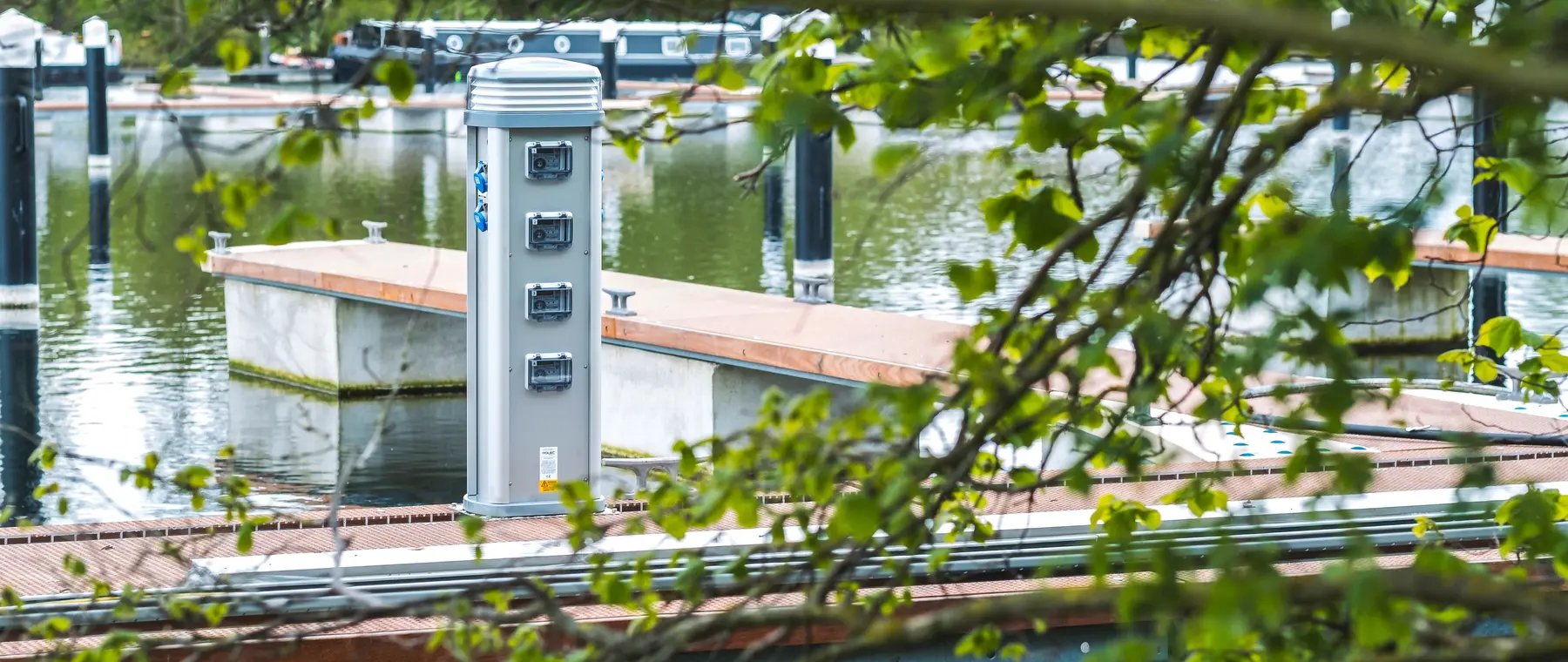
Source documentation: https://www.metstrade.com/exhibitors/rolec/news/rolec-goes-greener. Photograph: Rolec marina service pedestal on a pontoon, supplied with its manufacturing statement — Rolec, official issuer photograph accompanying its 12 October 2026 METSTRADE exhibitor announcement.. Manufacturer-supplied image attached to the specific exhibitor press release made available through the official virtual press room for coverage of the announcement; copyright remains with the rights holder.