A manufacturing proposition rather than a finished yacht
Triac Composites is returning to the Foiling Technology Zone at METSTRADE in Amsterdam this week, with a business proposition aimed at yacht designers, shipyards and equipment manufacturers seeking a partner for the production of advanced composite structures. The manufacturer, which operates in Vietnam, explained its objectives in a September announcement ahead of the exhibition. It is meeting industry representatives at stand 10.703 during the event from 17 to 19 November 2026.
The company is using carbon foils as a prominent example of its capabilities, but its offer extends beyond appendages intended to generate hydrodynamic lift. Spars, rudders, beams, custom structural assemblies and manufacturing tooling are also within the scope described by the supplier. For builders of luxury sailing yachts and performance multihulls, including vessels below 24 metres, the breadth of this offering is relevant to decisions about which parts of a project should be produced internally and which should be entrusted to a specialist.
This is an announcement of manufacturing capability and an invitation to discuss projects. Triac has not disclosed new November contracts, their financial value or the delivery schedules for any resulting yacht programme.
Working from engineering supplied by the customer
A significant distinction in Triac's proposition is that it manufactures components from designs and engineering supplied by customers. The manufacturer's catalogue describes this approach for both foil structures and custom carbon or glass-reinforced composite assemblies. Such a commercial arrangement can allow the yacht builder or naval architect to retain responsibility for the design while engaging an external specialist to turn that design into a manufactured component.
In practice, the division of responsibilities must be precisely understood. A drawing that defines the exterior shape alone is not necessarily sufficient to manufacture a structural composite part. The materials, laminate configuration, manufacturing tolerances, interfaces with adjoining components and acceptance requirements may need to be specified in far greater detail. The design team and manufacturer must also have an agreed process for resolving questions that arise during production.
This is particularly important in the case of performance sailing yachts, where changes to weight, stiffness or geometry can affect the way a component behaves within the larger vessel. The manufacturing process should preserve the relevant engineering intent rather than introduce uncontrolled substitutions in material or construction. The exact technical responsibilities depend on the contract and the scope of the particular project. The exhibitor announcement does not identify a standard contractual allocation of those responsibilities for every customer.
Why composite tooling is part of the discussion
The means of making the part can be as important to a composite manufacturing project as the finished item. Tools provide a reference shape during production and help define the geometry that subsequent operations must achieve. A one-off component may require dedicated tooling even when only one finished part is envisaged. In repeat production, the cost and durability of the tooling can become significant commercial considerations.
Triac identifies robotic machining and in-house tooling among the capabilities available at its manufacturing facility. It also describes prepreg carbon construction, autoclave curing and vacuum infusion. These are different manufacturing techniques and equipment capabilities, not interchangeable descriptions of a single production process. The appropriate combination depends on the component's design, material system and engineering requirements.
For a yacht builder, the useful question is whether the proposed manufacturing process is adequately matched to the required part. An elegant exterior finish does not by itself establish the quality of the internal laminate, and the use of advanced manufacturing equipment does not remove the need for suitable process controls. Acceptance arrangements should be discussed before production begins. The parties may also need to agree on what happens to a dedicated tool after a project ends and who is authorised to use it again.
Foils and the requirements of performance sailing
The company's decision to exhibit in the specialist Foiling Technology Zone reflects an area of particular interest in contemporary performance sailing. A foil that operates beneath the water may experience changing loads as the yacht encounters different speeds, waves and manoeuvres. Its dimensions and surface geometry are relevant to the designer's intended hydrodynamic characteristics, while its internal structure must be suited to the anticipated loading.
Triac's product listing identifies several kinds of appendage, including daggerboards and foils for actively controlled systems. It describes production from customer engineering, covering the tooling through to machining and finishing. That approach can serve one-off projects as well as programmes requiring a series of components. It does not establish the performance of a particular foil design or guarantee that a given appendage is suitable for a yacht whose structure was not designed for it.
The wider luxury sailing market includes boats whose designers may be more concerned with reducing structural weight or improving the arrangement of a conventional rig than with lifting the vessel above the water. Composite manufacturing capabilities can therefore have relevance beyond the more visible developments in foiling. The company's existing relationship with Rapido Trimarans, cited in its September statement, illustrates its participation in the manufacturing supply chain for performance multihulls. No particular new Rapido model or delivery is announced in the release.
Assessing an overseas production relationship
Engaging a specialist manufacturer overseas necessarily raises questions about communication and production oversight. For complex yacht components, a purchasing organisation may need to establish how design information will be transferred, how changes will be reviewed and which records will accompany the completed product. The practical arrangements for monitoring progress can be especially important when the customer and manufacturing facility work in different time zones.
Transport is another factor. The dimensions of a completed composite structure may create logistics requirements far beyond those of an ordinary equipment shipment. Packaging has to protect the item from damage, and arrangements for delivery must reflect the point in the yacht construction schedule at which the component is needed. If the part is supplied for installation by another business, the interfaces and sequence of responsibility should also be understood.
These considerations do not establish that manufacturing in Vietnam will be more or less expensive than production in any other location. A comparison needs to consider the actual scope of the work, including design support, tooling, testing, shipping and other obligations. Triac describes its proposition as commercially competitive, but the announcement does not disclose quotations or provide an independent comparison of manufacturing costs.
A meaningful conversation at the trade show can therefore be more valuable when the prospective customer has a reasonably developed engineering brief. The supplier can then discuss whether its capabilities are relevant to the actual component rather than simply to a broad category of yachts.
From prototype to continuing production
The manufacturer distinguishes between one-off structures, prototypes and repeat orders in describing its business. Those requirements may lead to different decisions concerning the manufacturing process and the records needed to establish consistency. A prototype may be intended to help validate a design before further investment, while a repeated production run may depend on the ability to reproduce agreed dimensions and material characteristics.
For a luxury-yacht builder managing several production models, supplier arrangements may also influence future service. A replacement rudder, spar or moulded component might be needed years after the original vessel was completed. The availability of manufacturing documentation and the continued accessibility of a tool can become important at that point. These matters should be considered alongside the cost of the original part.
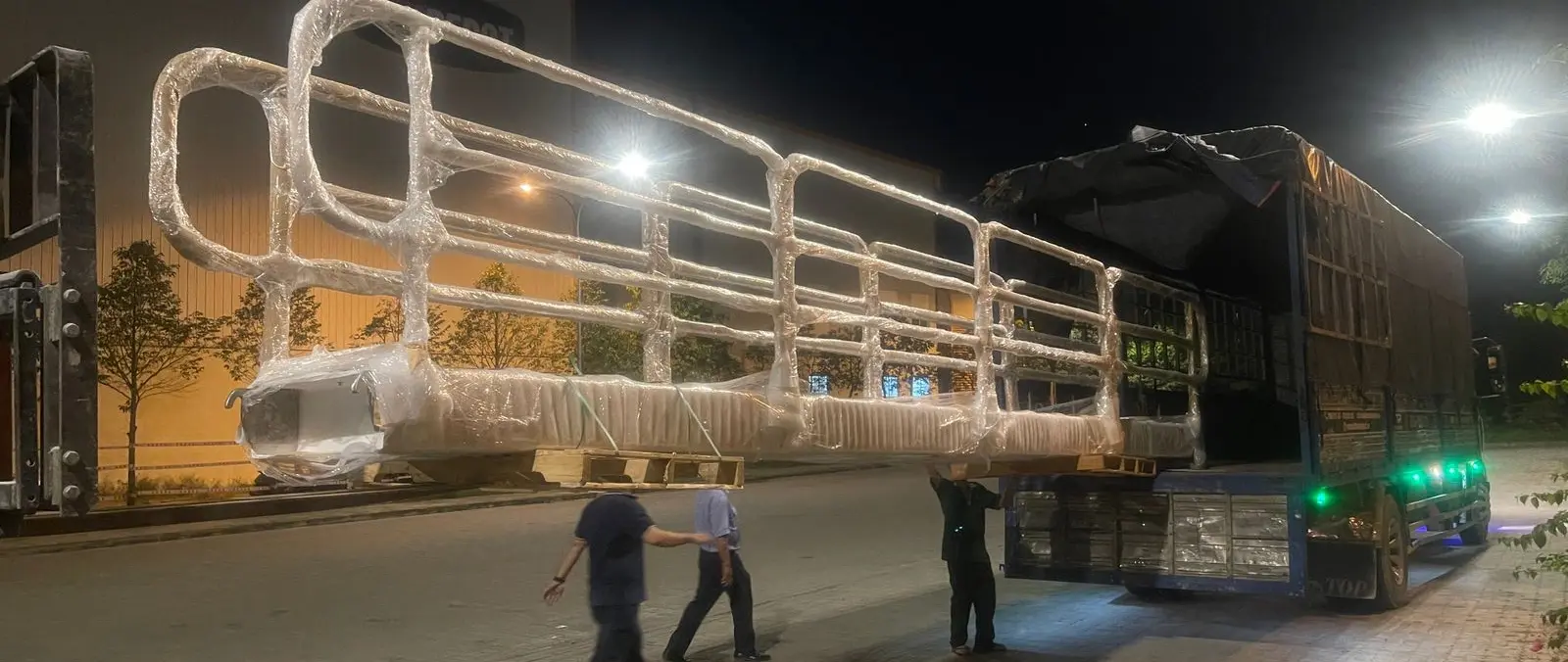
The official catalogue photograph accompanying this report shows a composite gangplank rather than a foil. It illustrates the breadth of the supplier's custom structural work, not a claim that the photographed item is destined for a specific luxury yacht. The company's other catalogue material describes applications in industrial and aerospace manufacturing as well as marine equipment, and its announcement does not assign every illustrated component to the recreational yacht industry.
The significance of Triac's presence at METSTRADE is therefore the opportunity for international designers and builders to evaluate a manufacturing relationship. For the luxury sailing sector, advanced composite construction depends on a connection between engineering, production and subsequent service. The exhibition provides a setting in which the details of that relationship can be discussed before the next manufacturing project is committed.
Sources and lead image
Source documentation: https://www.metstrade.com/exhibitors/triac-composites-vietnam/news/triac-composites-returns-to-metstrade-2026-showcasing-advanced-carbon-foil-manufacturing, https://www.metstrade.com/exhibitors/triac-composites-vietnam/products/custom-composite-structures-components, https://www.triaccomposites.com/post/carbon-foil-manufacturer-metstrade-2026. Lead image: Triac composite gangplank being transported from the manufacturing facility — Triac Composites, official exhibitor catalogue photograph of a composite gangplank; illustrative of manufacturing capability, not a photograph of a yacht foil.. Issuer-supplied media asset published with the relevant official exhibitor release or product catalogue made available through the official virtual press room for coverage of the announcement; copyright remains with the rights holder.