Three suppliers in one exhibition presentation
Italian marine materials business Vaber Industriale is exhibiting with ITW Plexus and Specialinsert at METSTRADE in Amsterdam this week. Its announcement, published through the exhibition's official exhibitor newsroom on 17 September 2026, identifies structural adhesives and marine sealants as the subjects of the presentation, with a particular emphasis on solutions for professional boatbuilding. The companies are meeting the industry's purchasing and technical specialists during the exhibition from 17 to 19 November.
The news is distinct from Vaber's October presentation in the United States. At the Amsterdam event the supplier has specifically identified a joint exhibition presence with ITW Plexus and Specialinsert. The announcement does not describe a merger or acquisition, disclose the financial terms of their relationship or confirm a new boatbuilding contract. Its significance lies in the opportunity for design, engineering and procurement specialists to discuss the interfaces between different types of assembly materials and systems.
For yards building or refitting luxury yachts between 12 and 23.99 metres, the quality of those interfaces can have a considerable influence on the work involved in making a component part of a complete vessel. A finished yacht conceals many of its joints, making careful consideration of their design and manufacture particularly important before they are closed behind trim or interior fittings.
The distinction between joining and sealing
The supplier's product listing identifies structural adhesives and sealants as related but distinct elements of its marine range. An adhesive may be intended to join components so that forces are transmitted between them, while a sealant may be selected primarily to close a joint against ingress of water or other substances, sometimes while accommodating movement. Some products may serve more than one purpose, but those capabilities need to be established for the particular materials and service conditions involved.
This distinction can be especially relevant in the luxury-yacht market, where a single assembly may need to meet aesthetic, functional and structural objectives. A bonded panel or fitting may form part of an arrangement that must tolerate vibration or changes in temperature, and its appearance may also be important to the owner. Designing the visible finish independently from the underlying assembly can introduce problems when the two sets of requirements prove incompatible.
The Vaber announcement identifies PLEXUS structural adhesives as part of the exhibition presentation. The accompanying product catalogue refers to compatibility with composites and metals among other substrates. Those general characterisations are not approvals for specific joints. A builder must select materials on the basis of the manufacturer's technical information and the engineering requirements of the application, rather than assuming that all products in a family have the same characteristics.
Similarly, the presence of marine sealants in the portfolio should not be interpreted as evidence that any one product can replace the sealant specified for an existing yacht. The materials that are being joined, the condition of their surfaces and the demands placed on the joint are relevant considerations.
How the assembly process influences material selection
In a professional boatbuilding environment, engineering decisions about joining components need to be considered alongside the production process used to make the yacht. An assembly involving large moulded composite parts can present different requirements from a small repair to an interior fitting. Access to the joint, the time available to align the parts and the equipment used to handle them can influence the choice of process.
The timing of material application and subsequent operations is also relevant. If a joint is concealed during a later stage of assembly, the builder needs to determine when inspection can take place and which records will provide evidence that the work was carried out as intended. A purchasing decision based only on the price of a cartridge or other package does not account for the time and resources needed to perform and verify the complete operation.
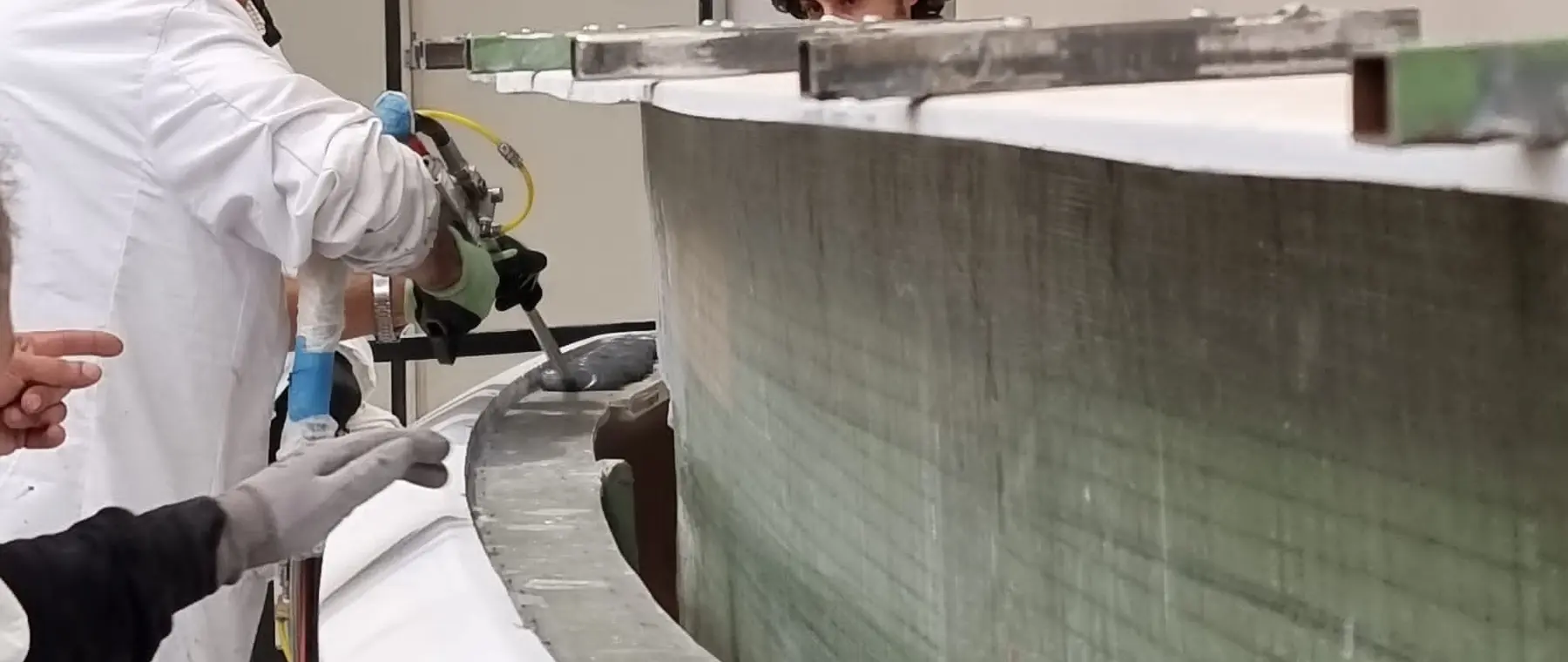
The exhibitor catalogue presents PLEXUS MA590 in an illustrated marine bonding application. The manufacturer's photograph shows a workshop operation rather than disclosing the engineering specification of the part being joined. It would be inappropriate to infer the strength of a finished joint, the materials used in the structure or its suitability for a particular yacht from the picture alone.
The useful question for a professional purchasing team is whether the proposed adhesive, the associated manufacturing process and the design of the assembly have been evaluated together. Vaber's presence in Amsterdam gives the businesses involved a setting in which to discuss that documentation and those production needs.
Mechanical connections and the wider design discussion
Specialinsert's participation in the shared exhibition provides an additional commercial point of interest. The three companies have chosen to identify their presence together, rather than present Vaber's adhesive and sealant portfolio in isolation. The announcement does not list particular Specialinsert products being introduced at the event, and it would be inaccurate to attribute a specific new fastening system to it on the strength of this release alone.
For yacht builders, however, the wider engineering distinction between bonding and mechanical attachment is familiar. An assembly may be permanent, or it may need to be opened to permit inspection and replacement of the equipment it contains. The chosen method of connecting parts must reflect that intended function. A serviceable access panel has different requirements from an assembly intended to form a permanent part of the boat.
Combinations of attachment methods can also occur within the same structure. A joint may involve components with different materials, stiffnesses and responses to loads. Its design should take account of the way those components interact, including any relevant effects of repeated loading and the service environment. Such decisions belong with the responsible designer or engineer, drawing on the appropriate product documentation and testing.
The joint exhibition is consequently an opportunity for technical dialogue, not proof that a particular combination of adhesives and fastening devices has been tested or approved. The product listings provide an introduction to available technologies, while the detailed assessment remains specific to the vessel and its assembly.
Refit projects pose a different set of questions
The challenges experienced by a refit yard are not always identical to those encountered in production. A new-build team can often select materials and design surfaces with the assembly process in mind. A yard working on a yacht that has already been in service may have to assess the condition of existing structures and determine what was originally used to join them.
Repairs can expose earlier modifications or deterioration that was not visible during the initial assessment. The requirements for removing the previous material, evaluating the underlying parts and preparing the joint may affect the scope of work considerably. A suitable replacement material cannot be selected reliably simply by matching the colour or appearance of an older sealant.
This consideration is especially important for premium motor yachts whose external finishes are expected to maintain a consistent appearance after work has been completed. The visible result matters, but it is not a substitute for determining whether the joint is appropriate for its intended function. Decisions about structural repairs or the integrity of watertight boundaries require particular care and suitable professional assessment.
The supplier's catalogue describes products intended for professional marine applications, but does not provide a generic method for repairing every kind of yacht. A yard evaluating the range should request documentation for the intended application and establish whether its work falls within the manufacturer's specified uses. The relevant handling and safety information must also be followed.
An opportunity to assess technical support as well as products
The marine trade exhibition provides buyers with the opportunity to discuss the availability of materials, technical assistance and the documentation that accompanies the products. For a yacht manufacturer producing a series of vessels, consistency of supply and the management of changes to materials may be especially important. For a refit business the ability to obtain appropriate guidance for an unusual repair may be a greater concern.
The September exhibitor statement does not quantify improvements in manufacturing throughput or the cost of joining particular yacht components. Nor does it announce an exclusive arrangement for any named boatbuilder. The benefits of a specific product or purchasing arrangement would have to be established under the circumstances of the project.
The commercial importance of the shared presentation is that it brings related marine assembly disciplines together at the same trade event. Builders can investigate the materials and technical support available before committing to production orders, while yards can identify potential suppliers for forthcoming work. For owners of luxury yachts, those discussions take place largely behind the scenes, but their results may influence the reliability, serviceability and finish of the vessel.
The Amsterdam appearance is therefore best understood as a professional supply-chain development. Vaber is presenting its established bonding and sealing capabilities with two other named marine-industry participants, without claiming a new completed yacht installation. The next stage for an interested yard is a documented technical and commercial assessment based on the components it actually needs to assemble.
Sources and lead image
Source documentation: https://www.metstrade.com/exhibitors/vaber-industriale-s-p-a/news/vaber-industriale-at-metstrade-2026, https://www.metstrade.com/exhibitors/vaber-industriale-s-p-a/products/structural-adhesives-sealants-for-marine-applications. Lead image: Official photograph of marine structural bonding work illustrating PLEXUS MA590 application — Vaber Industriale, official exhibitor catalogue photograph of a marine structural bonding application; not a photograph taken at the Amsterdam exhibition.. Issuer-supplied media asset published with the relevant official exhibitor release or product catalogue made available through the official virtual press room for coverage of the announcement; copyright remains with the rights holder.