Heavy-vessel handling on the exhibition agenda
Vanclaes is presenting a range of vessel transport and launch systems at the November 17–19 Metstrade exhibition in Amsterdam, with particular attention to purpose-built heavy trailers capable of launching and recovering a craft directly at a suitable slipway. The Dutch supplier outlined its exhibition programme and heavy-trailer approach in two announcements dated October 20. The presentations are scheduled for the current exhibition on stand 02.126. The company identifies O3 and O4 trailer systems as a means of addressing the demands of vessels whose weight exceeds conventional leisure trailer capacities. It says it has delivered launch solutions for craft weighing more than twenty tonnes. That experience is relevant to some larger leisure boats, specialist yachts and the yards that handle them, although vehicle and road requirements make this a different proposition from towing an ordinary small recreational boat. The company has not announced a single standard product capable of accommodating every yacht within a defined length range.
O3 and O4 refer to trailer mass categories
The manufacturer identifies O3 as the European category for trailers whose maximum permissible mass exceeds 3.5 tonnes and does not exceed ten tonnes, and O4 as the category above ten tonnes. Those classifications concern the trailer and its permitted mass, not simply the weight of the vessel carried on it. The weight of supporting equipment, the trailer construction and the actual load are also important. Applications involving heavier vessels may require specialist towing vehicles, routing and permissions, which are not determined solely by identifying the trailer category. The appropriate legal and technical requirements must be confirmed for the jurisdictions and routes concerned before transport is undertaken. A vessel whose hull is well suited to launch from a slipway is not necessarily easy to transport over land. Dimensions and arrangements for securing the vessel also need assessment. Vanclaes describes its approach as an engineered response to the specific vessel, journey and launch conditions rather than a fixed trailer configuration.
A trailer that must also work at the water's edge
The company's central proposition is that heavy transport and launching should not always be treated as separate projects. A craft delivered by road may otherwise require access to a crane or travel lift before it can enter the water. If the vessel, trailer and launch environment are appropriately designed and assessed, launching from the same support system may reduce the reliance on separate handling equipment. However, a suitable slipway is a prerequisite, not a universal characteristic of waterfront facilities. Its geometry, access, surface condition and the circumstances under which it will be used all need to be examined against the equipment. The means of retaining control of the craft during launch and recovery must be appropriate to the operation. For a yacht yard, the most important question may be whether the proposed arrangements make sense for the type of vessel handled repeatedly, rather than whether the trailer alone is capable of carrying the required weight.
The difference between standard production and bespoke engineering
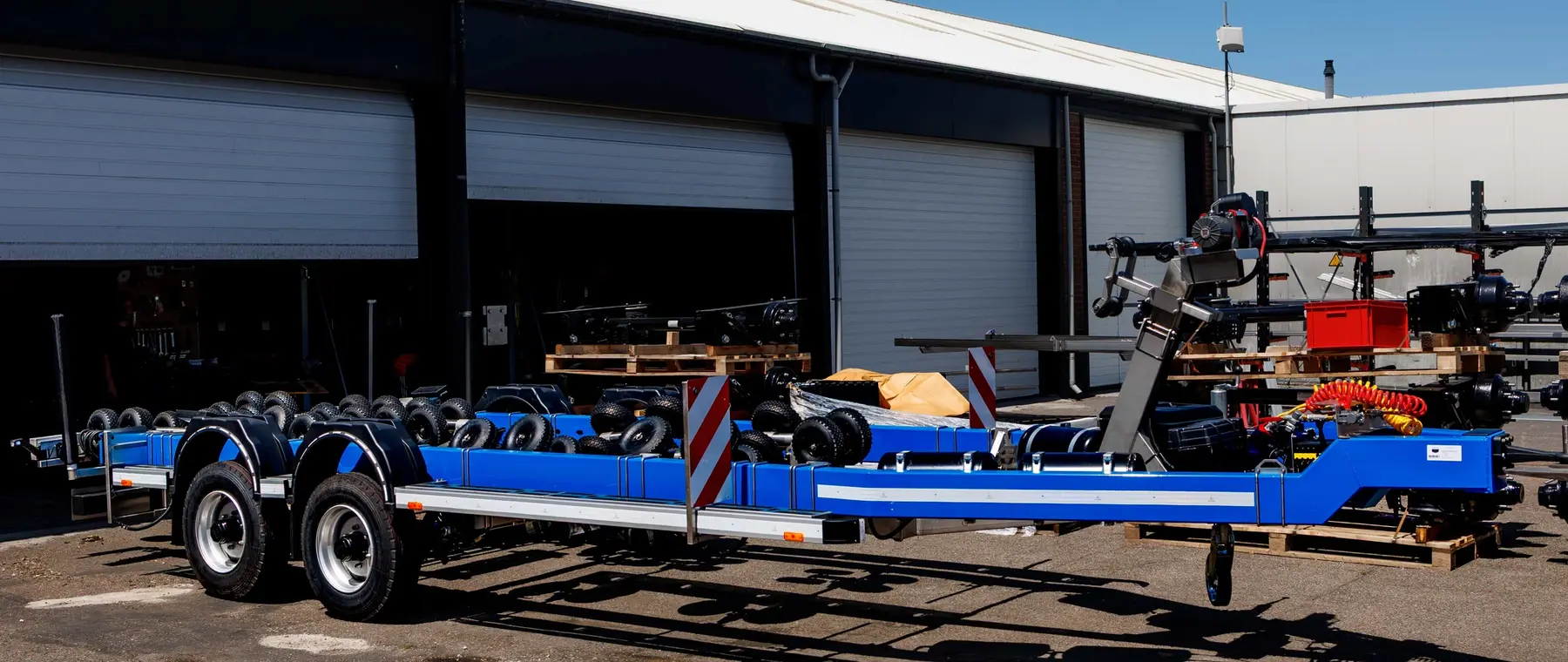
Vanclaes says that individual systems can be configured as centre-axle trailers or semi-trailers. Depending on the application, its work may involve a new chassis or the conversion of a suitable existing one. The materials and equipment described in the release include stainless or coated structural steel, air braking systems with ABS, adjustable axles, hydraulic equipment, electric winches and supports designed for the individual hull. These are options, not a specification shared by all of the company's heavy trailers. A suitable system requires a design taking account of the actual craft, its mass distribution and the positions at which it may be supported. A boat owner's request to move a yacht from one site to another is the starting point for the engineering exercise. Appropriate professionals must establish how that work can be undertaken without imposing unacceptable loads on the hull or on the equipment carrying it. The release does not give engineering limits for any particular customer project.
Relevance to luxury yacht builders and refit facilities
The manufacturer's list of heavy-system applications includes commercial and emergency craft alongside large RIBs and specialist leisure boats. For the luxury yacht industry, the relevant cases are those where the vessel's form and intended use are compatible with this method of handling. A builder may need to transport a completed hull to a launch site, while a yard may regularly move suitable vessels between a working area and the water. Some owners operate large open powerboats for which access to services at several locations is significant. Each of these circumstances presents a different handling requirement. Conventional yacht construction with deep appendages, restrictions on allowable support points or dimensions that make the proposed route impracticable may require entirely different facilities. The announcement should consequently be understood as a description of specialist engineering capability rather than an argument that heavy trailers should replace travel lifts throughout the industry. The selected handling method must suit the actual boat.
An additional electric launcher remains under development
Vanclaes is also describing an electrically driven Boat-Launcher during the exhibition. The concept combines the company's stainless-steel chassis with Tectrax amphibious wheel technology and is intended to permit remote-controlled movement without a conventional towing vehicle. The company announced that a working model would demonstrate the operating principle on its exhibition stand. It separately identified a full-size demonstration as part of a proposed factory visit in Alphen aan den Rijn. The manufacturer stated in October that the full-size equipment was progressing through the European CE approval process and that final saleable specifications, price and availability would be confirmed after approval. Consequently, the electric launcher should not be presented as already approved or immediately available for every application. It should also not be conflated with the existing O3 and O4 road-transport systems. The latter are the principal subject of this report; the separate launcher illustrates another direction in which the manufacturer is investigating vessel movement.
Planning a repeatable yard operation
An organisation handling multiple vessels needs to consider more than the initial cost of acquiring a trailer. The routes within a yard, the availability of appropriately trained operators, support arrangements for different hulls and the way equipment is maintained can all affect the practicality of the chosen solution. For repeated launch and recovery, the design should be evaluated in relation to the expected operating conditions rather than a single demonstration. A trailer engineered for a particular vessel might need different supporting arrangements to accommodate another craft. The owner of the handling equipment must also establish responsibility for inspection and servicing, particularly where mechanisms or components operate in a marine environment. Vanclaes' announcements describe its willingness to assist customers with specification, manufacture and testing. They do not establish that the cost or operational advantages of a trailer-based system will be identical at every marina or shipyard. Those outcomes need to be assessed against the actual pattern of use.
The manufacturer's current exhibition programme
Vanclaes is inviting industry visitors to discuss heavy transport and launching requirements during the November show. In its October exhibition announcement, the company also offered a hosted production-facility visit from the RAI exhibition centre, where it intended to explain trailer design and manufacturing. The existence of that programme does not guarantee spaces or availability for an individual visitor. The photograph provided with the heavy-trailer press release is identified by the issuer as the Vanclaes 3500+ Trailer; it illustrates the type of equipment discussed, rather than documenting the transport of a particular luxury yacht. The published material does not specify the load rating or the complete configuration of the photographed example. For purchasers, the value of visiting an equipment supplier is the opportunity to discuss the actual project and determine what further information is required before the design is finalised. Specialist handling equipment should be evaluated on its documented capabilities and suitability for the intended vessel.
A focused equipment option, rather than a universal solution
The confirmed announcement for this week's exhibition concerns Vanclaes' approach to integrating heavy-vessel road transport and slipway launching, including equipment in the O3 and O4 categories. Its earlier October releases provide the facts behind the current presentation; this is not a claim that an entirely new range was launched on November 18. The manufacturer's experience with craft of more than twenty tonnes gives a useful indication of the scale of some of its projects. Its additional electric launcher represents a different proposed method of vessel movement whose commercial availability has not been established. For luxury yacht yards and operators, the relevant question remains whether a specific yacht and operating site support the intended method of handling. Vehicle selection, vessel suitability, appropriate approvals and an engineered launch arrangement all need confirmation. The exhibition offers an opportunity to examine those considerations directly with the supplier, while the published specifications remain the basis for further discussion rather than authority to undertake an individual transport operation.
Sources and photograph
Source documentation: https://www.metstrade.com/exhibitors/vanclaes-boat-trailers-b-v/news/vanclaes-brings-slipway-launch-capability-to-o3-and-o4-boat-trailers, https://www.metstrade.com/exhibitors/vanclaes-boat-trailers-b-v/news/vanclaes-brings-complete-boat-transport-and-launching-solutions-to-metstrade-2026. Photograph: Vanclaes 3500+ heavy boat trailer, manufacturer publicity photograph — Vanclaes Boat Trailers, manufacturer-supplied photograph attached to its official Metstrade exhibitor press release dated 20 October 2026.. Manufacturer-supplied image attached to the specific exhibitor press release made available through the official virtual press room for coverage of the announcement; copyright remains with the rights holder.