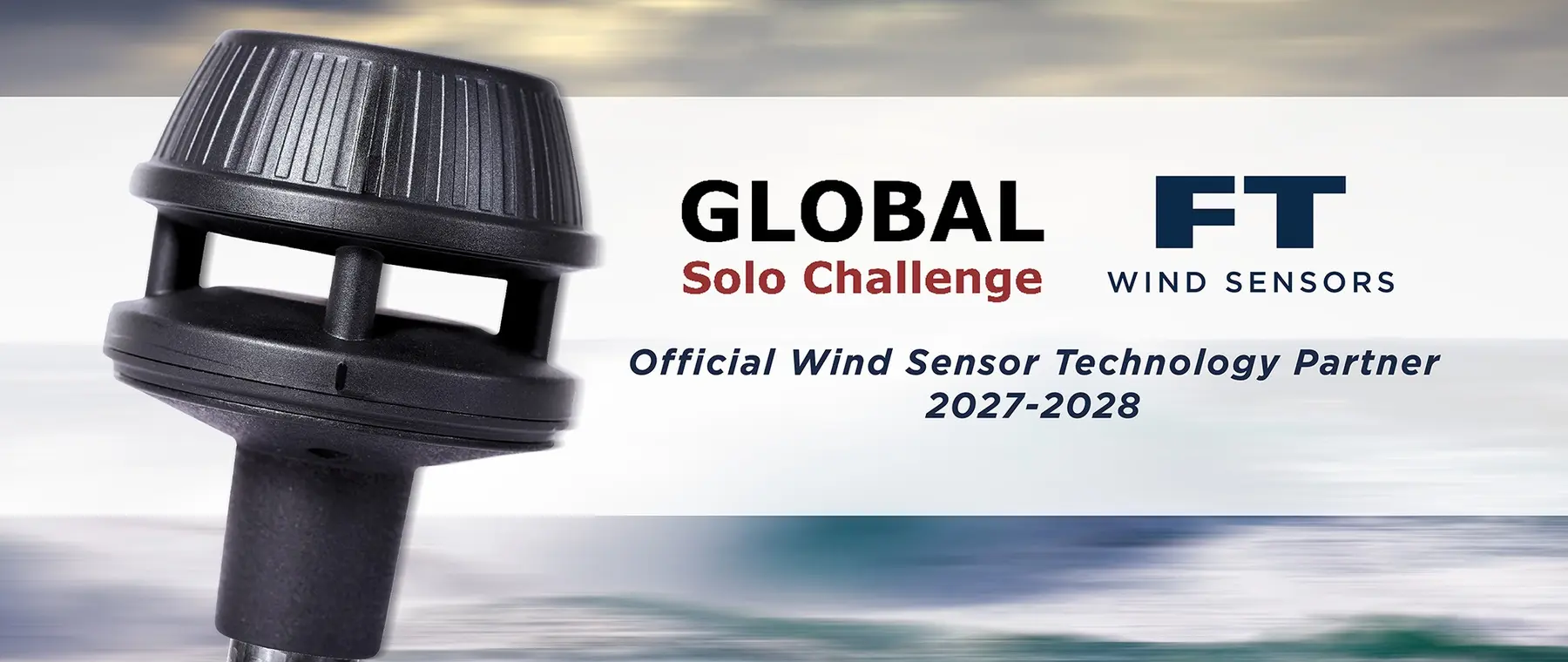
A wind instrument partnership for a demanding race
The Global Solo Challenge has appointed British wind sensor specialist FT Technologies as its official wind sensor technology partner for the 2027–2028 edition of the offshore race. The organiser announced the relationship on 9 November 2026 and the same announcement is carried in the METSTRADE exhibitor news. It concerns support for competitors assessing wind-measuring equipment as they prepare to sail around the world without stopping.
The next edition is scheduled to begin from Vigo in Spain in 2027, with a staggered departure structure. The race brings together boats with different performance characteristics rather than requiring every entrant to sail the same class of yacht. That variety gives the technical partnership particular relevance beyond the fastest professional racing machines. A privately operated offshore sailing yacht may have an equally strong interest in dependable wind information, especially when its crew is small and the vessel will spend long periods away from shore-based maintenance facilities.
The announcement is not a claim that every entrant must install an identical instrument. It describes access to technology and expertise, leaving the suitability of the equipment to be assessed against the configuration of each boat.
Why a wind reading matters when nobody is on the wheel
On a modern offshore sailing yacht, the wind instrument is more than a display of conditions. Its measurements may feed navigation equipment, performance displays and an autopilot. A sailor can use a wind-steering mode to maintain a selected relationship to the apparent wind, rather than simply holding a compass heading. The appropriate mode varies with the situation, but it depends on the quality of the information supplied to the equipment.
Without dependable wind data, a steering system operating in such a mode loses one of its important inputs. A compass-based mode may remain available on a suitably configured boat, but the vessel's relationship to the wind can change when conditions or course relative to the wind shift. That matters to the sailor who is managing sail trim and vessel behaviour, especially offshore, where a sudden change in the yacht's heading or the load on the sail plan can have consequences.
The Global Solo Challenge organiser identifies the difficulty of replacing a failed masthead sensor while alone at sea as a reason to focus on reliability. This is a practical rather than theoretical problem. The mast may be moving considerably, and the tasks of securing the vessel and maintaining a watch do not disappear during a repair. A design that reduces some potential failure modes is attractive, although it cannot guarantee that the instrument will remain operational throughout a circumnavigation.
An alternative to rotating mechanical instruments
FT Technologies uses a proprietary acoustic resonance measurement technique which does not rely on a mechanical rotating cup or vane assembly. The principle is to use acoustic behaviour within a sensor to derive information about the movement of air. The company originally developed equipment for demanding industrial environments, and the Global Solo Challenge says its technology has subsequently become familiar in offshore sailing.
A solid-state instrument removes certain mechanical components from the measuring process. This can address wear mechanisms associated with bearings and moving assemblies, but the term solid-state should not be taken to mean that there are no failure modes. Electrical supply, connectors, mounting arrangements, water ingress and the integrity of communications with other equipment all remain relevant. Installation of any masthead instrument must also account for exposure to the environment and the difficulty of inspecting it once the yacht is underway.
The organiser states that roughly half the IMOCA fleet in the 2024–2025 Vendée Globe used FT equipment. It also refers to adoption in other offshore racing classes. This is evidence of reported use by competitors, not a controlled comparative trial establishing a specific improvement in reliability or performance. The yacht owner who intends to rely on a wind sensor over long distances still needs to assess the relevant model, its outputs and its integration with the existing instrument system.
The challenge of obtaining representative wind data
The position of a wind instrument is an important part of the overall measurement arrangement. Wind at one place on the vessel is not necessarily identical to wind at another. Airflow is altered by sails, rigging, hull and superstructure, and many display systems calculate additional quantities using information such as heading and boat speed. The resulting value may depend on more than the performance of the sensor itself.
A backup installed lower on a yacht may consequently provide useful information without producing exactly the same readings as a functioning masthead instrument. That distinction is important when reviewing the redundancy arrangements of a cruising yacht. An alternative input can help preserve a capability while changing the quality or interpretation of that capability. The crew must understand how to select and use it.
The announcement does not name one sensor model as suitable for all the Global Solo Challenge entrants. It instead refers to assessing appropriate solid-state equipment against their existing navigation and autopilot arrangements. This is a sensible distinction for a fleet of yachts of different ages and designs. A yacht with an integrated modern instrument suite may present quite different requirements from one refitted over a series of seasons using components from several suppliers.
Implications for luxury-yacht commissioning and refit
A yacht owner planning an electronics upgrade should think in terms of the whole measurement chain. The sensor supplies data through a connection or interface. Those data may then be processed by other instruments or the autopilot and presented in different forms on the yacht's displays. A fault at any point in this sequence can affect what the sailor sees or the response of the steering equipment.
Before specifying new components, an installer can document the existing system, including the make and model of the instruments, the interfaces used and the way in which wind information is shared. Compatibility is not simply a question of whether both systems have cable connections. The format of the information, required conversion equipment, supported update rates and configuration of the receiving instrument may all affect the result. There can also be practical differences in the physical installation of a replacement sensor at the masthead.
The same thinking applies to maintenance. A boat owner may prefer components that can be assessed and supported by a service network along an intended cruising route. Racing crews preparing a global voyage may make different choices from a couple using a luxury cruiser for Mediterranean passages. The decision should reflect expected operation, acceptable downtime and the resources available to manage a fault. The race partnership creates an opportunity for technical discussion rather than eliminating the need for this vessel-specific assessment.
From competitive sailing to ordinary cruising
The Global Solo Challenge offers a particularly visible example of the value small crews place on dependable information. A solo racing sailor is responsible for everything from navigation and sail management to maintenance, rest and communication. On a cruising yacht, additional people may be available to help, but the challenges of remote maintenance and changing weather can still be significant.
For owners of yachts in the 12 to 23.99 metre segment, the transferable lesson is not that racing equipment must automatically be installed on a cruising yacht. It is that the apparently modest measurement at the top of the mast may influence several other systems, and therefore deserves consideration during a refit alongside the more conspicuous display equipment. A sensible equipment decision requires the owner and installer to identify the circumstances in which the information will be used and what happens when it is lost.
FT Technologies' appointment is a confirmed partnership for the forthcoming race, not a report of future race results. The November announcement does not disclose contract values, equipment purchases by individual competitors or the detailed configuration of their boats. As preparations advance, the practical relevance will lie in how sailors integrate, test and maintain their instruments. For the wider sailing-yacht industry, that attention to dependable measurements is one of the more useful aspects of the relationship.
Sources and lead image
Source documentation: https://www.metstrade.com/exhibitors/ft-wind-sensors/news/global-solo-challenge-ft-technologies-as-official-wind-sensor-technology-partner-2027-2028, https://globalsolochallenge.com/en/ft-technologies-news/. Lead image: Official partnership illustration featuring FT wind sensor — Global Solo Challenge and FT Technologies, issuer-supplied announcement artwork; not a photograph of a race in progress.. Issuer-supplied media asset attached to the specific exhibitor press release made available through the official virtual press room for coverage of the announcement; copyright remains with the rights holder.