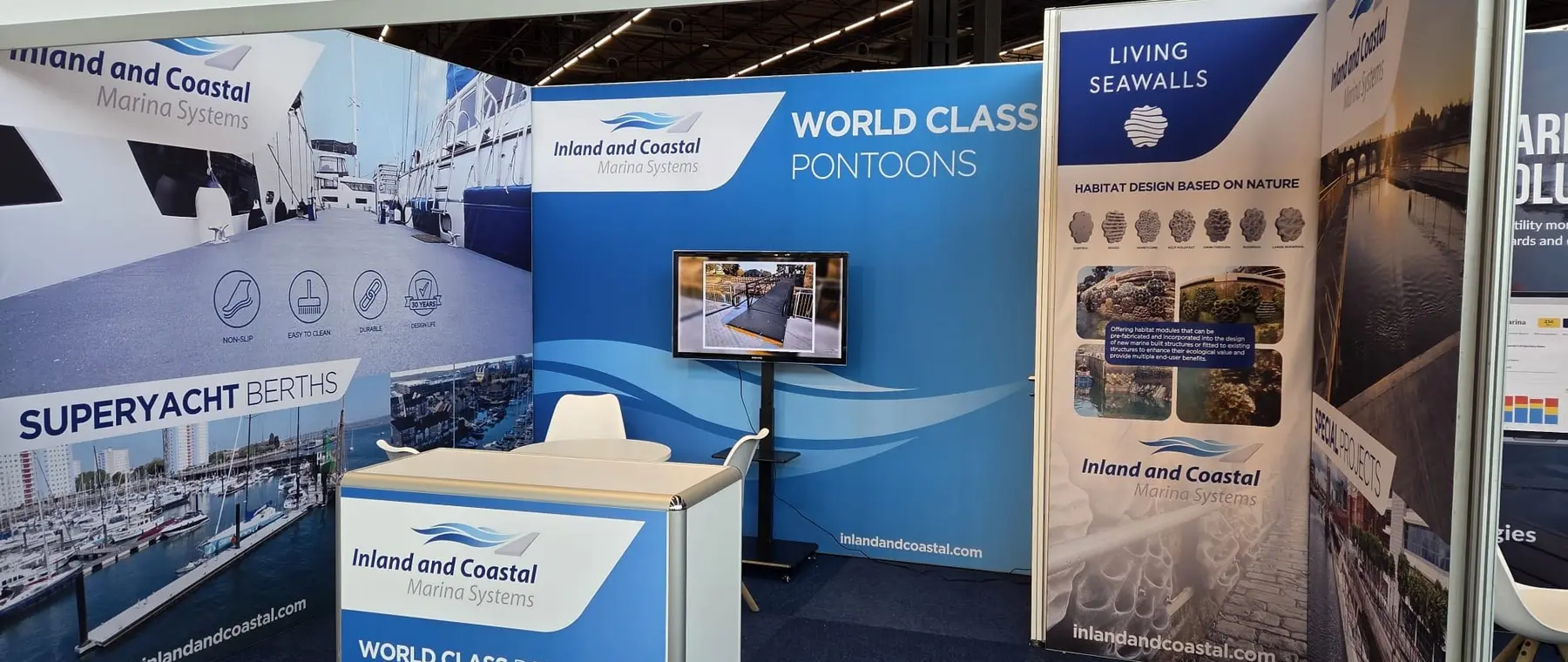
Marina infrastructure takes a prominent place at Amsterdam
Inland and Coastal Marina Systems has announced its programme for METSTRADE 2026, highlighting a series of engineered floating facilities extending beyond conventional yacht berths. The announcement, issued on 11 November by its communications agency MAA, confirms that the company will exhibit from 17 to 19 November at RAI Amsterdam. Its stand, 09.126 in Hall 9, is in the new Marina & Yard zone next to the expanded Superyacht Zone. Among the projects presented in advance of the exhibition is an accessibility-focused passenger ferry pontoon in Padstow, Cornwall. For owners of luxury yachts between twelve and twenty-four metres, this is a particularly relevant example of how a waterfront can be designed around the people using it rather than exclusively around the vessels it accommodates. The announcement concerns the manufacturer's project experience and exhibition plans; it is not a claim that all of its facilities are compatible with every yacht or that the show has already taken place.
A passenger boarding project with implications for marina design
The Padstow project addressed the passenger connection for the ferry between Padstow and Rock. Passengers previously boarded using a tidal slipway. Inland and Coastal says it supplied a purpose-designed, heavy-duty concrete floating platform and a 24-metre access gangway. The stated aim was to improve the consistency and safety of boarding and departure. The company consulted Geoff Holt MBE, a yachtsman with direct experience of disability, during the development of the accessibility approach.
Although this is a passenger ferry installation rather than a private yacht berth, several considerations are directly transferable to the way owners assess marinas. An individual may be perfectly comfortable once inside a yacht yet find the route from a car park to its accommodation difficult. Changes in level, the slope of a connecting gangway, the distance along a pontoon and the arrangement of the final step aboard can each affect the experience. Creating a usable connection is consequently a matter of the complete route, not only the position of a berth within a harbour. The actual performance of the Padstow facility under different combinations of tide, loading and weather must be assessed through the appropriate project information; the press announcement does not establish compliance with every possible mobility requirement.
The relationship between the fixed shore and floating platform
A floating pontoon moves in relation to the water surface, whereas the shore end of its gangway generally occupies a more stable position. An installation in a tidal harbour therefore has to accommodate changes in the geometry of the connection as the water level varies. A long gangway can allow a change in elevation to be distributed across a greater distance, but the resulting slope depends on the actual difference in level and the geometry of the installation. The 24-metre length reported for Padstow should not be read as a recommended universal dimension.
Owners arranging a berth for a yacht with elderly guests, wheelchair users or people recovering from injury can benefit from discussing these matters directly with the marina. A photograph of the gangway at an intermediate tide provides limited information about conditions elsewhere in the tidal cycle. Ask how guests actually reach the pontoon, whether assistance is available, and what alternatives exist if the normal route cannot be used. The design of the boarding arrangement on the yacht remains a separate issue. A destination can have accessible facilities on land while presenting a difficult final transfer aboard a vessel whose deck is considerably higher than the pontoon surface.
Assessing an individual berth beyond length and beam
Marina discussions frequently begin with the overall length of a yacht and the approximate beam. These dimensions are essential, but they are not sufficient to establish whether a facility is appropriate. For a substantial private yacht, the position and type of cleats or other mooring fittings, the characteristics of the fendering arrangement, the location of electrical connections and the nature of access to the shore need to be considered as well. The owner may have particular requirements relating to deliveries, guest transfers or the movement of equipment for maintenance.
A floating structure has its own displacement, stiffness, arrangement of floats or chambers and relationship with the supporting or restraining system. Engineering assessments depend on the forces and conditions for which the particular installation is intended. A pontoon that accommodates a heavily used passenger ferry is not necessarily a suitable yacht berth, just as a marina pontoon is not automatically suitable for supporting a public facility. This is the common thread in the manufacturer's exhibition announcement: facilities should be developed with a defined purpose. Ask the operator or designer for information relevant to the proposed use rather than rely on a comparison based exclusively on visible dimensions.
A swimming installation illustrates another set of requirements
Inland and Coastal also identifies a swimming pool development at Banagher in Ireland among its specialist projects. The activities that take place around a floating swimming facility differ fundamentally from normal mooring operations. Movement of people, the arrangement of entry and exit points, the relationship with the surrounding water and the separation of swimmers from other activities all need to be considered.
For a private yacht owner involved in a waterfront development, that example illustrates why multiple recreational functions should not simply be added to infrastructure originally designed for a different purpose. A usable swimming facility requires its own operating arrangements, appropriate supervision and safety provisions. Yacht traffic and swimmers should be managed according to the actual rules and design of the facility. The presence of a floating recreational structure in a harbour does not establish that swimming elsewhere in that harbour is appropriate. The company has not published detailed structural specifications for the Banagher installation in its November announcement, so the project should be understood as evidence of the range of applications it will discuss in Amsterdam, rather than a basis for reproducing the design.
Oyster infrastructure and the Jeanie Johnston
The manufacturer further identifies a specialised oyster pontoon at Glenarm in County Antrim and a platform associated with the replica ship Jeanie Johnston in Dublin. The projects illustrate two additional purposes for floating infrastructure: supporting an activity associated with aquaculture, and supporting access to a vessel with a historical and public interpretation role.
An oyster-growing operation may have obligations relating to its equipment, environment and the handling of its produce that are quite different from the requirements of a recreational marina. Similarly, a ship open to visitors requires access arrangements capable of accommodating people whose individual familiarity with boats may vary considerably. The significance of the examples is not that one particular design is suitable for all three types of activity. Rather, they show why the designer should establish the operational circumstances of an installation before determining its configuration. Detailed information about each facility should be requested from the responsible company or operator. Yacht owners considering their own private waterfronts may find it useful to investigate these distinctions before deciding which facilities should be combined and which need independent arrangements.
Precast concrete and the wider marina offer
Alongside its specialist projects, Inland and Coastal plans to present precast construction capabilities, including glass-reinforced concrete technology, heavy-duty pontoons and concrete breakwaters. The different products serve related but distinct roles. A mooring platform provides a connection between a floating vessel and an access route; a protective structure may be intended to modify the wave environment in which the platform operates. Choices about the structural system, appropriate restraint and suitability of access depend on the particular location and programme.
Owners commissioning a private marina or participating in a yacht club's redevelopment should approach the exhibition with sufficiently detailed questions. Establish the actual conditions to be accommodated, whether the facility is intended for seasonal or permanent operation, and the needs of the largest and heaviest vessels expected to use it. Consider maintenance and inspection arrangements as well as the initial installation. A material advertised for its durability still requires specification and appropriate maintenance for the environment in which it operates. The manufacturer has not supplied project-independent performance guarantees or engineering calculations in this announcement. Its stated capabilities are a basis for technical discussion, not an alternative to a site-specific assessment.
Living Seawalls and a more varied waterfront surface
The exhibition stand will also include information about Living Seawalls, an initiative associated with the creation of additional habitat opportunities on engineered waterfront surfaces. Inland and Coastal describes itself as the supplier of Living Seawalls in the United Kingdom and Ireland. The concept is relevant to the wider question of how marine infrastructure interacts with the environment in which it is installed.
A marina operator considering such an intervention should establish the objectives of the actual project, appropriate permissions and the intended monitoring arrangements. Biological outcomes depend on the location, water characteristics and organisms present, among other factors. The installation of additional habitat features does not by itself establish that a whole development has no adverse environmental effects. The significance of the planned exhibition display is that structural design and ecological considerations are being presented within the same discussion of waterfront development. The company also identifies its ISO 14001 environmental management certification. This relates to the organisation's management systems and should not be confused with independent certification of the ecological outcomes of every individual project.
The questions to bring to Amsterdam
The November announcement provides a useful reason for marina managers, yacht club committees and private waterfront owners to consider accessibility, the intended use of floating facilities and the role of the surrounding protective infrastructure together. METSTRADE visitors can discuss these topics with Inland and Coastal at stand 09.126 in Hall 9. The company publishes sales@inlandandcoastal.com for exhibition meeting enquiries, while the release identifies Mike Shepherd, mike@maa.agency, as the media contact. The associated official press photograph is provided through MAA's editorial-use gallery. The show opens on 17 November, so the reported programme remains a preview. For luxury-yacht owners, the practical consideration is the quality of the complete connection between vessel and shore. A properly considered marina does more than accommodate the boat: its facilities must support the actual requirements of the owners, guests, crew and people working around the waterfront.
Sources and photograph
Source documentation: https://maa.agency/wp-content/uploads/2026/11/News-Release-Inland-and-Coastal-to-showcase-pontoon-innovation-at-Metstrade-2026-11NOV26.pdf. Photograph: Inland and Coastal specialist pontoon infrastructure — Inland and Coastal Marina Systems / MAA official press photograph. Official press photograph provided by MAA for editorial use only.