A gas-free deck-cooking option in the 2026 marine catalogue
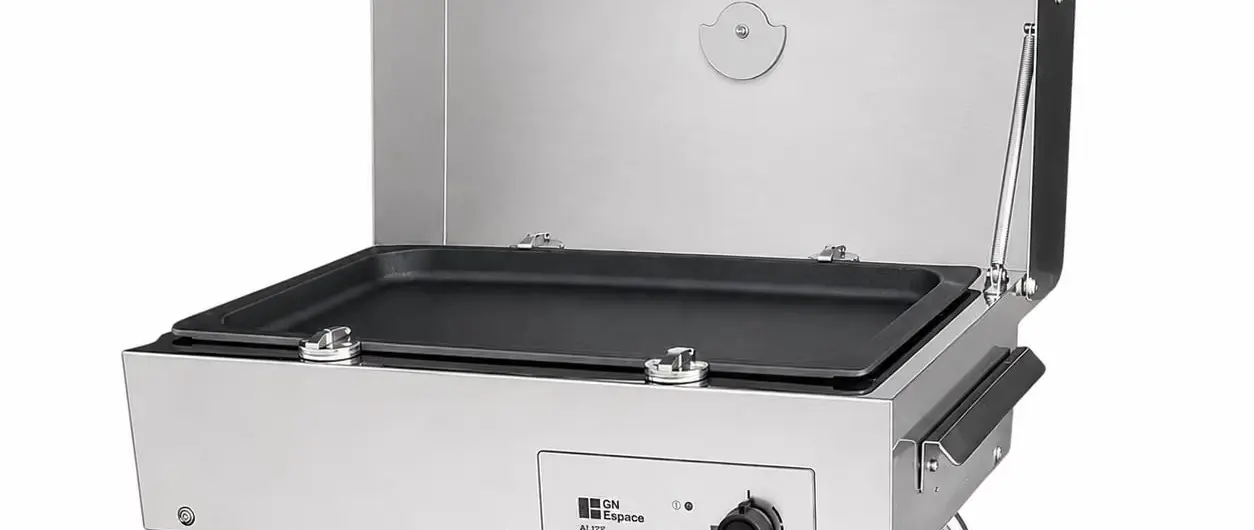
GN Espace's Alize Gastro Grill remains part of the 2026 marine equipment discussion as builders and owners consider alternatives to conventional deck barbecues. The British specialist describes a fully electric 2,000-watt grill designed for exposed outdoor use, with IPX5-rated protection and a removable Gastronorm cooking plate. The model was announced earlier in 2026, so its inclusion in the METSTRADE catalogue should not be portrayed as a first unveiling in November. The development is useful for owners evaluating how to cook outdoors on a luxury motor yacht or sailing catamaran without introducing an LPG cylinder or open gas flame.
What IPX5 indicates and what it does not
The manufacturer highlights IPX5 water-jet resistance, which is an important distinction from a household grill intended only for a sheltered kitchen. An outdoor appliance may encounter rain, spray, cleaning water and the movement of people preparing food alongside the cockpit. However, IPX5 does not mean that the appliance can be submerged, operated with damaged connectors or exposed indefinitely to every marine condition. The precise test concerns water ingress under specified circumstances. Users must still protect the electrical supply, comply with the maker's instructions and consider how the unit is secured when it is not being used.
The electrical requirement is substantial
A 2,000-watt heating appliance is a significant electrical load even on a yacht with modern batteries and inverters. At a nominal 230 volts, its operating current is on the order of nine amperes before any losses or other loads are considered. A yacht with a 12- or 24-volt battery bank must supply the corresponding energy through an inverter if it operates away from shore power. The grill's advertised gas-free convenience should therefore be evaluated alongside battery capacity, charging sources, cable ratings, inverter limits and the load from refrigeration, air conditioning and other hotel equipment. The 2 kW rating alone does not establish an owner's practical off-grid cooking time.
Outdoor placement and the yacht's layout
The Alize is a portable or mountable stainless-steel unit rather than simply another fixed domestic hob, and that creates opportunities to arrange cooking near the cockpit or aft deck. Owners might prefer food preparation away from the main saloon, particularly in warm weather. Yet a grill placed too close to guests, loose upholstery, canvas or doorways can create its own hazards. A designer should consider clearances, the path for carrying hot trays, stable mounting, wind exposure, water accumulation and the position of children and passengers. A safe, practical site will differ between a sheltered flybridge and the open aft cockpit of a sailing yacht.
The value of a removable thermoplate
GN Espace promotes a removable GN 1/1 thermoplate, a format familiar from commercial food-service equipment. The option to remove the cooking surface can help crew clean away grease and food residue in a more convenient area of the galley. This matters on yachts because an outdoor cooking station is often a short distance from a compact sink, with limited water for cleaning large fixtures. A detachable plate may improve servicing, but owners should confirm its weight when hot, the approved cleaning methods, whether it can be immersed and how replacement components are obtained. The maker's instructions take precedence over assumptions based on restaurant equipment.
Cooking performance is more than a power rating
Electricity can provide predictable heat without combustion gases from a gas burner, but the cooking result still depends on the size and temperature distribution of the cooking surface, the food being prepared and the operator's technique. The published 2 kW figure is an electrical or heating power specification, not an independently verified comparison with every gas grill. Owners should seek information on warm-up time, control response and real food preparation capacity before choosing this model for a crew that regularly entertains eight guests. A sea trial is not needed for every galley appliance, but a controlled demonstration and clear operating manual can prevent expensive disappointment.
Ventilation and heat near the seating area
Removing a gas flame does not remove smoke, cooking odour or surface heat. Oil, grease and food can still produce vapours that need to dissipate away from guests and interior furnishings. On some aft decks, an electric grill may be situated close to a glass saloon door, canvas enclosure or refrigerated cabinet. A yacht's layout should include a sensible air path and a safe route for handling hot dishes. Because guests frequently move between cockpit seating and water-access steps, a cooking station must also be kept out of circulation bottlenecks. These practical considerations determine whether deck cooking improves the ownership experience or merely transfers kitchen problems outdoors.
Stainless construction needs appropriate care
The official product description identifies a marine-grade stainless-steel build. Stainless steel is valuable in a salty environment, but its resistance to staining and corrosion depends on grade, finish, exposure and cleaning practice. Owners should not assume that a polished exterior can be ignored for an entire season. Residues from salt, food and cleaning products may require periodic attention, and contact between dissimilar metals should be considered when a unit is mounted to custom hardware. Good practice includes rinsing where appropriate, drying accessible surfaces and following the manufacturer's maintenance guidance. Cosmetic durability is not a substitute for checking electrical connections and mechanical supports.
Electrical protection must include the deck environment
A deck-cooking circuit should have appropriately rated cabling, switching, overcurrent protection and residual-current safeguards where required by the vessel's electrical design and applicable standards. The connector should not become a hidden weak point simply because the cooking appliance itself has an ingress rating. A temporary extension lead lying near the cockpit drain may be much less suitable for marine service than a permanent well-protected outlet. A qualified yacht electrician should inspect the complete circuit, including inverter compatibility and any shore-power arrangements. Owners should resist an installation that relies on improvisation, especially when salt spray and frequent cleaning are part of normal operation.
Comparing electric, LPG and diesel galley choices
There is no single ideal energy source for every luxury yacht. LPG can provide high cooking power without drawing heavily from batteries, but gas installations require carefully designed storage, regulators, shutoffs and leak precautions. Diesel-based galley appliances can be useful where fuel is abundant but may have their own operating characteristics and maintenance needs. The Alize's electrical method eliminates the need for an appliance-specific gas flame, yet transfers more demand onto the onboard electrical system. The appropriate choice depends on the yacht's existing infrastructure, cooking routine, storage volume and guest preferences. A new appliance should form part of a coherent hotel-services plan.
Portability has benefits and responsibilities
A unit that can be moved or detached may be easier to store away from weather and to service in a workshop. It might also offer flexibility between different outdoor seating arrangements. Movement creates a need for secure stowage and clear handling instructions, especially when the yacht is at sea. A portable grill cannot be treated as a loose domestic appliance on a heaving deck. Owners should establish where it will be placed, how it is restrained, where the electrical connection will reach, and how long the cooking plate must cool before storage. These details should be agreed with regular crew rather than improvised by visiting guests.
Procurement and the limits of the product listing
The METSTRADE product entry describes the Alize Gastro Grill's 2,000-watt rating, IPX5 classification, removable GN 1/1 plate and stainless construction. The manufacturer's own webpage provides additional commercial context. Neither a photograph nor a brief exhibitor text establishes all prices, country-specific electrical variants, spare-part lead times or warranty conditions. Owners should request a current quotation and a precise model specification before commissioning cabinetry or installing an outlet. Where the yacht is professionally operated, the person responsible for maintenance should participate in the choice. A sophisticated outdoor cooking area is only successful if the appliance can be operated, cleaned and serviced safely.
Why the subject matters to mid-size yacht owners
In the 12-to-23.99-metre market, many owners increasingly treat the aft cockpit or flybridge as an extension of the living and dining space. A gas-free electric grill is one way to support that pattern, provided the power system and layout are prepared for it. GN Espace's product is a concrete example rather than proof that all yachts should abandon other cooking methods. The confirmed information comes from the manufacturer's catalogue and product pages, not an independent performance test. The lead image is GN Espace's own Alize photograph; it should not be described as a fresh picture taken at the November trade show. The real purchasing question is whether the appliance fits the yacht's electrical and hospitality requirements.
Source and image: Primary product data: https://www.metstrade.com/products-and-services/gn-espace-galley-solutions-ltd/products/alize-gastro-grill. Photo: GN Espace official Alize product image from its manufacturer product webpage; used for product-specific editorial reporting. Original media URL: https://cdn.prod.website-files.com/65c4babbd575326075c62931/6ac65d5c26b6c3557d4a6219_6ac653d6c3e01416b899164e_alize%2520grill%2520open.avif.