Luxury Yacht Guide News | 21 November 2026
A retrospective with a practical message
The 35th anniversary of the DAME Design Awards at METSTRADE 2026 provides an opportunity to examine how apparently specialist equipment has reshaped the layout of the modern luxury yacht. In a retrospective published by the exhibition organiser, three earlier overall winners are singled out for their effect on the aft deck: the Montague Smith Crane Davit of 1998, Besenzoni's G 326 MAGIC hydraulic davit of 2002 and Opacmare's Teaky Beach platform furniture of 2007. All three addressed the relationship between function and the visual character of an increasingly important part of the boat. Their significance is relevant to yachts in the 12-to-24-metre range, where stern platforms, tender stowage and outdoor seating compete for a limited footprint. None is a new 2026 product launch; the news value lies in the anniversary review of how these older innovations shaped the spaces buyers now expect.
The stern was once mainly a working space
On many earlier motor cruisers, the aft end of the vessel was dominated by exposed dinghy davits, ladders, access hatches and practical hardware. Designers made these features attractive where possible, but their essential function was to move equipment and people safely between boat and water. As boatbuilding evolved, buyers began to expect a more continuous outdoor living environment: larger bathing platforms, comfortable seating and easy movement to a tender. The change was not simply cosmetic. A platform that doubles as an entertaining space needs load capacity, drainage, safe edges and the ability to transform without creating dangerous pinch points. Equipment manufacturers were therefore asked to solve problems that increasingly influenced the layout of the complete yacht. The DAME retrospective highlights the importance of recognising those practical engineering contributions in accounts of yacht design.
Montague Smith's unconventional 1998 davit
The Montague Smith Crane Davit received the 1998 DAME overall award for challenging the familiar polished stainless-steel dinghy-handling arrangement. According to METSTRADE's historical account, the device was manufactured from Kevlar-reinforced epoxy resin in a one-piece moulding, with a curved form that concealed the mechanical workings and mounting details. The organiser says the construction cut weight substantially compared with a davit of equivalent capacity made from stainless steel. Weight reduction is especially significant when the installation is carried far aft, where changes can influence trim and how a boat behaves in the water. Yet the design was not only about mass. The award recognised the way its shape could be integrated into the exterior architecture. A piece of working equipment was beginning to be treated as part of the yacht's visual identity rather than merely something that designers had to disguise.
A mechanical detail with a safety purpose
The 1998 Crane Davit incorporated an enclosed winch operated with a conventional winch handle and used epicyclic gearing intended to reduce the risk of an uncontrolled run. This design decision reveals the difference between engineering novelty and genuine user benefit. A tender-lifting device must work predictably in variable conditions, often when a boat is moving slightly and crew are occupied with the tender's balance. Ease of operation matters, but safety and appropriate load management remain paramount. A historic award cannot establish that an old unit is suitable for every installation today. Owners contemplating retrofit equipment should seek contemporary testing information, manufacturer support and compliance with relevant installation requirements. The retrospective is useful because it shows how safety, aesthetics and mass distribution can be considered together instead of as separate concerns.
Besenzoni's G 326 MAGIC changes the package
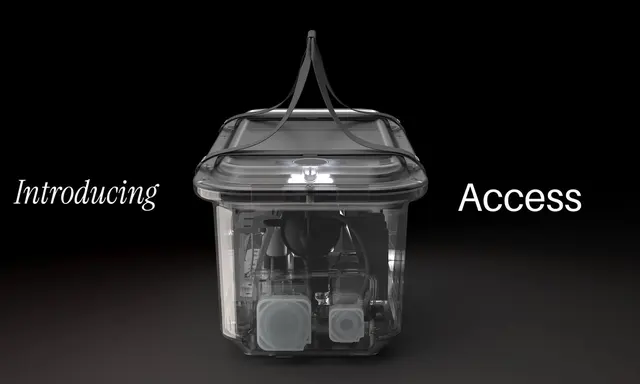
Four years later, Besenzoni's G 326 MAGIC was recognised for a different way of stowing and deploying a tender crane. The telescopic hydraulic arm could collapse into a compact enclosure rather than remain prominently visible above the stern. METSTRADE's review gives a reach of approximately 1.43 metres and a lifting capacity of 300 kilograms for the historical model, with a folded enclosure measuring roughly 490 by 450 by 600 millimetres. The concept was particularly appropriate as motor yachts developed larger bathing platforms suitable for carrying tenders directly on chocks. Instead of leaving a dinghy suspended outboard behind the vessel, the handling mechanism could be integrated into a deck area that had other uses when the tender was absent. That transition foreshadowed a broader rethinking of what the last few metres of a yacht could become.
The mechanical platform must still be engineered
A retractable davit is attractive partly because it disappears, but the loads it transmits do not disappear with it. A designer must consider the foundation, supporting structure, hydraulic system, safe working load and effect of lifting a tender away from the vessel's centreline. The historical MAGIC was controlled with a wired waterproof remote and included an alarm while operating. Those details were significant because the operator needed to be able to observe the moving equipment while keeping controls manageable. On an actual installation, safe positioning of crew and guests remains crucial. A refit specialist cannot simply choose a crane by its rated capacity and install it into an arbitrary platform. Structural reinforcement, equipment clearances, emergency procedures and maintenance access all require careful planning. The retrospective illustrates the origin of an idea whose safe use depends on much more than an attractive folding enclosure.
Opacmare's Teaky Beach makes the deck furniture disappear
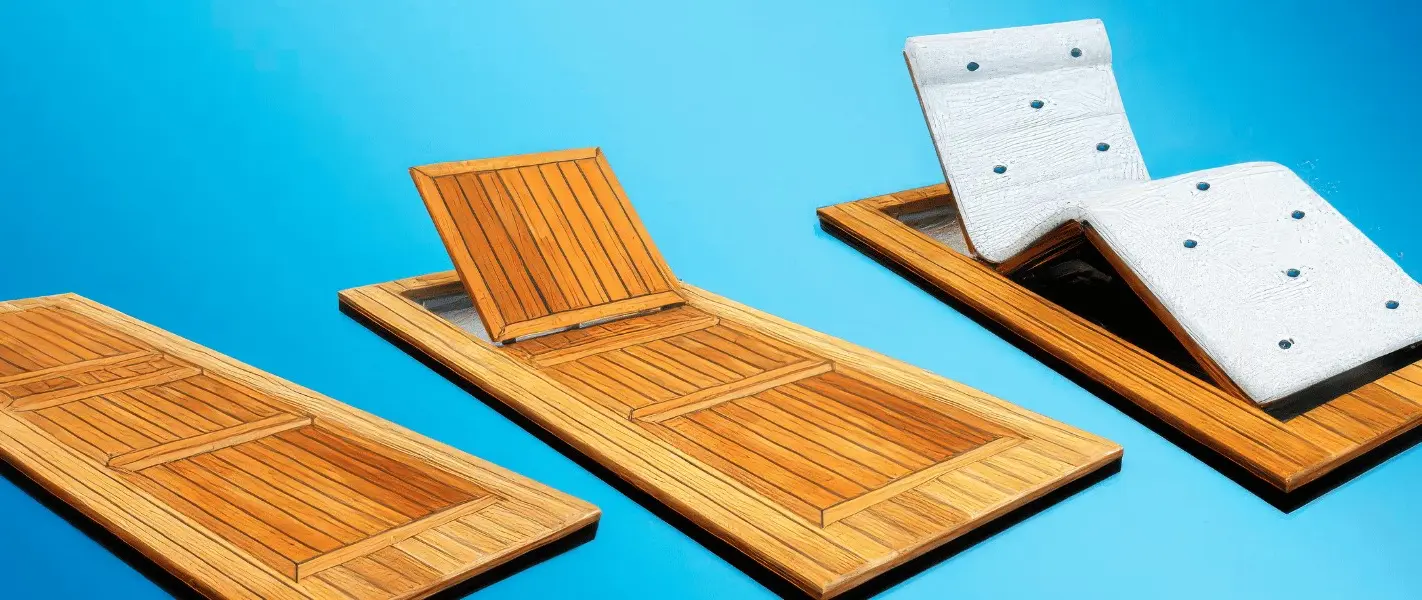
In 2007, Opacmare's Teaky Beach won the DAME overall award with a sun-lounger concept that folds into a nearly flat stern platform. METSTRADE's historical review notes that the mechanism occupies approximately 75 millimetres beneath the deck surface, enabling the seat to appear without consuming a large part of the space below. The product can be operated by an appropriate control system, creating an inviting place to sit when the platform is used for relaxation. When it is folded away, the surface returns to a more open working arrangement. The idea appears simple from above, but the engineering challenge is substantial. A moving support must be robust, stable and comfortable, while the concealed mechanism must fit into shallow available depth. Those requirements help explain why equipment design and yacht architecture have become increasingly interdependent.
Beach clubs begin with design decisions
The modern yacht's aft deck is often sold through images of broad sunpads, open bulwarks and generous steps into the sea. These experiences depend on a history of incremental machinery development. A transformer platform, folding lounge or concealed lifting system changes the usable area, but it also creates moving interfaces and new maintenance responsibilities. On a 17-metre motor cruiser, adding one multifunction component may free enough deck space to change the entire arrangement. On a larger 23-metre yacht, similar thinking can support a distinct beach-club atmosphere without exceeding the vessel's beam and length. The DAME examples show that designers were pursuing those objectives long before contemporary promotional language made the beach club a standard part of many yacht brochures.
What remains relevant after three decades
The three historical products did not enjoy identical commercial trajectories, and METSTRADE acknowledges that the Montague Smith concept was not adopted universally. Commercial success is influenced by production costs, service support, builder relationships and the ability to integrate equipment into repeatable designs. An award can recognise originality while the market ultimately favours a different solution. Besenzoni and Opacmare have continued developing related product lines, demonstrating how an initial idea can become part of a broader equipment family. For today's buyer, the key lesson is to judge installed systems by how reliably they operate, not only by whether the concept once attracted an award. Serviceability, spare-part availability and safe access for inspection deserve a place beside the visual appeal of a folding mechanism.
Implications for a contemporary luxury cruiser
Owners comparing mid-size motor yachts should pay close attention to the stern's operating sequence. Where does the tender go? Can guests move past it safely? How does the platform behave at anchor? Is furniture easily secured for passage? Can crew inspect the hydraulics and fittings without dismantling large areas of cabinetry? Such questions are rarely answered in a sales photograph but define the experience of ownership. The DAME anniversary review reminds the industry that useful innovation often consists of solving a familiar inconvenience exceptionally well. The Montague Smith, Besenzoni and Opacmare designs illustrate three different ways to turn the stern from a place of exposed machinery into a flexible part of the living space. Their legacy is visible in the modern luxury yacht, even when the original product names are forgotten.
Sources and image credits
Reporting based on METSTRADE official DAME Design Awards historical deck-equipment feature, September 2026.
Lead rendering: METSTRADE 35th anniversary DAME deck-design review illustration. METSTRADE / DAME Design Awards, official 2026 anniversary retrospective press media. Original official image source.