Luxury Yacht Guide News | 21 November 2026
A specialist application for the work behind hospitality
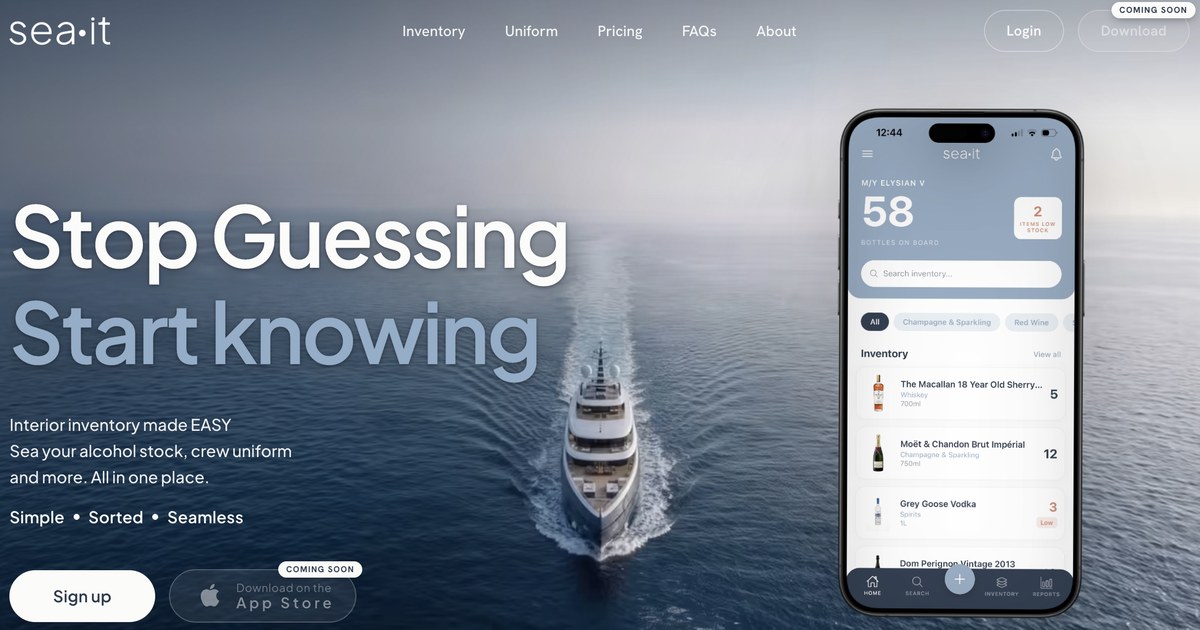
Sea-it has introduced a digital inventory platform intended to help yacht interior teams manage stores, uniform allocations and other onboard assets without relying entirely on static spreadsheets. The company was profiled among the marine technology businesses present at METSTRADE 2026, where founders with professional yacht-crew experience described the difficulty of keeping stock records accurate during an active charter or owner trip. The platform's official website now presents a single inventory view covering the cellar, tableware, bedding and crew uniform. Although its promotional language is directed towards larger crewed yachts, the practical challenge also exists on well-equipped luxury yachts around 18 to 24 metres, particularly those operating with a small permanent team. The significance is not the mere use of a phone application. It is the possibility of making routine stock information available to the people who need it without recreating the same lists after every voyage.
Why a spreadsheet loses accuracy quickly
An interior inventory is only useful if it reflects what is actually aboard. In a busy period, items are consumed, transferred between lockers, damaged or issued to crew, and the paperwork can lag behind the real movements. A spreadsheet may be well organised at the beginning of the season but become unreliable once several people make changes through separate copies. The consequences range from unnecessary provisioning to uncertainty when preparing a vessel for a new group of guests. A digital system promises to reduce that gap by allowing small changes to be recorded as they occur. This is a workflow challenge as much as a software one. Crew must still know where items are stored, understand the naming convention and enter movements consistently. No application can preserve a trustworthy inventory if the people using it do not follow an agreed procedure.
A live picture of the vessel's cellar
Sea-it's website describes organising beverage inventory by category, vintage and location, including the possibility of tracking bottles across different storage spaces. The concept is particularly relevant when a yacht carries expensive wines, spirits or other items that guests may request at short notice. A reliable cellar record can help crew locate a specific bottle and know whether a replacement should be ordered before the next trip. The company also promotes low-stock alerts and item-label scanning. Those functions need to be evaluated in real operation: a scan may speed identification, but the system must still distinguish among similar vintages, formats and partial stock movements. In a smaller yacht with limited refrigeration and storage, the value may be less about having a vast collection and more about reducing wasted space and avoiding last-minute purchases.
Provisioning records and receipts
According to the company's product description, users can add stock by photographing or importing invoices and receipts, reducing the need to type every item separately. For interior departments, this could change the way provisioning is documented after a delivery. Rather than placing paperwork aside and transcribing it at the end of a busy day, the crew can begin recording the new stock while it is being checked. Yet automated data extraction should not be confused with independent verification that the delivery is complete. Quantities, substituted products and damaged goods may still require manual reconciliation. A robust workflow should establish which person accepts delivery, who reviews the recorded quantities and how exceptions are reported. The application's potential benefit lies in reducing clerical repetition, not eliminating the judgement required to run a high-standard yacht.
Uniforms present a different kind of tracking problem
Crew uniform inventory involves sizes, individual allocations, replacements and handovers as people join or leave a vessel. An item can be physically aboard yet unavailable if it belongs to a departing crewmember or has been set aside for alteration. Sea-it offers tracking by type and size and the ability to associate allocations with particular crew members. This can be especially useful during seasonal transitions, when a yacht may recruit temporary staff or change the composition of its service team. On smaller luxury yachts, uniform purchasing may be modest but still costly enough to justify good records. A digital list can also help identify recurring requirements rather than purchasing the same spare size repeatedly. Personal data associated with staff should be handled under an appropriate privacy and access policy, and the platform's operational convenience should not become a reason to retain unnecessary information.
Port declarations and reporting
The supplier says it can produce reports intended to assist with customs and inventory declarations. Alcohol and other controlled stores can be subject to particular reporting requirements when vessels cross borders. A prepared report may reduce the time needed to assemble information, but the crew remains responsible for ensuring the contents are accurate and appropriate to the destination's rules. The presence of an export button does not establish that a report automatically complies with every national format. Captains and interior managers should confirm what authorities require and whether the system provides a complete enough record for their jurisdiction. The potential value is in having a consistent underlying inventory from which formal documents can be prepared, rather than making an unsupported claim of universal legal compliance.
Team access and handover continuity
One of the strongest arguments for a shared inventory is that several people can see updated information without sending copies of a file around the vessel. A chief stewardess, captain and interior team member may all need different views of the same supplies. During handover, the incoming crew should be able to understand where things are located and how much is available without reconstructing records from memory. The company describes live synchronisation across team devices and quick reports. Prospective adopters should examine how user permissions are assigned, whether changes can be audited and how the application behaves when internet connectivity is intermittent. Many yachts operate in locations where connectivity is not guaranteed at all times. A dependable marine application must acknowledge that operating reality and provide clear guidance on the handling of offline changes.
The founder perspective
METSTRADE's start-up coverage describes Sea-it as a project created by people who have worked in professional yacht departments, including a technician and chief stewardess. That background is relevant because inventory management includes details that can be difficult for a general-purpose software developer to anticipate. Guests may ask for a particular vintage, a fragile item may be transferred to a new cabinet and a uniform allocation may need to be recorded during a hectic changeover. The company reported early adoption and interest during its launch period, but self-reported usage figures should not be interpreted as an independently verified measure of market share. The greater test will be whether crews continue using the application after the novelty passes and whether it actually reduces the weekly hours spent on administration.
Suitability for 12-to-24-metre yachts
The system may be most visible in the superyacht interior sector, but owners of smaller professionally operated luxury yachts face many of the same issues at a different scale. A single steward may be responsible for guest service, provisioning, cabins and sometimes coordination with a shore-based manager. If digital records genuinely reduce time spent searching for stores and preparing lists, they could be valuable even where the stock is not extensive. The decision should depend on setup time, subscription cost, security, staff training and how easily existing data can be imported. There is little sense in installing a complicated platform to manage a dozen simple items. Conversely, an 18-metre yacht carrying specialist provisions and changing charter guests may benefit from procedures that resemble those used on far larger vessels.
What should be verified before adoption
An owner or captain considering Sea-it should request a demonstration using a realistic sample inventory, including awkward entries such as opened bottles, damaged items and equipment transferred between locations. Questions should cover data export, service availability, privacy, backups and how account access is handled when crew leave the vessel. The supplier's website promotes time savings and financial efficiency, but those benefits are company claims and should be tested against the yacht's existing procedures. The wider significance of the product lies in a simple observation: luxury hospitality depends on many routine tasks that guests never see. Digitising one of those tasks can be worthwhile when it makes the crew more reliable, not merely busier with another screen.
Sources and image credits
Reporting based on Sea-it official 2026 yacht interior inventory platform specifications, Sea-it official original product illustration (photo provenance).
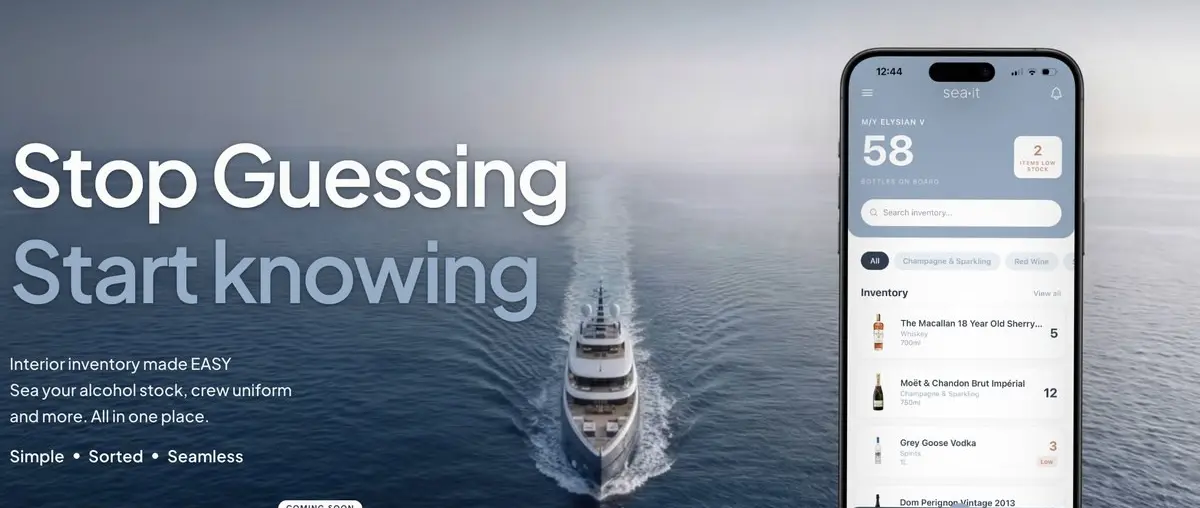
Lead photograph: Sea-it yacht inventory platform interface illustrated by the supplier. Sea-it, official manufacturer product image of its inventory software and yacht application. Original official image source.