Luxury Yacht Guide News | 21 November 2026
The problem of what happens after fibreglass
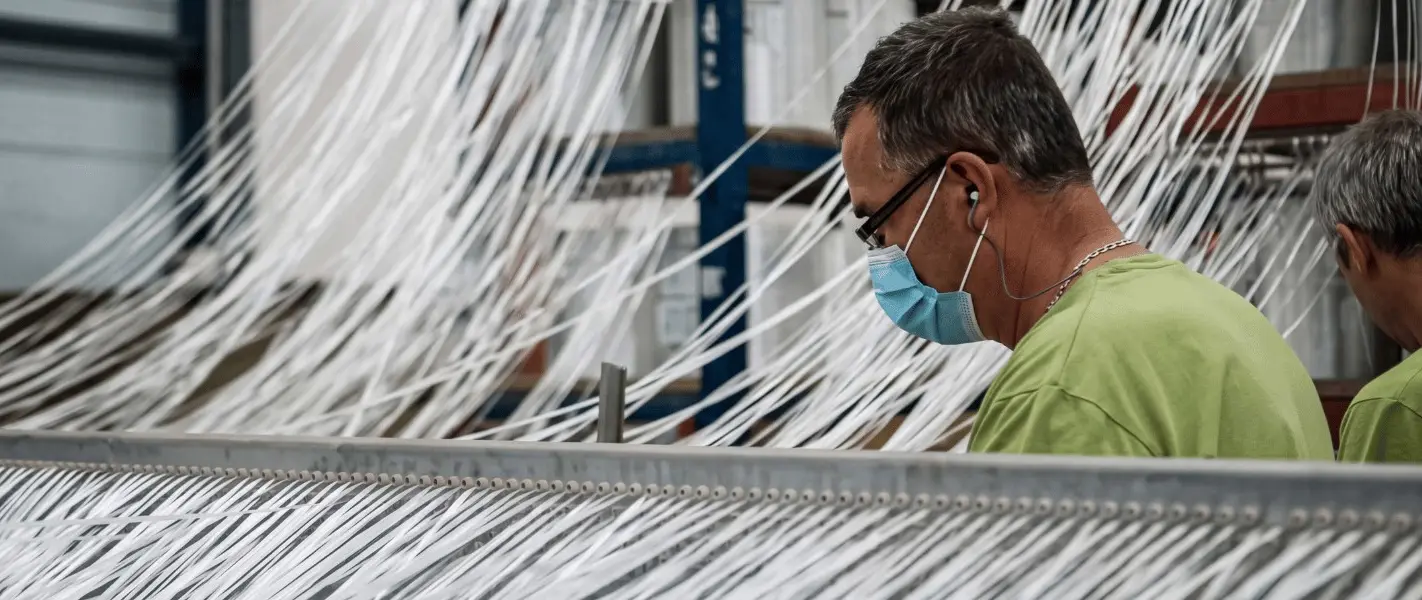
A group of marine and materials companies is demonstrating how composite waste can be recovered and returned to boat manufacturing rather than treated only as an end-of-life disposal problem. Chomarat, Groupe Beneteau, Veolia, Composite Recycling, Arkema and Owens Corning form the industrial alliance described in METSTRADE's 2026 Construction Materials Zone briefing. By the Amsterdam exhibition of 17–19 November, the partnership had moved beyond a conceptual discussion to the use of recycled fibres and recyclable resin in production boat programmes. The reported participants include the Beneteau Oceanis 60, a model relevant to owners of substantial cruising yachts, as well as the Jeanneau Sun Fast 30 One Design and Excess 11 catamaran. What makes the work important is not a claim that every composite boat can now be recycled without difficulty. It is the attempt to construct a repeatable industrial system linking manufacturing scrap to renewed material supply.
Why GRP is difficult to bring full circle
Glass-reinforced plastic has dominated many types of production boatbuilding because it can deliver useful strength, shaped surfaces and corrosion resistance at a competitive manufacturing cost. The same qualities that make a finished hull durable make disposal and material recovery complex. Resin binds the glass reinforcement into a continuous structure, making it difficult to separate intact fibres from the surrounding polymer after a boat or moulding reaches the end of its service. Mechanical grinding may recover material for lower-grade uses, but it does not necessarily create reinforcement suitable for demanding new laminates. METSTRADE's briefing focuses instead on recovering components through controlled thermal processing and then reincorporating them into new materials. This is a practical industrial challenge: it must work not only in a laboratory but within the quality, cost and certification requirements that production shipyards depend on.
Six partners covering different stages
The alliance distributes responsibilities among companies with distinct areas of expertise. Veolia collects manufacturing waste and transports it for processing; Composite Recycling applies pyrolysis technology to separate materials; Arkema converts recovered oil into resin feedstock; Owens Corning supplies glass fibres; Chomarat processes reinforcement materials; and Groupe Beneteau integrates selected products into new vessels. Each step addresses a different obstacle to circularity. Recovering fibres is of little practical value if no manufacturer can prepare them into a consistent reinforcement, while a recyclable resin has limited impact if a boatbuilder cannot validate its use in real structures. Collaboration across the chain is therefore essential. Claims of success should distinguish between demonstrated production use, industrial-scale potential and longer-term ambition. A working pilot does not mean that every type of older hull can be accepted at every processing facility today.
What the pyrolysis process does
Composite Recycling's approach uses an oxygen-limited thermal process to separate glass reinforcement from the resin system. The material entering the plant is heated under controlled conditions; vapours can be condensed to recover oil, while the glass reinforcement is retrieved for further processing. The company has developed a mobile plant designed to fit within a thirty-foot container. Its concept includes the potential to process sizeable pieces, rather than requiring every component to be reduced to fine particles first. This matters because retaining longer fibres can preserve more useful options for subsequent reinforcement manufacture. The recovered materials will still need quality assessment before being included in a production laminate. Heat exposure, contamination, fibre length and the original composite recipe can all affect what the recycling process produces. These practical differences are reasons to evaluate the technology carefully rather than regard recycling as a simple reversal of the original manufacturing process.
Production figures give the programme substance
METSTRADE's report cites a Groupe Beneteau update from June 2026 indicating that 12.6 metric tonnes of Elium resin had already been used in new boat construction. It also describes approximately 14 tonnes of recycled and natural fibres used through related work involving Chomarat's glass-and-hemp hybrid TER²A MAT. The report discusses an estimated carbon-dioxide saving associated with the resin, but such figures require careful interpretation. They depend on boundaries chosen for the life-cycle analysis and should not be presented as a universal reduction in the entire yacht's environmental footprint. Manufacturing energy, transportation, service life, repairs and end-of-life treatment remain relevant. The more important immediate fact is that material with a recycled or recyclable component has moved into identifiable production applications. Those examples make the partnership a meaningful development rather than a purely aspirational sustainability programme.
The relevance of the Oceanis 60
A model such as the Beneteau Oceanis 60 demonstrates why materials innovation is relevant to the luxury-yacht segment rather than only to small experimental dinghies. A substantial cruising yacht is expected to support long periods at sea, carry domestic systems and maintain structural reliability over years of service. Any alteration to reinforcement or resin design must be compatible with those demands. Builders cannot reasonably trade fundamental hull integrity for an unverified environmental benefit. The mention of Oceanis 60 in the reported group of beneficiaries suggests the programme is being considered within real product-development constraints. It does not establish that every laminate of every Oceanis 60 is made from identical recovered material. Customers interested in the environmental profile of a specific boat should request the builder's detailed construction statement and ask which components actually incorporate the new materials.
Manufacturing waste before retired yachts
The most immediate source of recoverable material is often the shipyard's own production process. Cutting, trimming and the manufacture of moulded components create offcuts, sometimes accounting for a significant share of input material. METSTRADE's briefing suggests that roughly ten to thirty percent of laminate material can end up as waste during certain construction operations. Recovering relatively consistent factory scrap can be easier than processing an older hull of uncertain age and composition. The eventual ambition is broader, including retired boats and large moulds, but the technical and logistical obstacles are different. Older hulls may contain repairs, coatings, embedded hardware or resin formulations that complicate separation. A responsible report should acknowledge that a factory scrap loop and a universal end-of-life yacht solution are not yet the same thing.
Structural evidence and classification questions
Boatbuilders contemplating different composite materials need evidence beyond a positive environmental claim. Mechanical testing, fatigue performance, adhesion, water uptake and resistance to damage must be evaluated against the intended structural use. Classification and regulatory requirements may differ depending on vessel size and operating category. Material traceability also becomes important when recovered inputs come from mixed sources. A shipyard may need to demonstrate that two reinforcement batches with different histories still achieve the same engineering properties. For a buyer, those questions are not a reason to reject innovation; they are the basis for confidence. An established builder can be an effective testing environment because it has the manufacturing discipline and service feedback necessary to judge whether a promising idea can survive ordinary use.
A development to watch after METSTRADE
Chomarat participated in the Construction Materials Zone at METSTRADE 2026, which assembled raw-material suppliers, construction specialists and yachtbuilders around the practicalities of new production methods. The alliance's earlier work was recognised by the Boat Builder Awards, providing an independent industry platform for discussion, although awards should not be confused with engineering certification. The relevant next milestones will be the volume and range of actual recycled-material use, the efficiency of collection and processing, and the quality of components produced at repeatable industrial scale. A demonstration that works once has value; a traceable supply chain that can support hundreds of boats has a different commercial significance. The participating companies have begun addressing that larger challenge.
What owners should take from the initiative
A luxury yacht purchased today may be in service for decades. Its environmental story involves production, energy use, maintenance and eventual disposal, so no single materials programme provides a complete answer. Yet a functioning route for recovering fibreglass and returning components to manufacture is an important step. For owners of mid-size yachts, asking builders about resin choice, structural verification, repairability and documented recycled content is more productive than relying on broad environmental labels. Chomarat's collaboration demonstrates that meaningful change can begin within a familiar industrial material, rather than requiring builders to abandon established composite construction entirely. Its longer-term promise lies in making circular practices commercially and technically ordinary, not merely spectacular when first announced.
Sources and image credits
Reporting based on METSTRADE official Construction Materials Zone editorial briefing on Chomarat and Groupe Beneteau, September 2026.
Lead rendering: METSTRADE official Construction Materials Zone article press illustration for Chomarat circular GRP. METSTRADE / RAI Amsterdam, official materials innovation press illustration. Original official image source.