An October 2026 update from the factory
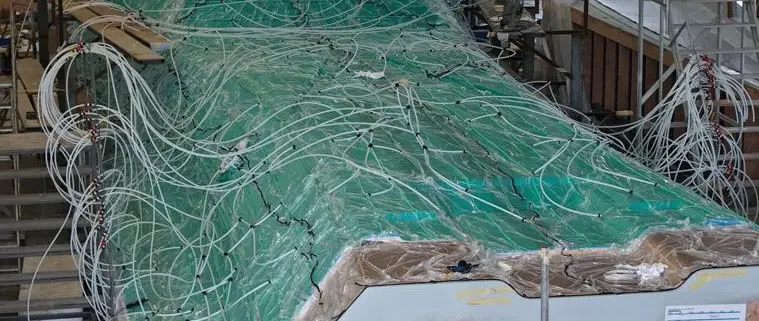
McConaghy Boats used its September 2026 edition of *Inside McConaghy*, circulated directly to the press on 6 October, to report that construction had begun on the first Panther 56 for an Australian couple. The news matters because it moves the electric-hybrid performance-catamaran programme from general concept imagery toward a specific owner-commissioned hull. The factory image distributed with the email shows composite construction underway. It does not show a complete vessel ready for launch, and the company's message does not establish a final delivery date. That distinction is essential when assessing a technically ambitious new yacht, particularly one combining carbon construction, solar generation and a substantial battery system.
A specific owner's yacht, not another model rendering
McConaghy has promoted Panther models for some time, including a Panther 48 and a larger 68-foot concept. Earlier correspondence circulated broad promotional renderings, which may look like finished cruising yachts even when they are not photographs. The October message is different: the manufacturer identifies its first Panther 56 actually in production for a customer. The original email image portrays the material lay-up or infusion stage in a workshop. Because no owner-provided name or numbered hull identification was published, the public fleet entry identifies this particular yacht as the first owner's Panther 56 under construction. Assigning a fictional name or borrowing photographs of another boat would create more confusion than useful information.
Battery capacity as a statement of intent
The main numerical claim in the new message is a battery system exceeding 120 kilowatt-hours. That is a capacity figure, not a proven motoring range or an independently measured discharge capability. The builder describes it as more than twice what some comparable yachts typically offer. Such comparisons depend heavily on model, installed configuration and the date of the specification, so the safest interpretation is that McConaghy is deliberately prioritising relatively high energy storage. At any stage before commissioning, the physical installation, battery chemistry, usable state-of-charge window, cooling and safety controls still require confirmation. The actual hull's finished electrical drawings will matter more than a rounded marketing number.
What storage can and cannot achieve
A large battery bank can support a useful period of quieter operation and provide power to domestic systems while the generator is off. However, its practical benefits depend on the combined loads from propulsion, refrigeration, navigation, cooking, air-conditioning, watermaking and other services. A kilowatt-hour is a quantity of energy; a kilowatt is the rate at which energy is consumed or supplied. Confusing those units leads to misleading range calculations. In a catamaran, hull resistance, speed, weather and sea state also play a substantial role. Neither the October email nor the official model brochure provides an independent trial showing how this first hull will perform under every combination of loads.
The official 17.94-metre platform
McConaghy's own Panther 56 model page currently lists 17.94 metres length overall, with a hull length of approximately 17.09 metres and a maximum beam of 8.2 metres. These measurements help explain its classification as a luxury cruising catamaran rather than a superyacht exceeding 24 metres. The wide platform supports generous living spaces and space for renewable-energy surfaces, but also has operational consequences for marina berths and haul-out facilities. Draft is given as about 1.2 metres with boards raised and 2.5 metres with them down. Those figures should be confirmed on the finished vessel, as equipment, loading and design refinements can affect the as-built result.
Carbon construction shapes the energy equation
The proposed Panther 56 uses vacuum-infused carbon hull, deck and structure. For a yacht with electric propulsion, mass management is especially significant because moving more displacement generally requires more power. Yet a lighter hull does not remove the need for robust scantlings, structural testing or the capacity to carry stores and equipment for an offshore voyage. Good composite design demands a considered relationship among fibre orientation, core materials, resin systems, joints and local reinforcement. The factory photo shows work in progress, not an independent certification of structural quality. Owners should request the applicable compliance documents and production records, especially for a first-of-type hull.
The role of solar power
The October source says Praxis high-output photovoltaic material is planned for integration into the cabin-top and deck. In principle, embedding generation into usable surfaces can increase renewable contribution without the visual effect of multiple raised-panel structures. The result depends on installed area, conversion efficiency, angle to the sun, shading by sails and rigging, and the electrical architecture behind the panels. An owner cruising under cloud or sailing through winter daylight cannot assume a brochure's peak generation figure remains available all day. McConaghy's programme is interesting precisely because it attempts to design the hull and energy package together, rather than bolt solar generation onto a conventional power arrangement afterward.
Manufacturer model propulsion specifications
The official Panther 56 product page specifies twin 45kW electric drives, with peaks of 60kW each. These are model-level design figures rather than verified output records for the customer hull photographed in October. The same page describes regenerative capability while under sail. Propeller regeneration may recover useful energy in suitable conditions, but it also affects hydrodynamic drag and depends on boat speed, sail trim and the generating equipment selected. It would be unsound to infer an exact regeneration rate or transoceanic electric-only range from those general statements. A properly commissioned owner yacht should have measured results that can be distinguished from forecasts.
Hybrid language needs precision
The manufacturer's marketing uses both 'full electric' and 'hybrid-electric' terminology in different contexts. The distinction can matter because a yacht may rely primarily on electric drive while retaining an auxiliary generator for certain operating conditions. Calling a boat zero-emission without specifying whether the claim concerns local propulsion, battery charging or a complete lifecycle can mislead readers. Charging may occur from shore power, onboard generation, solar or hydrogeneration, each with different environmental implications. The October email describes a substantial energy ecosystem but does not provide a complete as-built flow diagram. Owners interested in the environmental impact should request actual fuel-consumption and generation information, not just a label.
Accommodation is configurable
The published Panther model offers multiple cabin arrangements, allowing the final accommodation to reflect the owner's priorities. That flexibility is a central feature of a semi-custom sailing catamaran: one owner may favour dedicated work and storage spaces while another prioritises guest accommodation. The official model page illustrates three- and four-cabin configurations, but neither should be presented as the confirmed layout of the particular Australian owners' hull without signed specification details. Furniture materials, electrical equipment and tankage can all influence weight and service requirements. A successful design process has to reconcile those choices with the boat's sailing characteristics and available energy.
Daggerboards and real-world sailing
Retractable daggerboards form part of the model's intended performance package. They allow designers to seek useful upwind efficiency while maintaining a shallower draft when retracted, but they also add moving structures and service requirements. The practical benefits depend on the conditions in which the yacht will sail and the crew's operating preferences. Lightweight construction, rig arrangement, sail handling and autopilot performance must work together. A performance-oriented cruising boat is not automatically easy to handle simply because its promotional material emphasises short-handed use. Owners should confirm which sail-handling systems will actually be installed and how safely they can be maintained on passage.
Interior comfort and offshore capability
Panoramic glazing and open-plan spaces can create an appealing connection to the water. The challenge is providing that comfort without compromising ventilation, safe circulation, storage and secure furniture arrangements. Offshore cruising also means allowing for movement in a seaway, not just presenting a spacious boat at anchor. A large electrical system adds design choices around machinery noise and heat management that directly affect the saloon and cabins. The Panther programme's aspiration is to combine sophisticated accommodation with a purposeful sailing platform. The important evidence will come when the first boat has been completed and sailed in representative conditions, not solely from a visualisation of the completed interior.
Commissioning is a separate milestone
The first owner's yacht being in construction does not mean it has been launched, handed over or formally sea-trialled. Launching will establish that the vessel has entered the water; commissioning should then validate installed systems and their interactions. An electric-hybrid boat will need particular attention to charging, protection, isolation and thermal management, alongside conventional navigation, stability and sailing checks. Testing can uncover adjustments even when individual components performed well on a workshop bench. Until the manufacturer publishes the relevant milestones, its October 2026 production statement is the correct chronological point to record in the database.
The wider McConaghy engineering environment
The same October company briefing also discussed production of a Botin 41 racing yacht called SWING, composite centreboards for an Echo Marine project, and expanded mast-making equipment at MC1. Those activities provide context for the builder's decision to produce a carbon electric catamaran. They show a business using composite manufacturing across racing hulls, cruising boats and large individual structures. That does not establish that the Panther 56 shares every material or quality process with the racing projects. It does, however, make manufacturing control and integration a legitimate part of the story rather than focusing entirely on marketing the exterior appearance.
Photographs preserved with different meanings
Two kinds of original first-party imagery have been registered against this hull. The 2026 email photograph shows actual composite fabrication during construction. The February 2025 company email includes an artist's render of the Panther model. Both have legitimate editorial uses, but they must not be treated as interchangeable proof of what has physically been built. Source URLs, original-image SHA-256 hashes, email IDs and publication dates have been preserved with the image records. The public page explicitly identifies the earlier visual as a model rendering. That distinction protects the owner's future boat from being illustrated with an imagined final configuration without a warning.
What the announcement establishes
McConaghy had begun building the first Panther 56 for Australian owners by the time of its October 2026 corporate newsletter. The builder proposed a battery system in excess of 120kWh and integration of Praxis solar technology, while its published model specifications describe a 17.94-metre carbon sailing catamaran with twin electric drives and retractable boards. This is a material project update for Luxury Yacht Guide readers, not evidence of a delivered or independently tested electric yacht. The appropriate next milestones are the confirmed as-built specification, successful launch, commissioning, sea trials and handover. Keeping those stages distinct makes the resulting fleet and editorial record useful beyond a single promotional campaign.
Sources and provenance: McConaghy Boats direct original company email ID 1452, sent 6 October 2026 and dated September 2026; original direct Panther launch-design marketing email 453 from 12 February 2025; McConaghy official Panther 56 model specification; McConaghy official newsroom. Original factory construction photo and clearly identified 2025 model rendering, both with independently registered original source URLs and image checksums. All first-hull completion claims remain strictly unconfirmed.