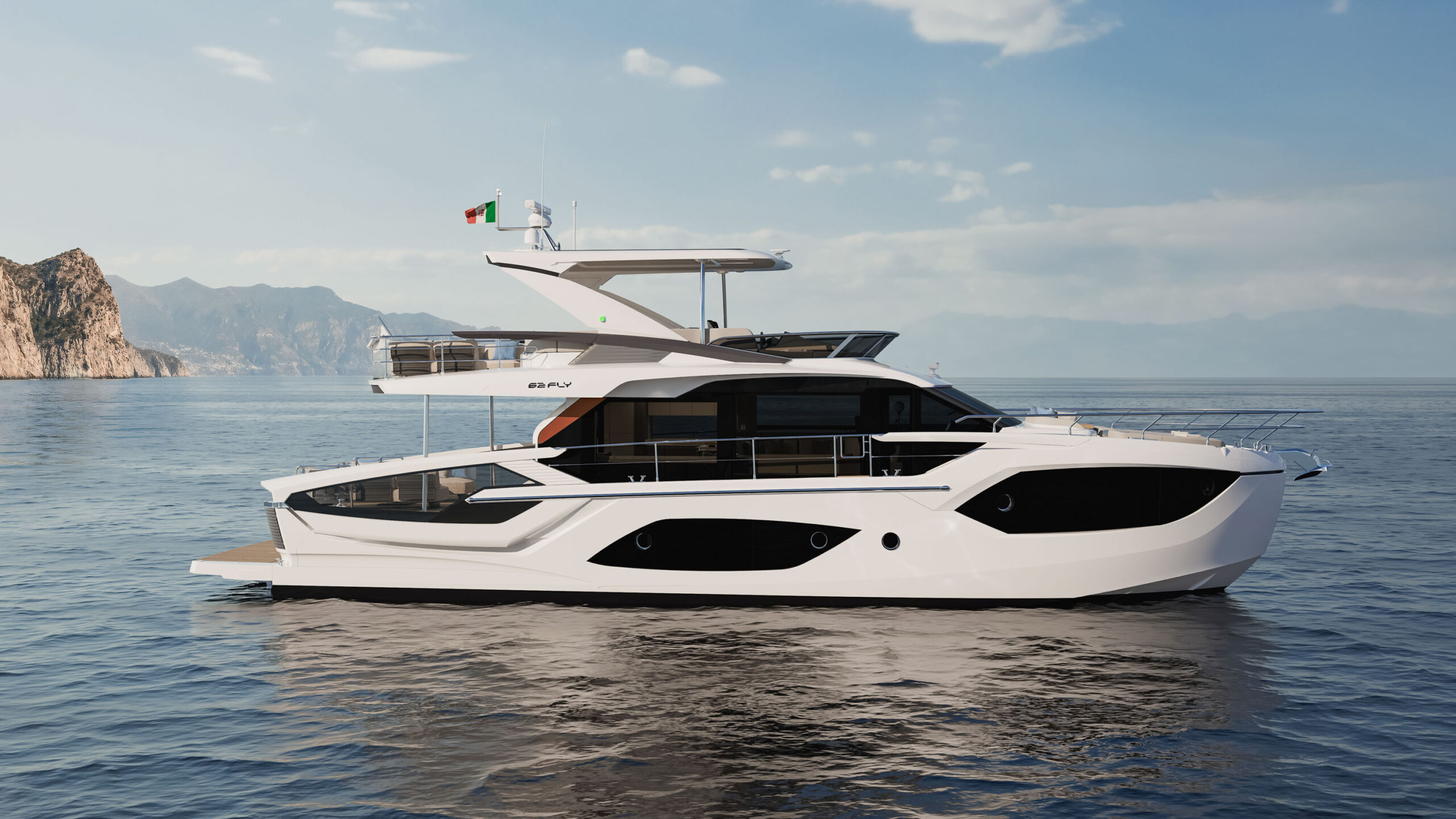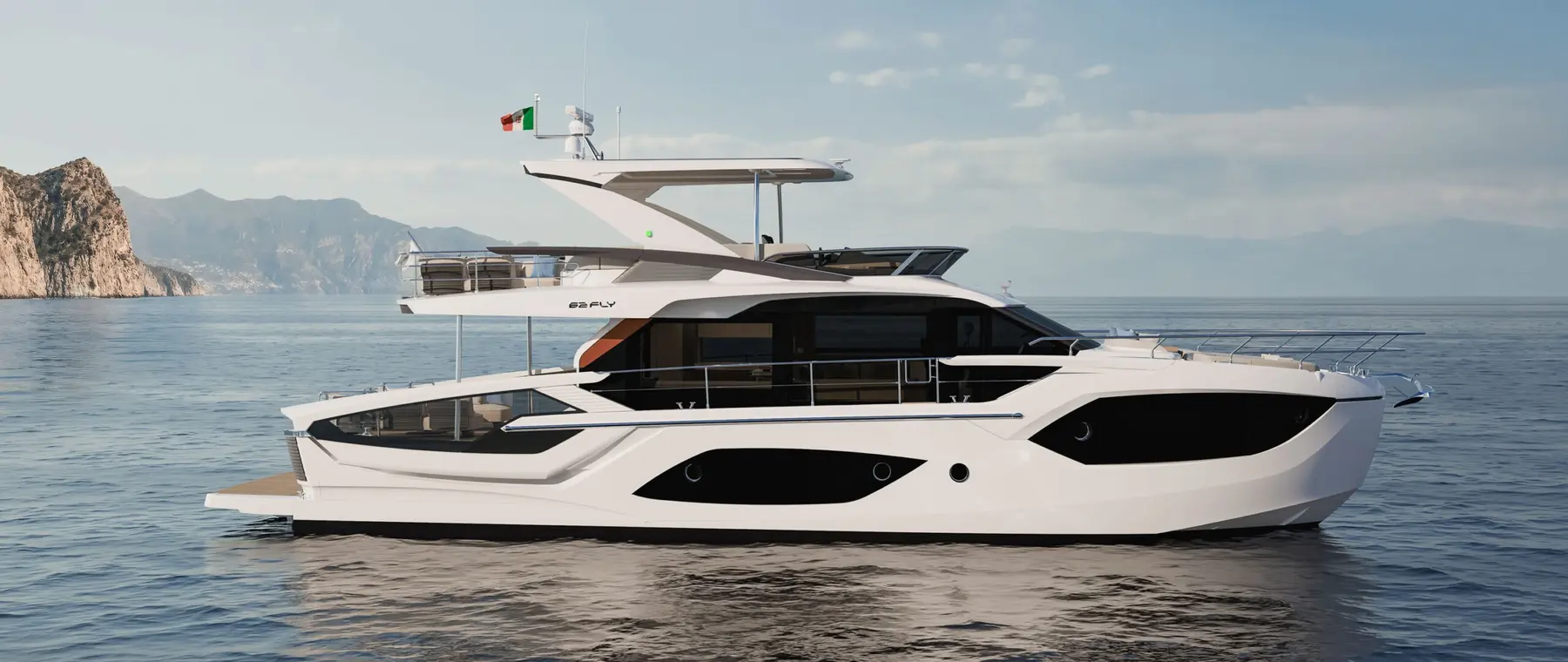
Absolute Yachts has detailed a new generation of its 62 Fly, an 18.66-metre flybridge motor yacht designed to make the boundary between inside and outside feel less restrictive while giving two guest cabins the proportions and privacy usually associated with an owner's suite. PressMare published a detailed presentation of the design on 18 November 2026, and Absolute's current official model page provides confirmed dimensions, layouts and engine choices. The new yacht should not be confused with the earlier 62 Fly that entered the market years ago under the name Absolute Alchemy. This is a newly presented interpretation of the size class, with a revised arrangement, contemporary glazing and a distinctive approach to accommodating guests on roughly 61 feet of hull.
The design idea is more than another sun deck
Absolute says the new 62 Fly follows a philosophy of continuous, flexible living spaces, drawing on ideas developed in its larger flybridge range. The owner is offered a yacht where dining, lounging, helm operation and direct access to the sea remain linked rather than divided by narrow internal corridors. Panoramic windows, sliding openings and transparent bulwark elements are part of that strategy. The challenge is to preserve privacy, weather protection and structural integrity while making those spaces feel connected. Large glazed areas can provide excellent sightlines at anchor, but they should be judged alongside shading, safety and the efficiency of climate control on a hot Mediterranean afternoon. A successful design makes the sea visible without making daily operation uncomfortable.
Principal dimensions and the actual operating envelope
The builder specifies a length of 18.66 metres and beam of 4.94 metres for the new 62 Fly. The official model page lists a maximum capacity of 16 people and design category B, and provides fuel capacity of 2,800 litres and fresh-water capacity of 730 litres. These are published vessel specifications rather than an invitation to carry 16 people in all circumstances or waters. The skipper must comply with the vessel's certification, applicable local regulations and practical limitations imposed by loading and sea conditions. An owner's cruising plans should also account for displacement, draught, tender weight and fuel consumption at the preferred passage speed. Headline dimensions help position the yacht in the market; a complete technical specification is needed before a purchase decision.
The flybridge becomes an additional main deck
According to PressMare's recent design report, the new flybridge occupies approximately 30.1 square metres on one level, a figure the yard presents as exceptional for this segment. The helm is located forward beneath a hardtop, with guest seating nearby. Behind it sit dining facilities and practical equipment including a grill, sink, refrigerator and ice maker. The aft portion can be configured to suit the owner's priorities, while an extending electric awning provides shade. The appeal of a large, level flybridge is clear: guests can move from lunch to observation and relaxation without repeated steps or awkward transitions. Yet every new activity placed above deck has implications for loading, windage and safe movement at sea. Owners should view the actual drainage, handholds, equipment mounting and weather protection during an inspection.
Aft terrace connects the saloon with the water
The stern arrangement is another major part of the design. PressMare reports an aft exterior space exceeding 15 square metres, with a movable bathing platform and modular lounge furniture. Transparent gates and glazing are intended to keep the water visible from the cockpit. Such an arrangement can support swimming, boarding from a tender and relaxed entertaining when conditions permit. It also places operational responsibility on the crew to ensure that guests do not approach moving platform equipment or manoeuvring hazards without supervision. A platform's useful load, extension limits and clearance for a tender should be confirmed from the builder's final equipment specification. The promise is a welcoming waterfront terrace; the practical questions concern safe recovery, cleaning, maintenance and movement around the aft quarters.
Two owner-style cabins define the accommodation
One of the most interesting choices is the decision to give both the forward master suite and the aft VIP suite unusually generous treatment. Absolute's official site describes a forward owner's cabin arranged on one level with extensive glazing, a dedicated walk-in wardrobe and an en-suite bathroom. The aft VIP cabin is also full-beam, with step-free access on either side of the bed, a full-height wardrobe and its own bathroom. The yard argues that the VIP space should feel like a second owner's suite rather than a clearly secondary guest cabin. For couples travelling together, multigenerational families or a charter-oriented ownership programme where appropriate, that symmetry can improve comfort and reduce the sense of hierarchy in sleeping arrangements. The remaining cabin can accommodate guests with a flexible twin-to-double configuration.
Comfort is found in small circulation decisions
The new 62 Fly reportedly avoids unnecessary steps in key living areas. That matters not only for appearance but also when guests move about in the evening, carry luggage or return from the water. It does not mean the yacht is fully accessible to everyone: boarding, stairs between decks, sea movement and emergency routes still require assessment. Practical comfort also depends on how doors, wardrobes and bathroom compartments open when the cabins are in use. A design with impressive showroom dimensions can feel awkward when two people try to dress or stow belongings simultaneously. Owners should spend time walking the intended routes and testing everyday tasks. The claim of dual owner-style suites becomes more meaningful when each space delivers privacy, ventilation, storage and sensible access throughout a cruise.
Sliding saloon windows provide flexibility
Absolute has included electrically operated sliding windows on both sides of the saloon, encouraging natural ventilation and a closer connection with the side decks. A broad sliding door opens toward the cockpit, connecting the galley and dining arrangements with the exterior. This approach can be pleasant in moderate conditions, reducing the sense of sitting in a sealed glass enclosure. But sliding glazing adds mechanisms, seals and maintenance points exposed to salt, vibration and weather. Owners should ask about manual operation if electrical power is lost, water tightness, lock status under way and whether crew can identify a partially closed opening easily. The best use of moving glass is selective: it should expand the experience when conditions allow while maintaining reliable protection during rain and rougher passages.
A galley designed for both guests and crew
The galley sits aft, close to the cockpit and the interior dining area, continuing a layout Absolute has used in several yachts. On the new 62 Fly, the yard describes an induction hob with integrated extraction. This positions meal preparation as part of the social flow without placing it too far from the people using the cockpit. The arrangement can be particularly effective on an owner-operated yacht, where those preparing food may also be hosting guests. Owners should nevertheless examine storage, refrigeration, electrical demand, extraction performance and the ability to secure cooking equipment at sea. A galley that performs well with two people aboard may be less convenient during a full guest gathering. The design should be assessed under realistic usage, not only with its worktops clear for photography.
Three control positions for different manoeuvres
The builder describes the principal helm as part of an integrated Volvo Penta glass-cockpit environment. The recent design account also refers to a third control location close to the starboard aft cockpit, intended to improve visibility during docking. Multiple steering stations can make manoeuvring more comfortable for a skipper who frequently operates with a small crew, particularly when the yacht's beam creates blind spots close to a pontoon. They also require careful station-selection procedures and clear communication among those on board. Owners should confirm that joystick, thruster and engine controls operate as expected from each position, and should practise switching stations before approaching a crowded berth. Electronic convenience is valuable only when the command path remains obvious and predictable.
IPS propulsion and optional power
Absolute's current model specifications name two Volvo Penta propulsion choices: twin D11-IPS950 units rated at 533 kW each, and twin D13-IPS1200 units rated at 662 kW each. These are not direct guarantees of a particular top speed or fuel range. Performance depends on final displacement, machinery selection, weather, hull condition and loading. The owner should ask for measured trial data for the exact configuration under consideration, including fuel consumption at realistic cruise settings, noise and the ability to maintain a comfortable speed in changing conditions. PressMare's report also mentions a Seakeeper gyroscopic stabiliser as part of the yacht's technical provisions. Whether a specific example has particular equipment fitted should be confirmed before treating a published feature as standard.
What prospective buyers should compare
The new 62 Fly faces a highly competitive 18- to 20-metre market in which flybridge volume, guest privacy and practical handling all influence purchasing decisions. Its dual-suite accommodation and single-level flybridge are meaningful differentiators on paper, but their value depends on the owner's intended way of using the yacht. A couple who travels mostly alone may prioritise the galley and master cabin, while those hosting friends may value the second private suite and generous cockpit. A survey should confirm construction details, systems access and the real dimensions of storage and service compartments. Sea trials should examine helm visibility, low-speed handling, platform operation and comfort underway. The newly released details make this yacht worth examining, but they do not replace hands-on evaluation.
A new expression of the 60-foot flybridge
The current 62 Fly is an example of a broader move away from dividing yacht layouts into rigid indoor and outdoor zones. Absolute has chosen a sizeable, flexible flybridge, an aft terrace closely linked with the saloon and two equally considered private suites. With official dimensions of 18.66 by 4.94 metres, the design sits squarely inside Luxury Yacht Guide's vessel scope. The November presentation supplies valuable details while leaving the usual need for witnessed operational evidence. Owners who prize entertaining spaces and generous shared accommodation will find the concept relevant; those making a purchase should still confirm final specification, delivery arrangements and the performance of the chosen propulsion package before committing.
Sources and image credits
Reporting based on Absolute Yachts official November 2026 new-generation 62 Fly technical and design specifications, PressMare original 18 November 2026 new 62 Fly design announcement.
Lead photograph: New-generation Absolute 62 Fly, original 2026 builder media photograph from Absolute Yachts. Absolute Yachts official 2026 new-generation 62 Fly builder photography published in the current model press/gallery materials for editorial use. Original official image source.