A new marina investment platform is taking shape in Italy as Balmaris brings Moniga Porto Nautica on Lake Garda and a majority interest in Porto Turistico di Jesolo near Venice into its first European portfolio. PressMare reported the transactions on 19 November 2026, identifying Balmaris as a business supported by Baltisse, the long-term holding company of Belgium's Balcaen family. Balmaris's own website confirms that the company was established in 2026 and presents Jesolo and Moniga as its initial collection. The development matters to owners of 12- to 23.99-metre luxury yachts because it may influence how berths, maintenance, guest facilities and marina management evolve across important European boating destinations.
Two different waters, one investment approach
Moniga sits on Lake Garda, one of northern Italy's best-known leisure boating regions. Jesolo is near the Venetian Lagoon, with access toward the Adriatic. The two sites have very different navigational conditions, cruising patterns and customer needs. A lake-based marina serving seasonal residents and day cruisers cannot simply be managed as though it were an Adriatic transit port. Balmaris says its approach is to preserve each marina's individual identity while supporting infrastructure and service development. The company describes a collection of distinctive local businesses rather than a chain in which every destination becomes visually and operationally identical. Whether that principle is retained as the network grows will be a significant test for berth holders and local managers.
A family-backed platform rather than a fixed-term fund
According to the company's published account, Balmaris is part of Baltisse, a family holding that has invested in businesses over long periods. Its background includes industrial companies founded and developed by members of the Balcaen family before later divestments. The marina platform says it is seeking full or partial acquisitions, with flexibility for existing owners to remain involved. It also emphasises that marina staff and local relationships should remain central to operations. This differs in stated approach from an investment strategy with a predetermined exit date, although the absence of a declared exit timetable does not itself guarantee stable berth pricing or uninterrupted service. Owners will judge the model by what happens on the docks and in the yard, rather than solely by the investor's description.
Moniga Porto Nautica and its established customer base
Moniga Porto Nautica has developed over many years as a Lake Garda boating centre with berthing, storage, repairs and associated services. PressMare says Laura Fadabini and Roberto Vassalli, who developed the site from 2005, will remain involved with the business following Balmaris's acquisition. The marina's current official website advertises 285 berths, a specialist boatyard and around 6,200 square metres of covered storage. PressMare's transaction report describes earlier or differently defined berth and land-storage figures; those numbers should not be merged without clarification from the operator. What matters for an owner is the availability of a particular berth size and the actual capability of the yard to manage a vessel's draught, beam, displacement and maintenance needs. A marina's total berth count is only the start of that enquiry.
A lake marina offers a different ownership rhythm
Lake Garda attracts owners who may use their vessels repeatedly for weekends, family outings and seasonal cruising rather than a long coastal voyage. Covered storage, winter preparation, mechanical servicing and dealer support can therefore be particularly valuable. Moniga's published services include sales activity associated with Cranchi and VanDutch, as well as technical assistance and hospitality. For a luxury motorboat owner, that combination can create an efficient local base if the yard has the appropriate lifting equipment and trained staff for the chosen yacht. Navigation on a large lake still involves weather, local speed rules and changing traffic; it is not a simplified version of coastal boating. Buyers should consult the applicable Garda regulations and the marina's berth restrictions before assuming that a particular 20-metre yacht is suitable.
Jesolo connects a different network of destinations
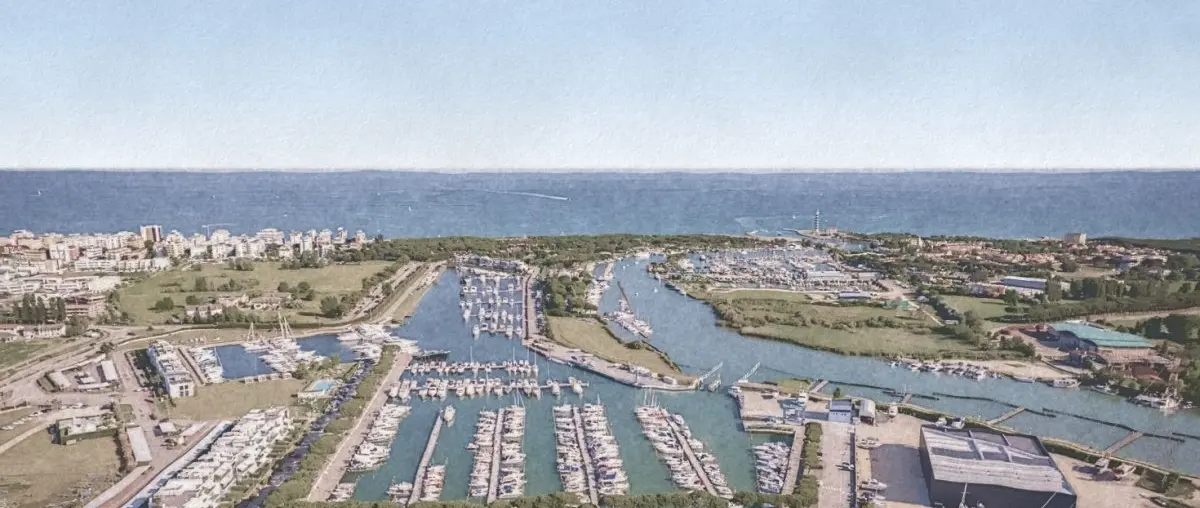
Porto Turistico di Jesolo stands along the Sile near the Venetian Lagoon and offers access to the Adriatic. The transaction report says the location has more than 600 berths, a travel lift rated to 100 tonnes, extensive indoor storage and leisure facilities including a pool and restaurant. Balmaris acquired a 51 percent interest rather than the whole marina, according to the report. That distinction matters when explaining the partnership: it describes a majority stake and continuing involvement of existing local stakeholders, not a simple replacement of everyone previously managing the site. For yachts cruising the northern Adriatic, Jesolo may be a base for regional passages, seasonal storage or visits toward Venice, subject to local navigation and access rules.
Facilities are more important than an attractive berth photograph
A prospective berth holder should examine the actual services behind a marina's promotional material. For a 21-metre yacht, access depth, maximum allowable beam, power supply, potable water arrangements, pump-out facilities and emergency response provisions all matter. The presence of a travel lift does not prove that every hull shape or keel configuration can be handled. A captain should confirm lifting slings, cradles, insurance requirements and whether work can be undertaken by independent contractors. Indoor storage dimensions and fire precautions can also determine whether a vessel can remain ashore during winter. Investing in facilities may create genuine benefits, but owners should ask which upgrades have been commissioned and which are still planned before making commitments.
The attraction and challenge of a shared marina network
If Balmaris expands into several countries, a common ownership group could support purchasing, technology, staff training and marketing. Owners with boats operating across regions might also value a familiar approach to reservations and customer care. However, the company has not announced a universal berth passport, guaranteed reciprocal availability or a uniform pricing arrangement across its locations. Those benefits should not be implied. Shared back-office systems can help staff spend more time on customers, but they can also reduce flexibility if local requirements are overlooked. Local management needs authority to handle particular waters, community relationships and environmental rules. The quality of the network will depend on how well the group balances its shared resources with site-specific expertise.
Marina investment has an environmental dimension
Waterfront infrastructure involves environmental responsibilities that differ between a freshwater lake and a coastal estuary. Fuel supply, runoff from maintenance areas, waste handling and protection of surrounding habitats are operational concerns, not matters that can be solved with marketing language. At Moniga, freshwater quality and lake regulations are central. At Jesolo, access to the Adriatic and Venetian waterways brings a different set of constraints. Owners should seek clear information about waste reception, permitted repair work, antifouling practices and water-use policies. When investors describe improvements, the most useful evidence will be documented upgrades and operating procedures. Environmental quality is an essential aspect of an attractive marina, but any claims about measurable improvements should be tied to facts after the work is done.
Preserving the character of the destination
For many owners, the appeal of a marina comes from its connection to the town, waterfront and cruising environment. A collection that preserves the individual character of its locations may attract clients who do not want every marina to feel like the same commercial development. Balmaris describes its model as a way to provide investment while retaining the history and expertise of each site. The approach could be particularly attractive at Moniga, where local services and long-standing relationships are an important part of the boating community. At Jesolo, customer expectations include access to local attractions, transport and hospitality. An internationally financed operator will need to demonstrate that it understands those different expectations rather than merely impose standardised branding.
Why the size of the owner yacht still matters
Luxury Yacht Guide's vessel range includes many motor yachts and sailing yachts capable of using European marinas, but their needs vary widely. An 18-metre flybridge yacht may require a high-capacity shore electrical connection and convenient access for a specialist technician. A sailing yacht of similar length may be constrained by mast height, keel draught and access to lifting facilities. A marina that is exceptionally suitable for one yacht can be unsuitable for another. Berth enquiries should specify dimensions and vessel characteristics accurately. Owners should also ask whether the advertised berth is seasonal, annual or transient; what it includes; and how maintenance bookings are handled. These questions are unlikely to change simply because the marina joins a larger investment group.
What to watch after the first two acquisitions
The Balmaris announcement is a concrete change in the structure of two Italian marina businesses, not merely a proposed investment theme. Moniga's full acquisition and Jesolo's majority-stake transaction provide the initial geographic foundation for a network the company wants to expand across Europe. The next meaningful developments will be further confirmed acquisitions, published infrastructure investments and the experience of customers at the existing sites. For yacht owners, the standard of service should remain the central measure. If patient capital and capable local teams combine to improve maintenance, berth facilities and hospitality without erasing the destinations' identities, Balmaris could become a noteworthy addition to the European marina sector. The claims should be tested against results at Moniga and Jesolo as their next phases unfold.
Sources and image credits
Reporting based on PressMare 19 November 2026 interview and acquisition details, Balmaris official 2026 corporate site and initial marina portfolio, Moniga Porto Nautica official contemporary berth and service information.
Lead photograph: Balmaris marina collection, original official investor promotional photograph, illustrating its new European portfolio. Balmaris official company website promotional photo of its marina collection, published alongside its company description and initial portfolio; rights remain with the issuer. Original official image source.