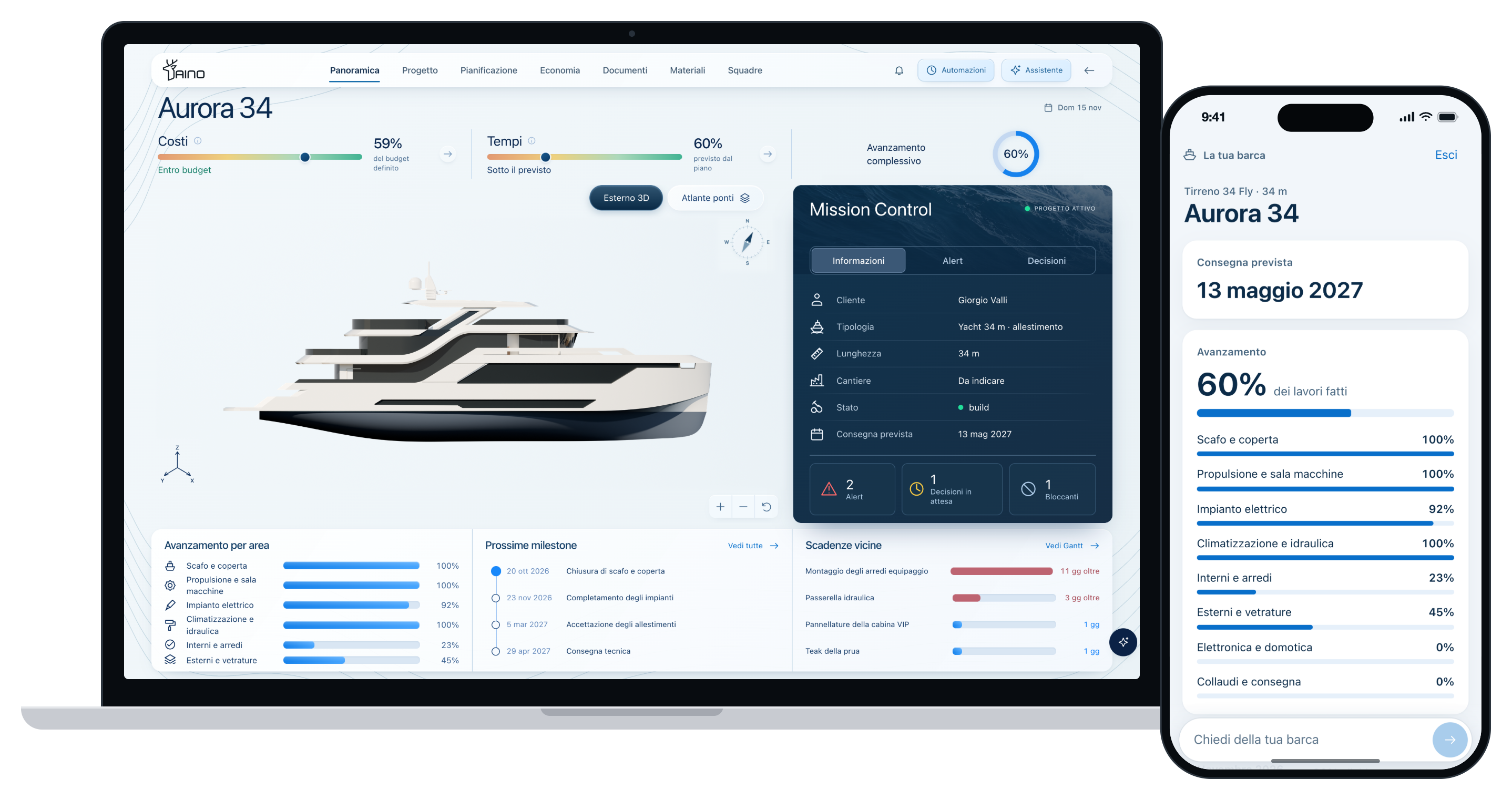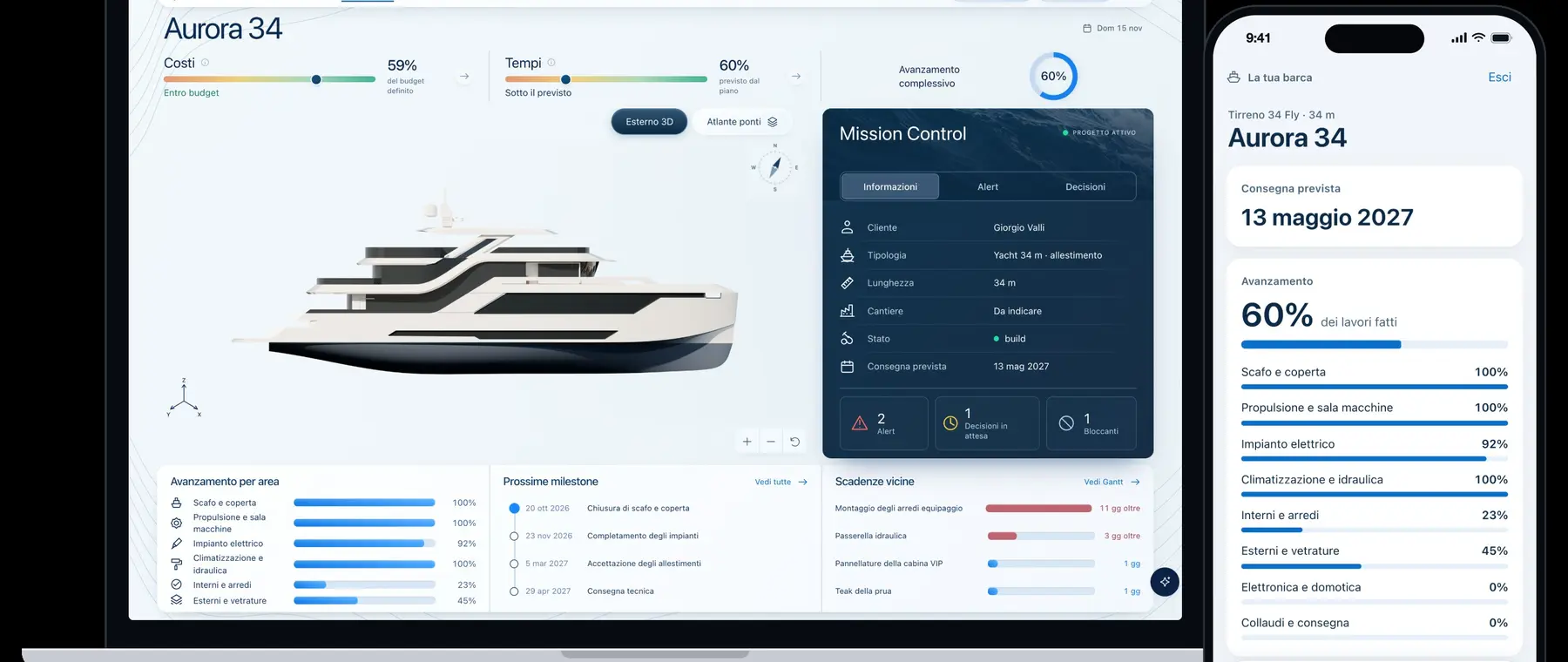
An Italian software venture called Daino is preparing to take its yard-planning platform into a real yachtbuilding environment after completing the design and development of what its founders describe as a digital operational brain. In an interview published by PressMare on 19 November 2026, co-founder Giulio Maria Santonico described work undertaken with Amer Yachts and said deployment was expected shortly. He also made an important qualification: measurable results from the system at Amer were not yet available. That distinction makes the story particularly interesting for the luxury-yacht industry. The idea promises to help workers and managers coordinate complex construction tasks, but it remains to demonstrate what it achieves in routine yard operations.
The hidden complexity behind a finished yacht
A new yacht may appear to move smoothly from design drawing to completed vessel, but its construction involves many activities that cannot happen simultaneously. Electricians need access to bulkheads before joinery closes them, painters depend on preparation and environmental conditions, and machinery installation must be coordinated with structures and interior fitting. A single unexpected problem can affect several separate teams. PressMare's interview uses the example of a carpenter arriving to find that an electrical task has made the intended compartment unavailable. The immediate cost is lost productive time, but the greater cost can lie in subsequent replanning and the arrival of materials or subcontractors at the wrong stage. Such changes occur on yachts of many sizes, particularly where owners request custom features during construction.
From scheduling spreadsheet to shared operational picture
Daino's founders envisage a system that gathers information from different parts of the yard, organises it into a consistent structure and uses an optimisation engine to propose changes to work sequences and resource allocation. Santonico describes three broad layers: collecting and standardising data, mathematical optimisation, and an accessible user interface. The objective is not simply to replace a wall chart with a digital calendar. A programme of work becomes more useful when it reflects actual dependencies, the availability of specialists and the consequences of a delayed task for people working elsewhere. Whether the software can maintain a sufficiently accurate picture in practice is the central test. Data need to be recorded when conditions change, and staff must trust that the displayed plan reflects what is happening aboard the yacht.
Why natural-language tools feature in the design
The developers describe natural-language interaction as a way to make sophisticated optimisation accessible to staff who do not want to learn a complex planning application. A manager might report that a painting task has shifted by several days and ask which work packages need to move. In principle, the system could then calculate and present implications for staff assignments, material deliveries and the following operations. That is a different use of artificial intelligence from asking a chatbot to draft marketing copy. The language interface would support questions and requests, while the mathematical engine undertakes the structured planning task. The exact division of responsibility, reliability of interpretation and approvals for changed schedules still require evaluation on live production data.
Custom construction cannot be treated as car assembly
Santonico said the team had studied heavily automated industrial operations, including factories associated with major automotive manufacturers, but did not propose turning Italian yachtbuilding into a standard mass-production line. Yacht owners frequently request particular materials, layouts, systems and finishing details. Craftspeople must respond to those requirements while working around construction realities that are not always apparent in the initial plan. A suitable optimisation tool therefore needs to preserve flexibility rather than force every task into an inflexible sequence. Human expertise remains necessary to decide whether a proposed change is safe, whether the quality standard can be preserved and whether a specialist is actually available. A system that merely accelerates paperwork while obstructing craftspeople would undermine its own purpose.
Amer Yachts provides an intended real-world setting
The PressMare interview identifies Amer Yachts as a development partner for Daino's proposed application. The important qualification is the deployment status. At the time of publication, the team said it had finished the design and development work and expected a yard installation soon; it had not yet measured economic or operational results from use there. Claims that Daino has already reduced construction times or improved Amer's profitability would therefore be premature. The company has discussed how operations research can improve planning in other industrial contexts, but those examples cannot be counted as verified results from yachtbuilding. A genuine pilot will need baseline data, agreed performance measures, staff feedback and a period of operation before conclusions can be drawn.
Material deliveries are part of the same calculation
A change to one build stage can alter when components should arrive, how long they occupy storage and whether they can be inspected before installation. Bringing materials in too early creates handling and warehouse costs; ordering them too late can stop a team that is otherwise ready. Daino's concept includes using updated plans to reconsider the timing of material arrivals. For a luxury-yacht yard, this could be especially valuable when components have lengthy lead times or suppliers are overseas. It also requires careful distinction between equipment that can be rescheduled and equipment for which manufacturing slots or transport bookings cannot be altered. The tool must reflect contractual commitments and operational constraints rather than assume that supply chains are infinitely flexible.
A possible digital passport for the finished vessel
The developers also discussed tracing installed equipment to create a record that can support later inspections and maintenance reminders. Such a digital passport could connect the as-built condition of a vessel with service planning after handover. That would be relevant to owners of 12- to 23.99-metre luxury yachts, where a new owner or manager may struggle to find reliable records for equipment hidden behind panels or beneath decks. The value depends on the quality of identification: serial numbers, actual installed models, commissioning dates, drawings and warranty information must be recorded correctly. If the system merely copies the original design specification, later substitutions may be missed. A reliable digital record should distinguish what was planned, what was delivered and what was verified aboard.
Data quality remains the deciding factor
Optimisation software cannot compensate for inaccurate or missing information. If work teams report progress late, if tasks are not broken down consistently or if dependencies are incomplete, the suggested schedule may be plausible on screen and unworkable aboard. Adoption also depends on how easily craft workers can record changes without interrupting their work. A mobile interface may help, but an interface alone does not solve process discipline. Yards considering such technology should establish who owns the data, who approves schedule changes, how errors are corrected and which staff can see commercially sensitive information. Owners commissioning a bespoke yacht may also need assurances that their design documents and personal details remain protected as work information passes between contractors and a shared digital system.
What can reasonably be measured in a pilot
The first practical evaluation should identify a baseline for lost work hours caused by blocked access, unplanned rescheduling, unnecessary material movements and late completion of dependent tasks. The yard could then compare those indicators during a controlled implementation, noting changes to workforce numbers, vessel complexity and order books. It would be inappropriate to attribute every improvement or setback to Daino without accounting for those factors. Staff satisfaction and quality outcomes are also important. A yard that meets a deadline by rushing work or increasing defects has not achieved an acceptable operational improvement. Measuring the real effect on coordination, costs and craftsmanship will be more useful than a promotional description of the software as an intelligent brain.
Relevance beyond the largest superyachts
The system has been discussed in a context that includes complex superyacht construction, but the underlying challenge also applies to smaller luxury vessels. A 19-metre yacht built in limited numbers may still feature significant owner choice, specialist systems and multiple subcontractors. A yard maintaining several such projects can have competing demands for the same electricians, engineers and finishers. Better scheduling could help it understand those bottlenecks. Nevertheless, the size and cost of the software need to match the scale of operation. A small builder may obtain much of the initial benefit by standardising its work records and documentation before adopting a sophisticated optimisation platform. The potential value should be judged against the actual processes and resources of the yard.
An experiment in bringing together people and mathematics
Daino's announcement is notable because its developers publicly acknowledge that the promised benefits remain to be proven in the intended yachtbuilding environment. That is a more useful basis for reporting than presenting every AI-driven platform as an established transformation. If Amer Yachts and the developers complete deployment, the next significant news will be evidence: whether the system accurately handles changing tasks, how staff respond, whether planning is measurably improved and which parts of the workflow still require experienced human judgement. Until then, Daino is a credible illustration of the industry's interest in combining operational research, software and natural-language access. It is not yet proof that a digital planner can remove the unpredictable, highly skilled character of building a bespoke yacht.
Sources and image credits
Reporting based on PressMare original 19 November 2026 interview with Daino co-founder.
Lead photograph: Daino desktop and mobile planning applications, original company-provided visual distributed in its PressMare industry interview. Daino manufacturer-supplied platform visual published as part of the original PressMare interview dated 19 November 2026; editorial use attributed to source and developer. Original official image source.