Two introductions address different stages of ownership
Norwegian marine technology company CoastKey has introduced CoastKey Connect and CoastKey MOB at the November 2026 Metstrade exhibition. Its release of November 17 describes a monitoring gateway intended to maintain a relationship between builders, dealers and owners throughout a boat's operational life, together with a narrower wireless engine-cutoff system. Although the two products are presented together, their purposes should not be confused. The gateway is designed to organise information and support selected remote functions. The cutoff system is intended to connect to a compatible existing engine cutoff circuit and stop propulsion when the designated wearer enters the water. The company is presenting both systems on stand 01.713 in the Norwegian pavilion at RAI Amsterdam. For luxury yacht manufacturers, the commercial significance of the combined announcement is that the firm is addressing the relationship with the buyer after delivery as well as the responsibilities of the person operating the vessel. The precise suitability of either system remains dependent on the installation concerned.
A digital identity from the production stage
Connect is described as a gateway associated with an individual boat's hull identification number. According to CoastKey, installation may take place during manufacture or subsequently as a retrofit. The builder's dashboard can follow equipment through production, movement to the dealer and delivery to the customer. Linking a device to a specific hull may provide a useful organising principle for information that would otherwise be maintained in separate records. An individual yard might want to monitor completed stock or coordinate the preparation of a yacht for collection. A dealer responsible for several demonstration boats may require a different set of records from the owner of a delivered yacht. These relationships make the assignment of access particularly important. A system representing an individual hull should be configured in such a way that previous users cannot continue accessing information or controls without the proper authorisation. The manufacturer has outlined the overall architecture but has not disclosed every procedure used to manage transfers between the parties.
Monitoring boats before handover
CoastKey states that the gateway's rechargeable internal battery can permit reporting before delivery for up to two years without requiring connection to an external battery. This is particularly relevant to equipment that may spend time in storage or transit before the yacht is prepared for use. The figure refers to an expected capability of the gateway, not to the ability to operate the yacht's other electrical equipment for that duration. Nor does it indicate that real-time information will be available regardless of the device's communications environment. A shipyard would benefit from understanding the reporting frequency and the conditions under which the internal battery figure was derived. The transport arrangements may also involve situations in which communications are unavailable or should be deliberately disabled. The information received through a monitoring service should therefore be interpreted in relation to the time of the last report rather than assume that an absence of new information establishes the yacht's current condition.
Maintaining a connection with the customer
The company's commercial proposal includes a builder-branded application, through which the user can access boat information and communicate with the dealer for service and warranty purposes. This is a different proposition from a standalone device sold directly to an owner with no continuing association with the original manufacturer. For builders in the twelve-to-twenty-four-metre sector, the quality of service provided after delivery can have a significant effect on the relationship with a household and the future reputation of the brand. A structured record of service enquiries, equipment documentation and relevant alerts could make those exchanges more practical. It would not, on its own, guarantee that a qualified technician is available in a particular cruising region. Where the owner intends to use the yacht internationally, the practical ability to obtain support remains distinct from the means by which a request can be submitted. The release does not provide a comprehensive service-level agreement or define the charges that individual builders or dealers might apply to services offered through the system.
Information available aboard an individual yacht
CoastKey lists position, geofencing, anchor-watch functions, automatic journey recording and information about equipment status as features of its owner application. It also identifies possible integrations with engines, batteries, bilge pumps and digital switching. Availability of any individual data item will depend on the connected equipment and the way it has been configured. Displaying a reported fuel level, for example, does not establish that the reading is independently accurate or that the fuel supply is appropriate for a contemplated voyage. Similarly, a remote anchor notification cannot guarantee that a yacht remains securely held in all circumstances. The person responsible for the yacht must still observe the applicable safety arrangements and use appropriate means of assessing its condition. The application may help an owner identify a reason to contact the crew or a marina, but it is not a replacement for inspections and competent watchkeeping. Owners should establish the implications of losing power or communications as part of evaluating the proposed installation.
Privacy and control require particular consideration
The operator of a privately owned yacht may regard information about its position, movements and times of use as particularly sensitive. CoastKey states that owners can choose whether to share location and performance information separately, and that personal information is encrypted and data anonymised when information sharing is declined. These are the manufacturer's descriptions of the system. They do not independently establish the complete behaviour of every service connected to it. A builder and its customers should have an opportunity to examine the relevant privacy information, determine which parties can see different categories of data and understand the process for changing those arrangements. The ability to use a phone to request an onboard action also introduces a separate question about who may exercise that authority. The owner should establish how individual access is granted or revoked and how a change of ownership is handled. Those are practical issues that affect whether a connected system supports the yacht's established management arrangements rather than complicate them.
A simpler engine-cutoff installation
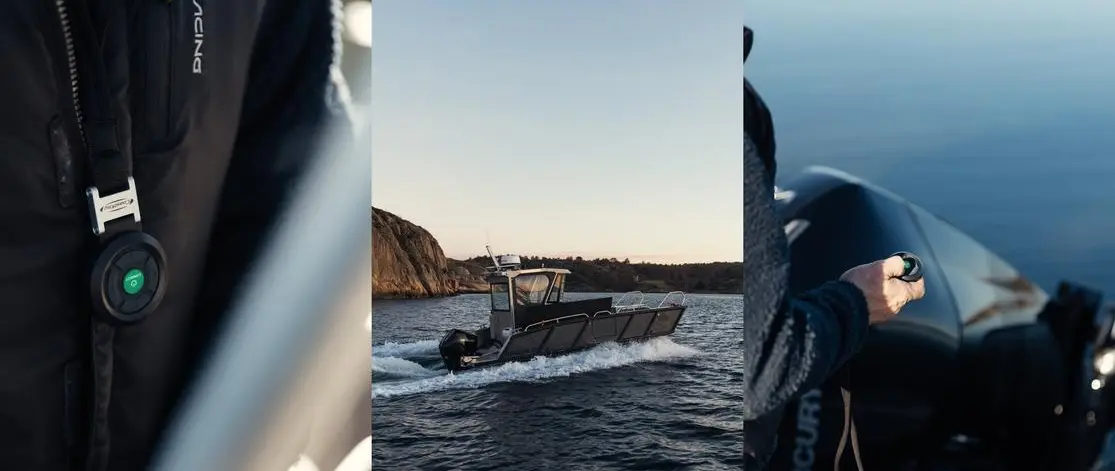
The second product, CoastKey MOB, connects to the existing engine cutoff switch lanyard circuit rather than requiring the more extensive engine and ignition integration associated with other CoastKey systems. The announced wireless fob is worn by the operator instead of being tethered to the conventional lanyard. The manufacturer's intended function is to stop the engine when the wearer falls overboard. The company describes the approach as appropriate for either factory installation or retrofitting. It should nevertheless be considered against the actual propulsion arrangement, existing safety circuit and requirements applying to the yacht. Owners of larger motor yachts should not assume that equipment intended to connect to a conventional cutoff circuit necessarily supports every multi-engine configuration. The details should be confirmed with the manufacturer and a competent installer. The new device is not a personal locator beacon, and stopping an engine does not by itself establish that a person has been located or recovered. It should complement appropriate seamanship and established man-overboard arrangements.
Optional functions and the importance of safe integration
CoastKey also describes optional integration of the fob with thrusters, trim equipment, windlasses and remotely controlled battery switches. These proposals address functions that can be useful in certain onboard circumstances. The possibility of activating equipment from another location can also change the relationship between the operator and the mechanism concerned. A person issuing a command should have the information needed to determine that its execution creates no danger for others aboard or alongside the yacht. Appropriate interlocks, local controls and arrangements for handling a failure should be considered as part of the manufacturer's installation guidance. For this reason the availability of optional functions should not be taken as evidence that every one of them should be installed. A builder should identify the appropriate use cases for its design and a refit yard should examine the existing equipment before proposing alterations. The November release does not disclose detailed circuit diagrams, the availability of independent certification for every combination or a universal list of compatible components.
The announcement opens a dialogue with the yacht industry
CoastKey is presenting its two new products to industry professionals during the November 17–19 exhibition. The photograph supplied with the company's press release depicts the wireless engine-cutoff product rather than a complete installation on a particular yacht. Connect's significance lies in the attempt to associate operational information and customer support with the identity of an individual boat. The separate MOB launch addresses demand for a simpler interface to compatible cutoff equipment. No universal retail price, installation quotation or delivery timetable for each application was disclosed in the release reviewed. Builders and owners interested in either product should discuss their specific requirements and confirm communications, electrical and data arrangements before making a purchasing decision. The new products illustrate two areas of development within the marine equipment market: more persistent relationships between manufacturers and their customers, and wireless interfaces designed to operate alongside existing onboard safety systems. In both cases the actual value will depend on implementation and continuing support rather than the launch announcement alone.
Sources and photograph
Source documentation: https://www.metstrade.com/exhibitors/nordic-wireless-solutions-as-coastkey/news/coastkey-launches-coastkey-connect-and-coastkey-mob-at-metstrade-2026. Photograph: CoastKey MOB wireless engine-cutoff device — CoastKey / Nordic Wireless Solutions AS, official publicity photograph attached to its 17 November exhibitor press release, which explicitly offers downloadable press images.. Manufacturer-supplied image attached to the specific exhibitor press release made available through the official virtual press room for coverage of the announcement; copyright remains with the rights holder.