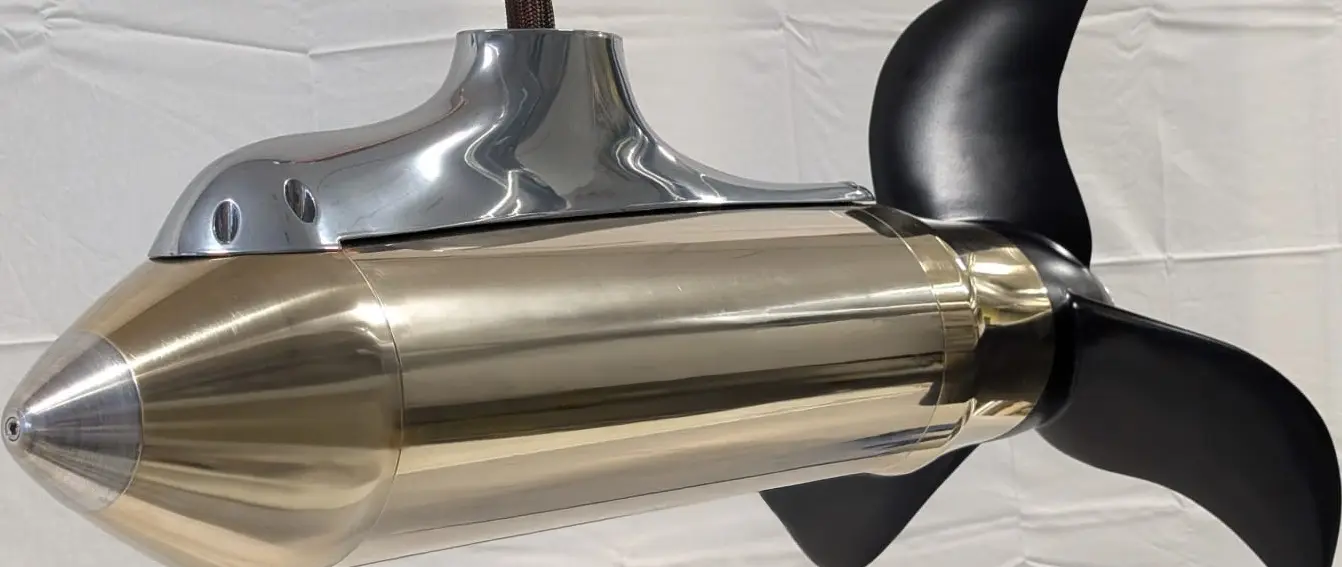
A new power level in a compact pod architecture
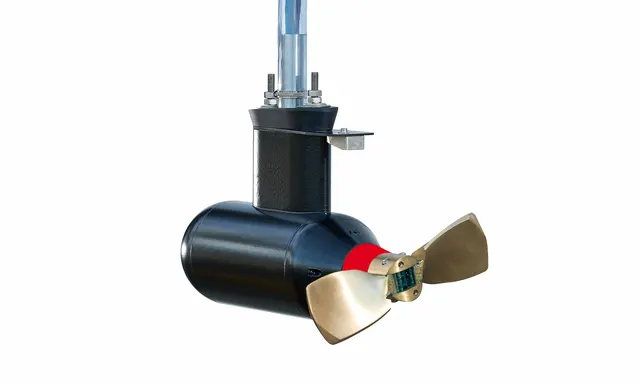
SeaDrive is presenting the world premiere of its POD 150 at Metstrade 2026 in Amsterdam, with the Norwegian marine propulsion developer exhibiting the new system from 17 to 19 November on stand 01.615. The announcement identifies a continuous output rating of 150 kW and an 800-volt nominal electrical architecture. SeaDrive states that the unit occupies the same compact footprint as its existing 60 kW model, an important design claim for yards investigating alternative propulsion in vessels with restricted installation space. The published specifications also identify a 120 kg pod-base weight, a stated maximum bollard pull of 1750 kg-force and steering movement of up to 90 degrees in either direction. These figures describe the manufacturer's propulsion equipment, not the guaranteed performance of a particular yacht. A boatbuilder would still need to establish the correct arrangement of the propulsion unit and electrical infrastructure for the intended hull, displacement and operational profile.
Understanding the 150 kW continuous rating
Continuous rated output is more informative for initial design discussions than a brief peak-power figure because a vessel may need to sustain propulsion for a considerably longer period than a vehicle performing a short acceleration. SeaDrive's specification identifies 150 kW as continuous output. It does not identify the cruising speed of a yacht fitted with one pod, the maximum speed available on a particular hull or the time for which a complete battery system could support full-rated operation. Those questions require details of the total installation. A yacht with a comparatively efficient displacement hull may impose substantially different demands from a heavier or faster planing yacht. The performance of the propulsor cannot therefore be inferred directly from the appearance or length of the yacht. Naval architects evaluating the new unit should consider the required thrust across its intended operating conditions, the manufacturer's applicable performance curves and the actual conditions in which the vessel is expected to operate.
The implications of an 800-volt system
The manufacturer gives 800 volts as the nominal voltage and a permissible operating voltage range of 600 to 900 volts. This is a substantially different electrical environment from the low-voltage services ordinarily associated with a yacht's domestic batteries. For a builder investigating the system, the principal benefit of the higher voltage is that a given electrical power can be transmitted at a lower current than would be required at a lower voltage, assuming comparable conditions. The complete system nevertheless needs appropriate high-voltage equipment and protection. Its design must take account of insulation, isolation, fault handling, battery-system compatibility and the applicable regulatory and classification requirements. Installation and maintenance are tasks for suitably qualified specialists. The November announcement does not specify a universal battery pack or charging arrangement, nor does it establish that an existing yacht's electrical systems are compatible. A proposed installation should be assessed as a complete electrical and mechanical project, rather than as a simple substitution of an individual motor.
Steering and the hydrodynamic installation
SeaDrive quotes steering movement of plus or minus 90 degrees for the new product. The ability to direct thrust offers a different design arrangement from a traditional fixed shaft and rudder combination, although the achievable manoeuvring characteristics depend on the number and positioning of the units and the geometry of the vessel. A designer will need to consider the available clearance beneath the hull, the operating envelope of the propeller and the effects of the hull form on the flow reaching the propulsion device. The mounting arrangement must also accommodate the forces generated during normal operation and any relevant exceptional load cases. Steering range is therefore one input to the vessel's design rather than a guarantee of a particular turning circle or berthing capability. Owners who are considering an electric yacht should assess the actual handling characteristics of the intended completed installation, supported by appropriate design information and trials. The published pod specification is a starting point for that assessment.
Published efficiency and static thrust figures
The manufacturer's exhibition release quotes 97 percent motor efficiency and 1750 kg-force bollard pull. These two figures describe different characteristics of the new equipment. A motor efficiency figure is not equivalent to the efficiency of the complete propulsion system from stored electrical energy to useful forward motion of the yacht. Losses associated with the other components and with hydrodynamic operation also matter. Static thrust measurements likewise should not be treated as a prediction of cruising performance at a particular forward speed. The useful thrust available under way depends on the operating condition of the propeller and vessel. SeaDrive has not supplied an independently verified sea-trial dataset for a particular luxury yacht in this release. For a yard making a comparison with conventional or alternative electric systems, detailed engineering information and common test conditions are especially important. The newly published figures indicate the scale of the equipment, but do not alone establish its comparative merit for every application.
Space, weight and integration beyond the pod itself
SeaDrive describes an approach in which the electric motor and controller are integrated into an externally mounted pod. The company's specification gives the weight of the POD 150 base as 120 kg. That figure should not be presented as the installed weight of the entire propulsion system. A complete vessel may require substantial energy storage, distribution and protection equipment, charging hardware, cabling and structural provisions. The available space in an existing engine compartment may be rearranged in a conversion, but not necessarily eliminated as a machinery requirement. Battery arrangements can influence the allocation of space within a yacht, maintenance access and the distribution of mass. For a sailing yacht the ability to preserve accommodation and storage volume may be particularly important; for a motor yacht the effect of added electrical equipment on displacement can be relevant to performance. Each project therefore needs a detailed equipment and weight schedule from the designers, not simply the published pod-base weight.
Assessing energy availability against the intended voyage
A yacht's owners may want to undertake short trips between nearby anchorages, maintain a reserve for unexpected manoeuvres or cruise for much longer periods. These use cases impose materially different energy requirements. The motor rating defines the ability to deliver power under specified conditions, while the energy stored in the selected electrical system determines how long a given demand can be supported. The available energy must also account for the requirements of other onboard services where applicable. Consequently, a new higher-rated motor does not independently provide a longer cruising range. More detailed information about the vessel, the propulsion demand at representative speeds, and the proposed energy system is needed to estimate the operating capability. Shore infrastructure can also be a significant factor in the way the yacht is actually used. A physically suitable propulsion unit may not fulfil the owner's intended itinerary unless the complete energy and replenishment arrangements are designed accordingly.
A potential newbuild or repower option
The compact footprint claim may be particularly useful to the engineering teams of a yard evaluating several propulsion options during the initial development of a yacht. Newbuild projects allow the structural, electrical and spatial arrangements to be considered together from an early stage. An existing yacht presents a different problem because the original installation, hull structure and weight distribution may have been selected for an entirely different form of propulsion. The feasibility of a retrofit should be investigated before assuming that the compact equipment dimensions will make the conversion straightforward. The manufacturer has not disclosed a universal retrofit package, price or confirmed delivery schedule in its exhibition statement. Its current website also identifies an operating water temperature range from zero to 35 degrees Celsius, another consideration for projects intended to encounter differing environments. The precise limitations and operating conditions should be obtained from SeaDrive's technical documentation before a project is specified.
What has been confirmed at the November show
The current event establishes the introduction of SeaDrive's highest-powered announced pod to date, with its Norwegian development team exhibiting in Amsterdam during the November trade show. The original product photograph supplied in the exhibitor release shows the propulsion unit itself rather than a yacht that has been independently tested with it. The manufacturer has published the continuous rating, nominal voltage, operating voltage range, weight of the pod base and static thrust specification, enabling initial discussions with yards and engineering teams. These facts provide a clearer basis for evaluating the intended size of the equipment than a general announcement of plans to electrify yachts. The next significant evidence for prospective owners will be detailed engineering proposals and completed installations demonstrating the performance of appropriately designed systems. Until then, the new POD 150 should be understood as an additional propulsion option for vessel-specific investigation, not a promise of identical operating results across different luxury yachts.
Sources and photograph
Source documentation: https://www.metstrade.com/exhibitors/seadrive-as/news/pod150kw-800v, https://www.seadrive.no/metstrade, https://www.seadrive.no/. Photograph: SeaDrive POD 150 kW electric marine propulsion unit — SeaDrive AS, original manufacturer-supplied product photograph attached to its November 13 Metstrade exhibitor press announcement. Editorial use for this specific launch.. Manufacturer-supplied image attached to the specific exhibitor press release made available through the official virtual press room for coverage of the announcement; copyright remains with the rights holder.