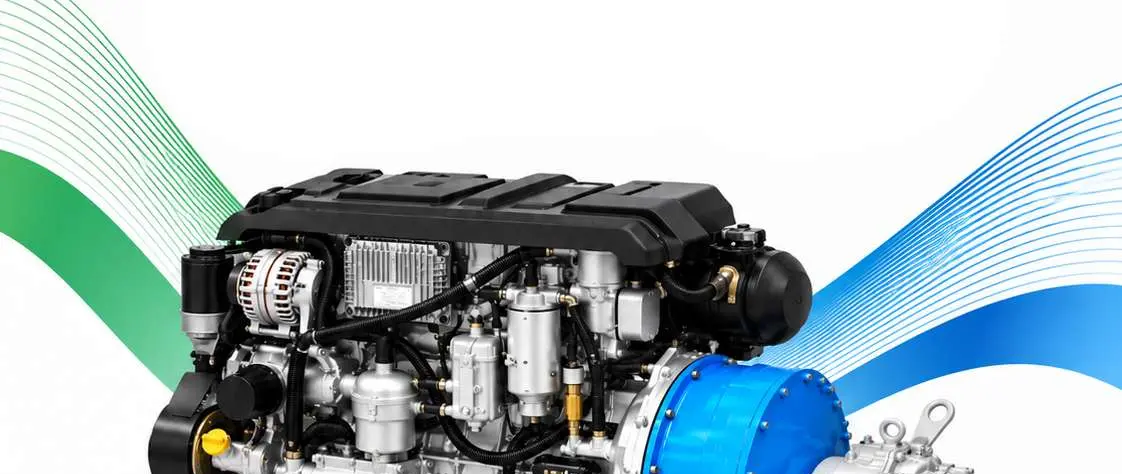
Blue Power scales from 50 to 400 kW
The new Blue Power platform is designed as a modular full-electric or hybrid architecture with 50, 100, 200 and 400 kW configurations. AS Labruna says the range allows builders to select propulsion around the operating profile of a particular boat instead of adapting a single fixed package to very different cruising requirements.
That modular approach is relevant to the 12-to-24-metre market because propulsion demands can vary widely between displacement cruisers, sailing yachts, fast planing boats and multihulls of similar length. A scalable system gives designers more freedom to balance battery capacity, electric power and generator support against the available machinery space and expected duty cycle.
Power 300 combines a 350hp diesel with 25 kW electric drive
Power 300 pairs a six-cylinder 4.2-litre VM 706 LX RCD II diesel rated at 257 kW, or 350 hp, with a 25 kW electric motor and a 15 kWh lithium-nickel-manganese-cobalt battery pack. The architecture is intended to support several operating modes rather than simply adding electric assistance to a conventional driveline.
Those modes include full-electric propulsion, normal diesel operation, charging and generator functions, simultaneous propulsion and battery charging, and a booster setting in which the electric motor adds torque and power. For owners, that flexibility could allow quiet low-speed operation in suitable conditions while retaining diesel range and familiar refuelling infrastructure for longer passages.
The system treats hotel loads and propulsion as one energy problem
AS Labruna’s broader point is that batteries, propulsion, generators and onboard services should be designed as a connected energy ecosystem. Blue Power can be combined with variable-speed generation and range-extender arrangements, while the company’s digital-management approach is intended to coordinate power flows between the different parts of the installation.
That matters on modern luxury yachts because propulsion is only one part of electrical demand. Air-conditioning, refrigeration, navigation electronics, entertainment and domestic equipment can create significant hotel loads, so an efficient hybrid installation depends on how the whole vessel is operated rather than the headline motor rating alone.
Genoa gives builders and owners a first close look
Both platforms are being shown within AS Labruna’s expanded presence at the 66th Genoa International Boat Show. The Blue Power project is also a candidate for the show’s 2026 Design Innovation Award, while a separate stand continues the company’s established work with FPT marine engines and conventional propulsion.
For prospective LYG owners, the new systems are best viewed as engineering options that need vessel-specific analysis rather than universal replacements for diesel. Weight, battery volume, cruising profile, charging opportunities and service support will determine whether full electric, hybrid or an efficient conventional installation provides the most useful solution for an individual yacht.
Official sources: pressmare.it.