The islands that reward restraint
The Poor Knights Islands off New Zealand's Northland coast appear at first to offer the perfect setting for a private-yacht diving expedition: steep volcanic cliffs, immense underwater arches and richly coloured marine habitats a short passage from the mainland. Yet their real appeal lies in strict protection, and the first question for a luxury-yacht captain is not where to anchor but whether the vessel may legally enter the surrounding waters at all. Poor Knights is a marine reserve where access, activities and navigation need unusually careful planning.
New Zealand's Department of Conservation places the reserve about 22 kilometres off the east coast of Northland and describes an underwater environment of caves, tunnels, walls and kelp-covered reefs. Tutukaka is its principal departure point for visiting dive boats, but a private yacht can only use the area in ways permitted by the reserve rules and by the wider maritime routing measures. Guests seeking an exceptional underwater day should value a well-organised, low-impact operation more than a secluded landing or an unregulated anchorage.
The 45-metre rule is decisive
Maritime New Zealand identifies an extended Poor Knights area to be avoided by ships with an overall length of 45 metres or more. It was designated to reduce the risk of pollution and environmental damage around a particularly sensitive marine reserve, and the area extends beyond the reserve boundary itself. The Department of Conservation also warns visitors about a protected surrounding area reaching approximately nine kilometres, or five nautical miles, from land along the relevant coast.
That distinction matters because a 50-metre superyacht cannot simply regard its captain's preferred anchoring spot as available on the same terms as a 20-metre dive boat. For yachts at or above 45 metres, the prudent choice is to plan the mothership's passage outside the charted area to be avoided and seek current, competent local and regulatory advice before considering any separately operated guest excursion. Tender dimensions alone do not settle every applicable operating, conservation or commercial rule.
What smaller yachts must still respect
Vessels below the 45-metre threshold are not excused from the reserve's strict protection. DOC lists no fishing, no removal of shellfish or other marine life, no disturbance of rocks, seabed materials or seaweeds, and no feeding fish, because even apparently harmless activity can alter natural behaviour. Captains and guests should understand that catch-and-release fishing is still fishing, and it is not an acceptable reserve activity.
Waste, ballast and sewage may not be discharged within the reserve, and anchoring must be carried out to avoid damage to the seabed with the minimum chain necessary. A yacht crew accustomed to generous anchor swinging room should treat site suitability and underwater habitat as essential constraints, and may prefer an authorised local diving operator rather than improvising a tender deployment. Any decision to anchor also depends on charted depth, holding, weather and current conditions.
A protected landscape without shore landings
The islands are also nature reserves, and DOC states plainly that visitors must not land on the islands or associated rocks or tie boats to the shoreline. The prohibition is important both for ecological protection against invasive pests and for the islands' profound cultural history. An itinerary describing a private beach barbecue, rock scramble or exclusive island picnic here would misunderstand the destination.
DOC explains that Ngātiwai have longstanding connections with the islands and describes a tapu associated with their history and guardianship. An informed excursion leader should convey this cultural context respectfully, rather than treating the islands simply as dramatic scenery for photography. The privileges of visiting these waters come with obligations to the people and conservation authorities who care for them.
Below the surface: the signature experience
The reserve's volcanic geology created an intricate underwater landscape of caves, arches, gullies and sheer faces where light and current can shift the mood from minute to minute. Sunlit kelp and more shaded reef environments support a range of marine plants, invertebrates and fish that make the area compelling for divers and snorkellers. The attraction is not a manufactured attraction park but a mature reserve where encounters unfold on the animals' terms.
A thoughtful private dive programme starts with an honest assessment of each guest's qualifications, experience and comfort in open water. An advanced diver may relish a supervised wall or arch environment, while another guest might enjoy a calm surface snorkel with a specialist guide in suitable conditions. Rather than promising that every named cave will be accessible, the crew should allow the local dive professional to select sites only after assessing sea state, surge, currents and visibility.
Designing an elevated yet responsible day
Luxury does have a place at Poor Knights, though it should be expressed through preparation, expertise and comfort rather than exclusive possession of the landscape. A private guide, expertly fitted equipment, warm post-dive refreshments and a relaxed return to the yacht can create a refined experience without conflicting with reserve management. Photography briefings can help guests capture the colour and structure underwater without contacting delicate organisms or chasing marine animals.
A yacht can organise separate in-water groups according to their abilities, keeping the support vessel, surface watchers and emergency arrangements proportionate to the plan. If a dedicated professional dive operator is used, confirm the actual vessel and its permissions, briefing standards and weather-cancellation policy before guests board. It is better to return from a single outstanding dive than to force a sequence of marginal sites just to fill an itinerary.
Boating speeds and dive safety
DOC reminds boaters that New Zealand's general five-knot limit applies within 200 metres of shore and within 200 metres of a boat displaying a dive flag, and within 50 metres of other vessels or swimmers. These limits become especially important when several tour boats and tenders share a confined area near caves or exposed cliffs. The skipper should adopt a conservative lookout, watch for divers surfacing unexpectedly, and use the radio rather than manoeuvre close to another group's dive site.
The destination's distance from shore does not make conditions uniformly benign, and open-ocean swell can generate powerful surge near rock faces. Guests should be given clear return signals, a separation plan and instructions for what to do if a dive or snorkel is abandoned. The captain's final decision on water operations should always outrank a guest's desire to photograph a particular underwater feature.
Biosecurity is part of the welcome
DOC's visitor advice emphasises cleaning hulls and marine equipment to prevent the spread of harmful organisms between New Zealand waters. Dive gear, tenders, anchoring equipment and other marine hardware may carry unwanted species even when they appear visually clean. Responsible preparation includes reviewing cleaning requirements before leaving the previous port, not trying to improvise procedures on arrival.
For a vessel with a full guest-toy inventory, the simplest plan may be to leave unsuitable powered equipment secured and use only the gear appropriate to the reserve and to current conditions. Jetskis, fishing tackle and other familiar forms of recreation should never automatically be included in the Poor Knights activity list. The aim is a conservation-led expedition with genuinely exceptional service, not a broad menu of toys.
The mainland makes the logistics work
Tutukaka and the wider Northland coast provide the practical mainland context for the islands, with commercial diving operations and access to shoreside services. A larger yacht whose length is excluded from the area-to-be-avoided can still consider Northland as a compelling stop while designing a legally compliant, operator-led day out separately from the mothership. Such an arrangement requires genuine voyage and activity planning, not an assumption that the marine reserve is an extension of a private anchorage.
For qualifying smaller luxury yachts, the challenge is to preserve options if wind or swell makes the crossing unsuitable. Build a flexible Northland itinerary with alternative shore visits, dining and coastal experiences, then select the Poor Knights day when the weather, local advice and guest abilities align. This approach produces a much stronger trip than committing an expensive dive day to an unsuitable weather window.
Practical official references
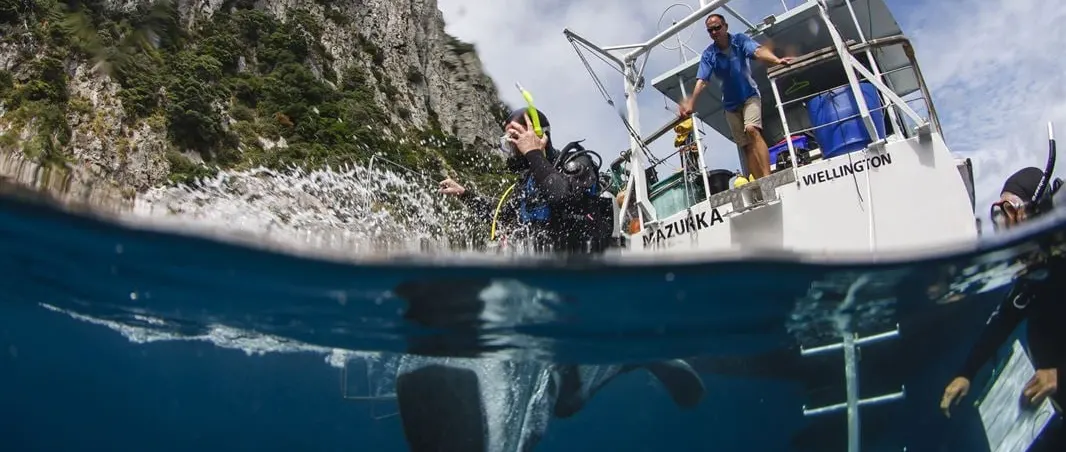
The Department of Conservation's Poor Knights reserve page explains the no-take, no-landing and speed rules and supplies links to maps and boundaries. Maritime New Zealand's safety-zone guidance separately identifies the 45-metre-and-over area to be avoided; current navigational charts and official notices remain essential. The accompanying hero photograph is sourced from DOC's official reserve page and depicts visitors diving from a boat, not an indication of conditions on any particular day.
Poor Knights is among the rare destinations where the absence of private access becomes part of the experience's meaning. Deep preparation can deliver an extraordinary, immersive day while keeping the reserve's wildlife, seabed, and cultural significance at the centre of decisions. For sophisticated travellers and crews, that balance of privilege and restraint is the enduring luxury.