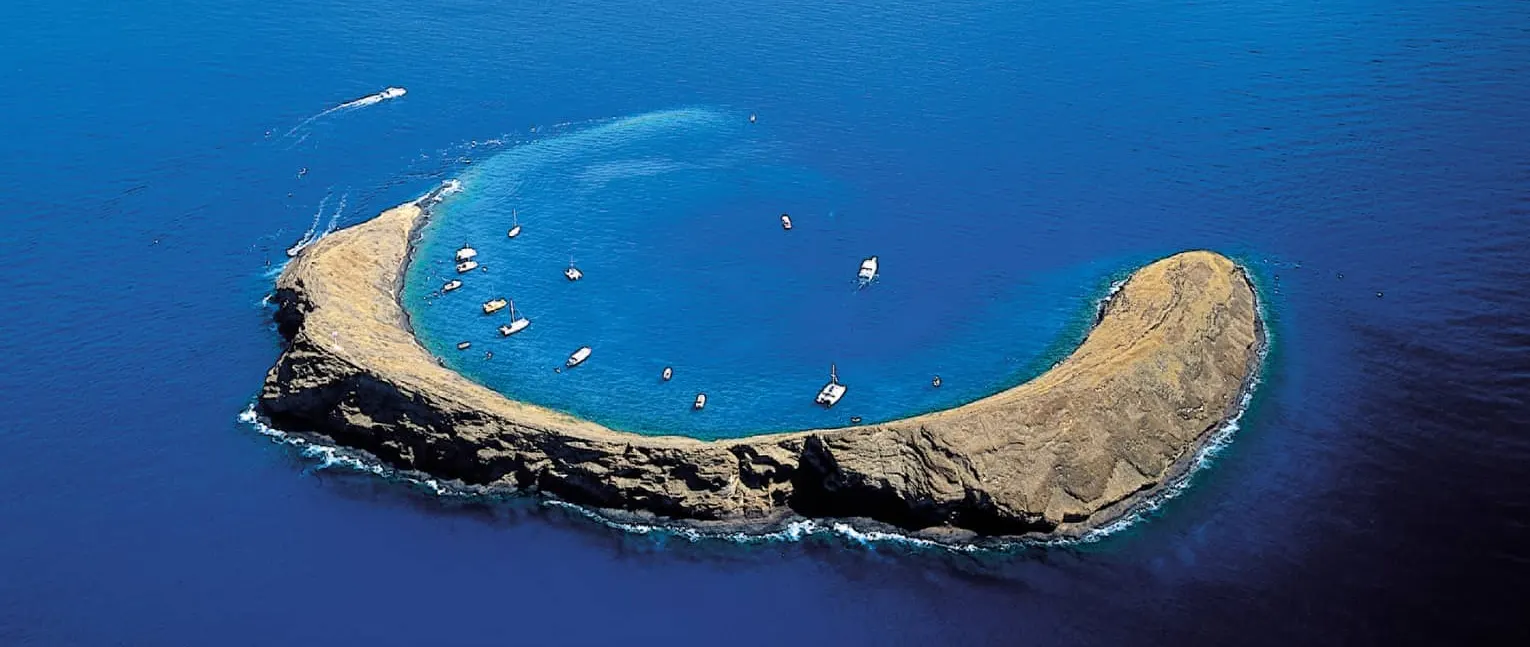
A crescent of lava and clear Pacific water
Molokini Shoal is among Maui's most recognisable places to arrive by boat, a half-submerged volcanic crater whose curved rim encloses vivid blue water just offshore. For owners planning a luxury-yacht holiday in Hawai‘i, the appeal is immediate: snorkelling among reef fish, serious diving for suitable guests and a striking natural setting within reach of the island's resort infrastructure. Yet its popularity and protected status make Molokini an excursion to arrange carefully rather than an anchorage to improvise.
The Hawai‘i Department of Land and Natural Resources describes the islet as approximately three miles off Maui's southwest coast and part of a 77-acre Marine Life Conservation District established in 1977. The crescent is the exposed southern edge of an ancient crater, with a shallow inner basin and a deeper outer wall that attracts divers. It is a marine sanctuary, not a private beach club, and operators are expected to respect stringent rules for wildlife, moorings and commercial activity.
Why the two zones matter
The state's Division of Aquatic Resources divides the marine conservation district into Subzone A, which includes the crater cove, and Subzone B, extending a specified distance around the protected waters. Permitted activities are defined very narrowly, and general recreational freedom at another Maui beach should never be presumed to apply here. Fishing and taking marine life are prohibited except for a limited allowance for trolling for finfish in Subzone B.
The same regulations prohibit removing coral, sand and geological features, deliberately feeding marine creatures or introducing attractants near them. A guest tempted to collect a small piece of shell or coral as a souvenir may see it as harmless, but it conflicts with the purpose of the protected area. Crews should give a conservation briefing before anyone enters the water and keep fishing and collection equipment secured away during the visit.
Moorings are not an invitation to anchor
DLNR's published rules prohibit anchoring when a state day-use mooring system has been established in the district. They also require permits for certain commercial activities, including operator-led swimming, snorkelling, diving, kayaking or paddle use, and for commercial mooring activity except as authorised. A privately owned yacht and a commercially chartered yacht may face different legal questions, so the operator must confirm its actual status and permits with the responsible authorities.
The practical starting point is to determine whether the yacht can use any authorised mooring suitable for its size, draft and conditions, or whether guests should make the trip on a licensed local excursion vessel. A mooring designed for a day boat is not necessarily engineered for a large yacht, and the existence of a buoy does not establish permission or physical capacity to use it. A careful captain will obtain current mooring guidance before committing the main vessel to an approach.
An underwater itinerary for different abilities
Molokini's inner cove can be attractive to snorkellers when wind, current and crowding are favourable, while its exposed outer face demands stronger water skills and professional judgement. The DLNR specifically warns that currents outside the cove can be difficult and that conditions inside may deteriorate as afternoon winds strengthen. An ambitious dive plan should therefore depend on conditions at the time, not on photographs taken on an unusually calm morning.
A good private programme separates experienced divers from guests who prefer a relaxed snorkel, with appropriate guides, safety watchers, equipment checks and clear return signals. Those with limited confidence can still enjoy the setting from a boat or choose a mainland alternative if the entry is difficult. Luxury service means keeping the experience comfortable and safe, even if that requires cancelling the signature activity.
Beyond the crater wall
According to the state, the inner basin descends through a mixture of sand, coral and basalt before deeper water, while the southern face drops more steeply into open ocean. This variation in habitat helps explain why swimmers and qualified divers may find very different experiences only a short distance apart. However, an underwater photograph showing excellent visibility is not proof that a particular dive will be easy, and depth management remains a professional responsibility.
Hawai‘i's reefs are living habitats, and even careful-looking contact can break coral or damage fragile life. Guests should be instructed to maintain buoyancy, avoid standing on reef structures and keep fins and cameras clear of the bottom. Any dive leader operating within the conservation district needs to manage group size and behaviour rather than allowing everyone to spread independently across sensitive areas.
No landing on the volcanic islet
Molokini itself is a state seabird sanctuary, and the state says entering the islet is prohibited. There is no sandy beach for a tender landing, and descriptions of a private island picnic or cliff walk would misrepresent what visitors may lawfully do. The experience takes place on or beneath the water, where the shape of the crater can be admired from a respectful distance.
That limitation can be a virtue for guests who want the reef's ecological story to be the central experience. A marine biologist or highly experienced local dive guide can interpret volcanic geology, fish behaviour and conservation measures while the yacht crew manages comfort, gear and transfers. The result can be more memorable than an itinerary overloaded with unrelated attractions.
Whale season changes the passage
The Hawaiian Islands Humpback Whale National Marine Sanctuary reports that humpbacks generally appear in Hawai‘i from November through May, with abundance usually highest from January to March. Anyone arriving later in the year should regard the passage between Maui and Molokini as potential whale habitat and keep an attentive lookout. Marine mammals may surface abruptly, and a close encounter is an operating hazard as well as a privileged sighting.
In Hawaiian waters, NOAA explains that approaching a humpback whale within 100 yards is illegal, and it publishes additional recommended speed precautions. Those rules apply to guest tenders and powered watercraft as well as the yacht itself; an animal's presence does not give a skipper permission to circle or pursue it. Experienced crews can put the guests' cameras to work at respectful distances and keep the whale's travel path clear.
Pairing the water day with Maui's comforts
Molokini works well as one element in a carefully paced Maui programme rather than the entire purpose of the voyage. On shore, guests can choose a sophisticated resort lunch, wellness treatment or cultural experience after an early start afloat, with the crew leaving enough margin for harbour formalities and travel time. The exact sequence should depend on the departure point and the permitted operating arrangement, not on a generic claim that all resort facilities are available to visiting private vessels.
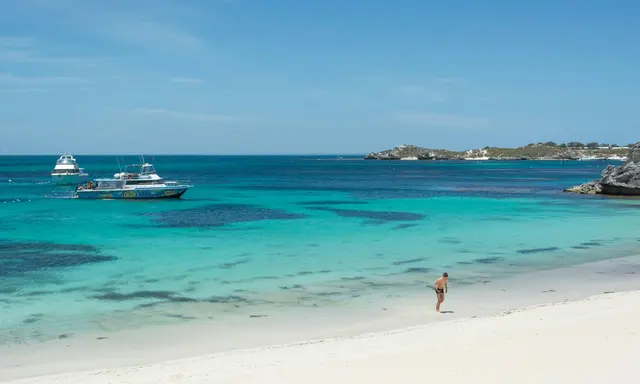
Four Seasons Resort Maui's official destination photography captures the crater's celebrated crescent from above, an image that conveys the landscape without promising that every guest can step ashore. The photographs are a useful reminder of how compact the visible islet is compared with the wider managed marine area. An experienced operator should distinguish the scenic attraction from the legal and environmental obligations that shape the actual visit.
Planning the return leg
The captain should check local sea forecasts, wind shifts, mooring availability, fuel and port arrangements, and the authorised activity list before departure. Maui conditions can change, and a protected inner-cove impression should not obscure the exposed water outside the crater. Leave a clear weather fallback that can deliver a rewarding Hawai‘i day even when conditions make Molokini unsuitable.
Guests should be told that the best encounters may be brief, that contact with marine life is off limits and that no souvenirs are removed from the reef. Responsible practice reduces the risk of damaging the very qualities that make Molokini sought after. The experience should feel calm and exquisitely planned, not crowded or rushed.
Official rules and further reading
The Hawai‘i Division of Aquatic Resources guide explains the district's subzones, protected activities, anchoring conditions and no-landing rule. The agency's regulated-area summary provides a second official reference, while NOAA's humpback boating guidance sets out whale-season precautions. The hero photograph is an official Four Seasons Resort Maui image of Molokini, used as scenic context rather than current navigational evidence.
The finest way to enjoy Molokini is to recognise that it is first a living conservation area and only second a beautiful setting for a private excursion. A yacht itinerary built around proper permits, a suitable support vessel and a skilled marine guide can deliver the sense of discovery guests are seeking without treating the reef as a consumable attraction. On a luxury holiday, that is an especially worthwhile distinction.